AITA: Diabetes Edition

If you aren’t familiar with the acronym AITA, then let me break it down for you: It stands for “am I the asshole”?

It stems from Reddit, which is basically a ginormous discussion thread website. It provides a forum for people to post stories in which they’re unsure whether they’ve acted like, well, an asshole. Then other folks who see the initial post can chime in with their opinion on whether they think yes, the OP (original poster) did act selfishly/foolishly/asshole-ly or no, the OP acted in accordance with what they would have done, had they been in that person’s shoes. It can be a wildly entertaining guilty pleasure to fall down the rabbit hole of these discussion threads and deduce for oneself if a perfect stranger on the Internet did indeed act like an asshole in a given situation or not.
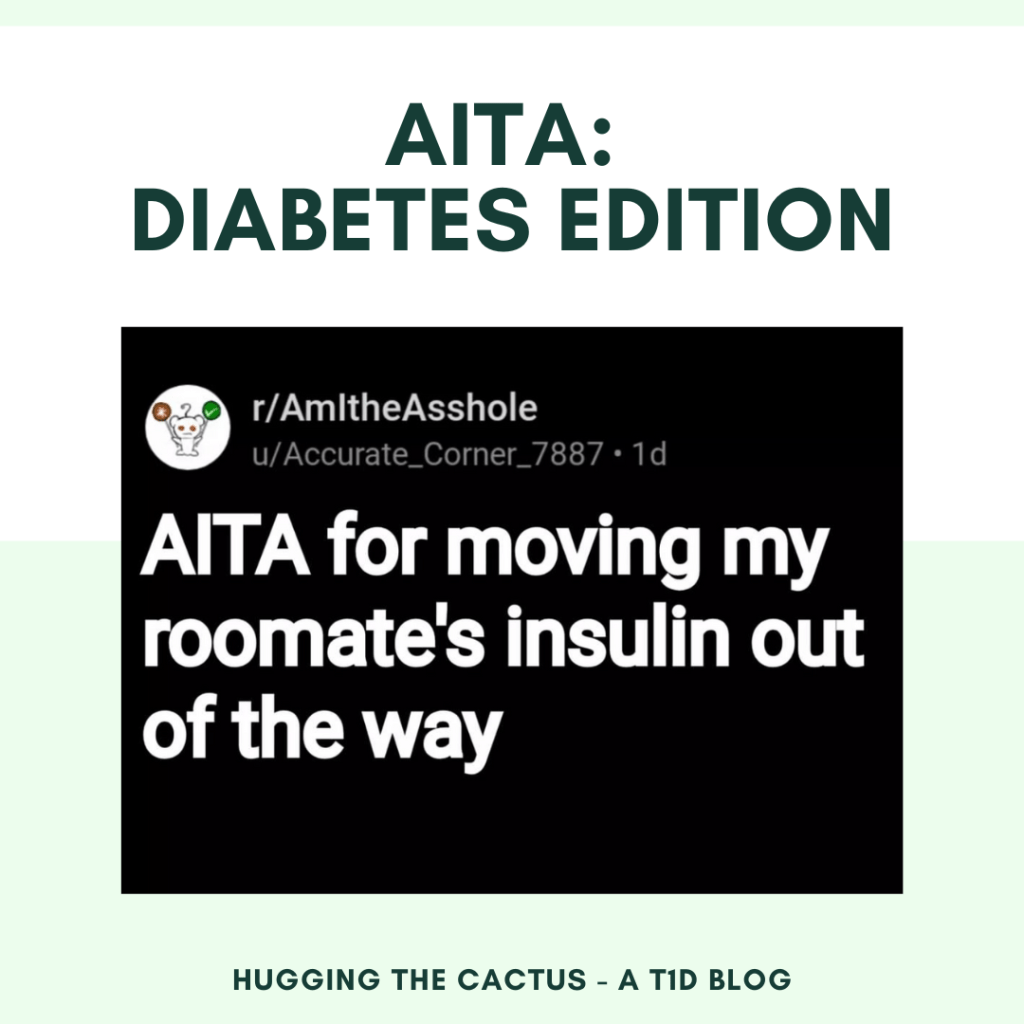
I found myself immersed in one of these AITA threads that my cousin sent me because, of course, it had to do with diabetes. Long story short, the OP wondered AITA for moving their roommate’s insulin out of the way, causing said roommate to panic and be forced to resort to an emergency insulin supply because they were unable to locate what had been stored in the refrigerator. Now, in just that context alone, I would’ve said that the OP wasn’t an a-hole because they probably just didn’t know any better, but as I scrolled further along in the thread I discovered that they thought it was fine to do and that diabetics were fine in historical times when there was no refrigeration. And he took his ignorance a step further by posting a comment about how he didn’t know what the big deal was about taking a vial of “sugar water” – yes, that’s what he called insulin – out of the fridge.

That’s when I immediately realized, yep, the OP can wear the AITA crown with certainty. This whole anecdote might come across as a teensy weensy blip in the universe of Internet discussion threads, but to me, it stands out as a perfect example that even people who are closest to those living with T1D can get such a significant detail about it so, incredibly wrong. And it’s proof that we’ve got a long way to go in terms of educating the world on the importance and purpose of insulin, apparently, even though stories about it have hit so many headlines in recent years.

TL;DR (another Reddit acronym meaning too long; didn’t read): Let’s get it straight, now, that insulin is a life-saving medication that needs to be stored properly in order for it to be used – and IMHO (in my humble opinion), never take it away from a person living with diabetes without asking them about it first.

Do We Take Medical Technology for Granted?

This was originally published on Hugging the Cactus on December 4, 2019. I’m sharing it again today because there have been many diabetes tech outages since then – and I’m certain there will be more in the future – but my question still remains: Do we take medical technology for granted? I ponder the answer to that below…

Alright, now that I’ve got THAT out of the way…

For the last several days, the DOC has been in a bit of a panic. And when I say “bit” I mean “a helluva lot”. That’s because the day after Thanksgiving, Dexcom Follow stopped working. This means that parents/caretakers who rely on the technology to monitor their child’s/loved one’s blood sugar levels were left in the dark. It sparked confusion, outrage, and downright fear, all of which only seemed to intensify over the weekend and into this week when the problem was only partially solved for most users.

Rather than coming together to support one another, the DOC swiftly divided into two camps: The first consisted of individuals who sought to gently remind others that this technology is still pretty new. It hasn’t even been around for two decades. That meant that for many years before then, people with diabetes were doing things the “old school” way, and getting by just fine. Doesn’t this mean that we should all be able to make it through unexpected technology blackouts, knowing that we have our blood sugar meters to fall back on?

The second camp was in a greater fury over the issue. This camp relied on the Dexcom G6 system because those within it simply didn’t know a life without the continuous glucose monitoring technology. For them, the outage was a bit like asking them to Google something without access to the Internet – it’s pretty much impossible, unless you’ve got an Encyclopedia handy. Oh, and it’s MUCH higher stakes, because people who don’t recognize symptoms of low or high blood sugar need this technology to work in order to stay on top of fluctuating blood sugar levels. Let’s not even get into how much is PAID for this expensive piece of medical equipment…one would argue that the high cost of supplies means that the technology should work at all times, no matter what.

If you’re like me, you can see that both of these groups have perfectly valid points. I’ve had diabetes long enough that I didn’t even use – and didn’t see the point in using – continuous glucose monitoring or insulin pumps until a few years ago. I took care of my diabetes the old fashioned way growing up: doing fingerstick checks multiple times per day, treating low blood sugars with 15 carbs then waiting 15 minutes, checking blood sugar levels about an hour after injecting insulin to make sure highs were coming down the way they should. This way of handling diabetes worked for me for a long, long time…throughout elementary, middle, and high school, right up to college.

Then I got a continuous glucose monitor (I believe it was the Dexcom G4) just before starting my freshman year of college. And I haven’t really been without a CGM device since then. It’s changed my life and helped me navigate adulthood with diabetes. Whenever I do experience periods of the technology not working the way it should, it’s infuriating because I feel like it’s not worth throwing away buckets of cash on it in those periods of inconsistency and inaccuracy.

But here’s what I’m wondering, as a result of this Great Dexcom G6 Outage of 2019…do we take this technology for granted?

Do we truly appreciate the times that it works the way it should?

Do we expect too much from something that, technologically speaking, still has a long way to go in terms of working perfectly?

Do we rely too heavily on continuous glucose monitors to provide us peace of mind when, in reality, they simply provide us with real-time updates of our blood sugar levels (i.e., it’s a stream of data)?

I don’t have answers to these questions. I can reflect on my own answers to them; furthermore, I can ponder how and why the DOC gets so divisive in these times where we should try to come together, listen to (and learn from) differing perspectives, and figure out what we can do to best support one another during trying times.

Another Day, Another Annoying Diabetes Reference

I have controversial taste in entertainment.

While I’m a huge fan of trending shows like The Last of Us and Wednesday (I recently finished both first seasons and fell in love with the characters on both shows/mourn the fact that they likely won’t produce second seasons until 2025), I’m also really into what my mother calls “trash TV”.

This is synonymous with reality television – think along the lines of anything that the Bravo network plays. Most of those shows symbolize pure escapism and innocently mindless entertainment for me, and I’m addicted, so much so that my trash taste in TV translates to my podcast listening.

I listen to a handful of podcasts hosted by personalities that either appear on the Bravo network or talk often about Bravo-lebrity drama, and while I usually find them wildly entertaining, I’ve noticed an emerging trend on these podcasts in recent months that makes me incredibly irritated. And that’s how often diabetes comes up as a topic on these podcasts.

Nine times out of ten, it’s about Ozempic (the type 2 diabetes drug that famous and non-famous folks alike have started using in order to lose weight). Usually, the podcast hosts are poking fun at it or spending way too much time speculating who is and isn’t using it, and it drives me up the wall. NOBODY is talking about the morality of taking a type 2 diabetes drug when they do not have that condition themselves, or the fact that since it’s become so popular it’s made it scarce and potentially unavailable to the people that really need it. Now, I’ll take a step off the soapbox for a second because obviously I 1) don’t have type 2 diabetes and 2) don’t use or need to use Ozempic; therefore, I don’t have a true stake in the game other than that I could imagine myself being even more worked up if it were a matter of people taking Humalog for similar reasons (goodness knows the rage that I would feel if Humalog was becoming virtually fetishized because taking it resulted in some desirable outcome).

I also shouldn’t sit here and judge people who go on Ozempic who have maybe tried multiple other weight loss methods that have failed them, and they’re genuinely using the drug to try and get healthier – I can empathize with that more. No, what really bothers me is the resulting dialogue that seems to happen every time Ozempic is brought up, and that is pure ignorant bliss regarding what diabetes actually is and how significant of a role it plays in the daily lives of people living with it. Multiple podcasts that I listen to have covered the Ozempic “fad”, explaining to their seemingly naive audiences that it’s a drug for diabetes, followed by a punch line about how they don’t even know the difference between type 1 and type 2, and saying things along the lines of how they hope they get diabetes just so they have an excuse to take Ozempic.

It’s gross. And quite frankly, embarrassing for these podcast hosts to admit that they know so little about a condition (and I’m speaking broadly here about both T1D and T2D) but then claim they want to be diagnosed with it so they can maybe indulge in their vanity and lose weight. There’s much better ways to make clever little jokes about diabetes and I’m getting tired of people being lazy in their comedy by continuing to be misinformed.

Maybe all of this is a signal to me that it’s time to take the trashy podcasts out of my rotation…

My Diabetes Does Not Make Me Brave

“I’m a big brave dog, I’m a big brave dog, I’m a big brave dog…” is a mantra that little Chuckie Finster repeats to himself, over and over again, in an episode of The Rugrats that I recall vividly from my childhood.

It’s probably so cemented in my memory because I identified a lot with Chuckie as a kid – I was constantly overly cautious, nervous to try new things and scared about breaking rules or going against the norm. While I’ve overcome many trivial fears as I’ve gotten older, I still don’t think that I’m brave, despite many people telling me that I am…almost always in the context of my diabetes.

“You inject yourself with actual NEEDLES?! You’re so brave!”

“You wear two medical devices at all times? You’re so brave!”

“You put your diabetes story out there to share with others? You’re so brave!”

These are comments I’ve received from family, friends, and total strangers over the years, and while I appreciate the sentiment, I definitely don’t think that my diabetes has made me brave. I do these things because I have to. If I chose to not take care of my diabetes, or talk about my lived experience with it, I would be a much less healthy and happy individual. In my opinion, this isn’t equivalent to bravery – it’s common sense. It’s my reality that I accepted a long time ago.

As someone who is generally anxious and constantly worried about so many things besides diabetes, I’d much rather be admired for being brave about anything else that doesn’t remotely relate to my diabetes. Call me brave for trying something new that I was genuinely terrified about, or maybe say “you’re so brave” in a situation in which I took a stand for something I believe in. Hell, I don’t even mind if you continue to think that I’m brave in my journey with diabetes, but just recognize that my diabetes doesn’t make me brave – there are so many other facets of life that require genuine courage and spirit, and for me, I prefer to think of my diabetes as one teeny, tiny speck in that much larger, grander picture.

People with Diabetes Are Good at Minimizing

A version of this blog post was originally published on Hugging the Cactus a couple of years ago. I’ve updated it and am sharing it again today because it still rings true – I’m good at minimizing my diabetes. Multiple aspects of it, in fact. Read on for more…

I was just sitting here, minding my own business when I got to thinking about how good people with diabetes tend to be at minimizing.

I speak for myself, and some other people with diabetes I know, when I say that we’re really good at making it seem like it’s not a big deal. We manage a 24/7, 365 chronic condition like it’s not the full-time job that it is. I have family and friends who occasionally pick up on this and marvel at my ability to be present in a myriad of social situations while discreetly watching my blood sugar levels or calculating insulin dosages. I rarely act like diabetes is as serious as it is and that’s because I’ve become an expert at making it seem like small potatoes in my life. And I’m not just good at minimizing my diabetes – I’m also highly proficient in minimizing the fact that it has forced me to make difficult decisions in my life, particularly when it comes to financial choices.

Over the years, I’ve become excellent at downplaying the impact of diabetes on many aspects of my life.

I’ve conversed with plenty of other people with diabetes about whether or not we, as individuals, have struggled to afford insulin. Most have been pretty lucky and have never really had to resort to making truly difficult choices when it comes to affording insulin or other diabetes supplies.But just because I’m able to afford insulin, that doesn’t mean that I haven’t had to make certain choices that I might not have had to make if I didn’t have diabetes.For example, when it comes to my career, I’d never consider a job that doesn’t offer solid health insurance plans. Even if my strongest desire was to be a freelance writer, I wouldn’t go through with it because I know that it would be challenging to figure out my health insurance. And I know that the minute I run out of FSA dollars each year, I start thinking about setting money aside just to cover the costs of my diabetes supplies…which means that instead of buying some new clothes or planning a weekend getaway, I sometimes have to sacrifice those luxuries in favor of ensuring I have enough money to cover my fixed expenses as well as my diabetes medications.When I think about it, of course I realize that it’s not fair, but haven’t really considered it before because this is just how it is. I’m used to it. And so are many other people. We’re all accustomed to having to make certain choices about our lifestyles or spending habits that minimize the larger issue of insulin affordability. We’re used to it, even accepting of it, but that doesn’t make it right and it certainly underscores the terrifying fact that too many people simply can’t afford insulin and have to make much tougher decisions in order to get it.It’s time to become a little less good about minimizing and better at vocalizing – not just the seriousness of diabetes, but also the dire nature of insulin affordability and access that affects millions around the world.

My Thoughts on Nick Jonas and His Dexcom Super Bowl Commercial

On February 2nd, Dexcom announced some major news: Nick Jonas – yes, the famous guy from that band – is starring in a Dexcom commercial that will be airing in a coveted Super Bowl Sunday advertisement slot.

This is pretty big for a couple of reasons, one being that Nick Jonas is now an official paid Dexcom spokesperson. In addition, this represents the first time that a diabetes company like Dexcom will be airing an ad that will be delivered to millions of Americans at the same time, which is definitely a big deal.

Upon hearing this news, the diabetes online community and I had some intense and justified reactions.

Nick Jonas is officially a Dexcom spokesperson, which generated some strong reactions from the diabetes community.

A lot of people expressed frustration that a superstar like Nick Jonas only ever seems to talk about his type 1 diabetes when he’s being paid to do so.

And listen, that frustration is warranted. It’s like the guy is trying to monetize his diabetes and it’s a little gross. There’s collective annoyance that Nick Jonas doesn’t use his (massive) platform and following on a more regular basis to advocate for diabetes. That’s a hard pill to swallow for a lot of us who have created blogs, podcasts, social media profiles, and more in order to help the diabetes community and beyond by doing things like raising awareness and talking about real issues regarding access to necessary diabetes care and medication (and so much more). So when Nick Jonas finally opens up about it, apparently it’s to advertise an expensive piece of technology that isn’t available to all people with diabetes. (And here’s my disclaimer: Yes, I use a Dexcom G6 CGM and I love it. But I’m very aware that I’m fortunate to be able to afford it because others cannot.)

It’s a little difficult for me to sympathize much with Nick Jonas here. Of course, I don’t know him (though I’m sure he’s a lovely guy and obviously he’s quite talented). I have no idea what it’s like to be a celebrity. He’s been in the limelight since he was a teenager. Many of us grew up with him. I can’t imagine what kinds of pressure he’s faced, so something like diabetes (a deeply personal condition) might be tough for him to talk about in a candid manner in front of the mass media. Or maybe he simply doesn’t know how to frame discussions around it. Who knows, but his acceptance of this sponsorship deal warrants the conversations that it has generated. Moreover, I can’t ignore his involvement with a non-profit that’s become infamous for accepting money from big pharma, which is massively problematic in the fight to make insulin affordable for all.

Let me end that line of thought by pointing out that he’s not the only person with diabetes featured in this commercial. There are two other “real-life”, non-celebrities living with diabetes who got this incredible opportunity to be featured in a freakin’ Super Bowl commercial. As someone who has participated in Dexcom ads in the past*, I can understand how exciting this time must be for these two people, and I hope that it isn’t diminished by the diabetes online community’s reaction to Nick Jonas’s appearance and sponsorship deal.

Now let’s pivot to the fact that Dexcom has dropped (probably) millions of dollars to appear in this Super Bowl ad slot…and signing a high-profile celeb like Nick Jonas as a company spokesperson likely wasn’t cheap, either.

It definitely leaves me feeling unsettled. Why did the company feel it was necessary to spend so much on this new advertising campaign? As my friend Stacey put it, Dexcom is putting corporate and celebrity money before patient needs. The reality here is that not everyone can afford insulin, let alone a “gratuitous” piece of diabetes technology like a Dexcom continuous glucose monitor. Elevating diabetes to the national spotlight only does good when it can do something about insulin access and affordability, or to raise awareness about it, or to explain how to recognize the symptoms of diabetes.

To sum it all up, I’ll share a thought from another person I’ve come to know from the diabetes online community: @miss__diabetes. The day that Dexcom announced the commercial, she tweeted:

Nick Jonas is the advocate of a privileged life with #type1diabetes. Doing super bowl ads tells the rest of the world that diabetics are living their best life with diabetes technology when the reality is diabetics are dying because they can’t afford insulin. #Insulin4all

@miss__diabetes

A nicely phrased sentiment as well as a reminder that we’ve got a long way to go in the fight for affordable insulin, don’t you think?

*When I appeared in Dexcom advertisements, I was not compensated beyond the company paying for my transportation, on-set meals, and hotel. If you want to learn more about the experience, I wrote this blog post about it, and I am always open to answering questions.

On a Scale of 1-10, How Satisfied Are You with Your Health Insurance Plan?

The title of this blog post is a question that I was asked on a phone call with a member of my healthcare team. And the answer to it really stumped me.

On the one hand, I am extremely grateful to be employed with a workplace that offers a few choices in terms of a healthcare plan. I know that there are many Americans who are not as lucky as me and either struggle to afford medical care as needed or lack a job and/or health insurance altogether. It feels selfish for me to complain at all about my health insurance because I should just feel lucky to have it, period.

If you were asked this question, how would you answer it?

On the other hand, I’d be lying if I said I was 100% satisfied with my health insurance plan. I pay a lot of money out-of-pocket to cover the costs of all my diabetes supplies. I try to help mitigate the expenses by contributing to an FSA account, but it doesn’t do anything to lower the actual costs of my supplies: It just means that I save an amount equal to the taxes I would have paid on the money I set aside.

So when I was asked how I’d rate my health insurance plan using a scale of 1-10, 1 being the worst possible plan and 10 being the best possible plan, I didn’t know which side of the argument I should go with. I know that I certainly don’t have the worst plan – for the most part, I’m able to freely choose things like which insulin pump I want to use and which doctors I want to see – but I definitely don’t have the best plan. To me, the best plan would mean I don’t pay anything for the medications and supplies that I need in order to live, so I absolutely wasn’t going to give it a 10 rating.

Ultimately, I answered the question by giving my health insurance plan a 3. I am dissatisfied with the amount of money that I need to pay and wish that my plan would shoulder more of the costs, but the plan earns a few points for the flexibility it gives me in terms of who I see for doctors and for being consistent in the last couple of years that I have spent on it.

As I said the answer out loud, I couldn’t help but think and dream about the day that I might be able to give a health insurance plan a 10 because it covers all medical costs, is easy to understand, and provides freedom to choose any medications, devices, and doctors that I want. It’s a hope that I have not just for myself, of course, but for all Americans.

I hope that day comes sooner rather than later.

Why I Wouldn’t Change the Age at which I Was Diagnosed with Diabetes

If I could cure diabetes for myself, my mom, my aunt, and all other people living with it, I would in a heartbeat, no question.

Unfortunately, I don’t have that capability, so I can’t change the fact that diabetes exists. Another thing I can’t change is that I was only four years old when I was diagnosed with it.

But let’s talk in hypotheticals here for a moment: If I could change the age that I was diagnosed, would I? Why or why not?

The answer is a resounding no, and here’s why.

I grew up with my diabetes. I don’t remember life before it. I don’t recall a time in my life in which I was finger-prick free or able to eat whichever foods whenever I wanted.

That might sound sort of depressing, but for me, it’s better that way.

See, little Molly clearly didn’t care about having diabetes – I was way too into my horsey to care about that!

I never have to long for the “before times”. I never have to look back on a time in my life that was hard because diabetes rudely interrupted it, causing a swift, drastic change to my daily routine. By the time I was old enough to start really recalling specific events, I already had diabetes. As far as I’m concerned, it’s always just been a part of me.

Some might argue that it’s “better” (imagine that I’m air-quoting that because it’s never better to have diabetes) to be diagnosed with something as life-altering as diabetes in adulthood, or at least in the teenage years, because comprehension of what it is, exactly, is stronger. I’d imagine that the adaptation of new technologies is easier, too, seeing as teenagers/older individuals tend to pick up on these things faster than, say, a toddler that is needing to learn how to safely use an insulin pump.

But for me, it’s been good to learn about diabetes as I’ve matured. As a kid, I just knew it was the thing that prevented me from eating certain foods at certain times, and that I needed my parents’ help at mealtimes in order to calculate carb intake and bolus amounts. As a teen, I started to actually learn the science behind diabetes in various classes I took throughout high school, and expanded on that knowledge in college by taking a nutrition course that taught me all about the glycemic index and how that impacts blood sugar. And as an adult, I’ve been able to make informed choices regarding the use of insulin pumps, CGMs, and other matters of that nature that require some research and understanding.

And more important than anything else…being diagnosed with diabetes at 4 years old had zero impact on my quality of life. I had a wonderful childhood and all the credit goes to my parents, who made sure that I was raised knowing that diabetes couldn’t stop me from doing anything. I know they would’ve handled a potential diabetes diagnosis later on in my life with an equal amount of grace and strength, but the fact that I grew up with it meant that we all, as a family, grew up with it as a normal part of our lives.

So even though I’ll never be okay in the traditional sense of the word that I have diabetes, I am okay with getting diagnosed as a little kid.

National Diabetes Awareness Month 2020: A Recap

And just like that, we’ve somehow, bewilderingly, arrived at the final day of National Diabetes Awareness Month 2020.

Not sure how that’s possible considering it should still technically be March 2020 (you know, when shit hit the fan), but here we are!

The blue circle…a symbol of diabetes awareness and advocacy efforts.

At the beginning of November, I really wasn’t sure that I was ready to don my diabetes advocacy hat and amp up my awareness efforts for the entire month. I’ve had enough going on in my personal life (spoiler alert: I bought a condo and moved into it at the start of the month) and as a result, I’ve spent much less time on social media and a whole lot more doing my very best attempt at adulting.

And despite that, I still found myself immersed in advocacy efforts – and blown away by what everyone else in the diabetes online community was doing.

Daily posts, live IG videos, fundraising efforts, and so much more happened all month long. They were inspiring, educational, and highly motivational to someone like me who was tepid at best about diving into advocacy activities this year. They were definitely enough to encourage me to keep posting for one of the many diabetes-themed Instagram challenges for the month. As minor as it was to write captions each day based on the prompts, it’s still what worked best for me in this weird year.

My big takeaway from this, though, isn’t that I should have done more or that I should feel guilty for doing the bare minimum…no, it’s a reminder that advocacy doesn’t take place during a single month or on one day.

Advocacy is a year-round thing.

I’m proud to talk about diabetes practically every damn day in some shape or form because I think that it helps people in my life realize that diabetes itself is a 24/7, 365-kind-of gig.

And I’ll keep talking and writing and expressing and advocating ’til the day there’s a cure for it.

“You’re Being Too Paranoid”

They didn’t say that to me, but they didn’t have to…it was written in bold all over their faces.

Recently, I dined outside with people who are close to me (I’m not going into specifics as to who exactly they were to maintain some level of discretion). I was explaining to them that come the winter season, I probably won’t be dining out much out of COVID concerns.

I wish people would spend less time judging others and more time taking the proper precautions to help protect themselves and their loved ones.

I’m just not ready to dine indoors yet. In fact, since March, I’ve only set foot into a physical store, dwelling, or other establishment a dozen times. For me, the risk associated with spending time inside when it’s completely avoidable just isn’t worth it.

But what sucks about this is the judgment I receive from others. Just like I did in this scenario, the looks on their faces make me feel like I have to defend myself. I wanted to scream at them, “you try having a chronic illness and dealing with it during a global pandemic!”…but of course, I’d never do such a thing, and I’m very glad that they don’t have to worry about that.

I do wish, though, that they – as well as other people who are quick to judge individuals like me who are scared and overly cautious these days – would use a little more grace and humility when conversing with those of us who are high risk.

Please try to put yourself in my shoes.

Please understand that not only am I considered high risk, but I’m in direct contact with loved ones who are also considered high risk.

Please know that, yes, I do have a desire – a very strong one – to get back out there and do “normal” things.

But think about the things holding me back…a chronic condition that requires a lot of my time and energy, for starters.

And think about how there are millions of other people like me who share this great responsibility for an underlying health condition that they didn’t ask for on top of a great fear.

I hope it changes your perspective.