When Carbs Collide with a Bent Cannula, Chaos Ensues

Sushi. Wine. Not one, but two slices (I swear they were slivers, honest) of cake. A pod with a cannula that got bent out of shape accidentally due to clumsiness.

The above sounds like some sort of weird laundry list, but it’s really just all the factors that contributed to a night of high blood sugars and relative sleeplessness.

Let me explain what happened: The night started out fabulously! I got sushi for dinner from a local spot that I was trying for the first time. I was excited about it because sushi is a rare treat for me, and I figured the occasion warranted some wine – my first glass(es) that I’ve had in about 2 months (I gave it up for Lent).

Those two things right there are definitely a “dangerous” duo that can cause carbohydrate calculation errors or prolonged blood sugars, but I tucked that in the back of my mind because I wasn’t done with indulgences for the evening.

I want to say I regret nothing about this carb-o-licious evening, but…

That’s right, I kept up with the carb-loading by enjoying some cake (white chocolate blueberry cake that I made myself that is just as decadent as it sounds) soon after dinner was done. My problem is that I thought I’d curbed the impact of the carbs by setting a temporary basal increase and stacking a small amount of my insulin, but no such luck. I’d destroyed my second piece (it was just a tiny sliver, people) and noticed that I was creeping up. I took more insulin and soon forgot about my high blood sugar as I immersed myself in episode after episode of Impractical Jokers, which, side note: It’s a series I just discovered and it’s hilarious cringe comedy that is the perfect thing to watch after a long day.

A handful of episodes later, it was time for bed. Or so I thought…because soon after I was settled in bed, I twisted around in just the right – or in this case, wrong – manner that was rough enough to loosen my pod from its allegedly secure location on my back. The smell of insulin was pungent and indicated to me immediately that the pod would have to be ripped off completely and replaced. And the sooner, the better, because my blood sugar was getting closer and closer to 300…definitely not a level I want to see before I go to sleep.

By 12:30 A.M., the new pod was on my arm and a temp basal increase was running to combat my lingering high blood sugar. I also gave myself yet another bolus and crossed my fingers, hoping that the combination would be enough to bring my levels down overnight.

At around 2 A.M., my PDM started beeping to let me know that it’d been about 90 minutes since the new pod was activated, so in response I woke up to silence it and glance at my CGM. My blood sugar barely budged! Frustrated, I gave myself more insulin and fell back into a restless sleep.

Several hours later, my alarm was blaring, far sooner than I wanted it to. I hit the snooze button, also taking care to check out my CGM yet again before I made an attempt at 15 more minutes of sleep. And guess what – I was still high. Quite high. Not 300, but in the mid-200s.

It was official: My blood sugar was punishing me for my night of careless carb consumption and reckless pod-handling. I shouldn’t have been surprised by the resulting chaos, but at least I was able to restore peace again the next morning…eventually.

The Forgotten Bolus

My friends and family have always complimented me for having a good memory.

What can I say? I have a knack for remembering names and faces. I’m slightly better than decent at keeping track of birthdays. And I’ve kept journals of some sort for most of my life, so I’m usually able to recall the date on which a certain event took place (or I can at least look it up fairly quickly).

But my memory can fail me sometimes, and it did just that the other day when I forgot to bolus for dinner.

I don’t think I’ve ever forgotten a mealtime bolus in more than 23 years of life with diabetes. I suppose there’s a first time for everything…

To give myself a little credit, I truly thought that I had bolused. I remembered picking up my PDM and entering my blood sugar and carbohydrate information, but I never actually hit the very important “enter” button that would start delivering my insulin.

Imagine my surprise, then, when I saw my blood sugar rapidly rising – I’m talking double “up” arrows here – approximately 20 minutes after I finished my dinner.

And at first, I decided to ignore it! I thought that my insulin just needed a little more time to kick in, so I waited. And waited. And waited. But when I saw that I was rising above 250 mg/dL, I figured I should increase my temp basal…perhaps my body just needed a bit more insulin than I anticipated.

That’s when I picked up my PDM and saw that I had zero units of insulin on board. Extreme confusion turned into extreme panic as I asked my mom if I could check her PDM – what if I had picked hers up instead when I bolused for dinner and mistakenly gave her the insulin that was intended for me?!

Thankfully, that wasn’t the case, and I slowly began to piece together that I simply forgot to hit the bolus delivery button.

Whoops.

Almost one full hour after finishing my meal, I was finally delivering my mealtime bolus and silently fuming over my high blood sugar that ended up lasting several hours. It was a completely avoidable situation that shouldn’t have happened, but at least one good thing came out of it: I don’t think I’ll be forgetting to bolus any time soon.

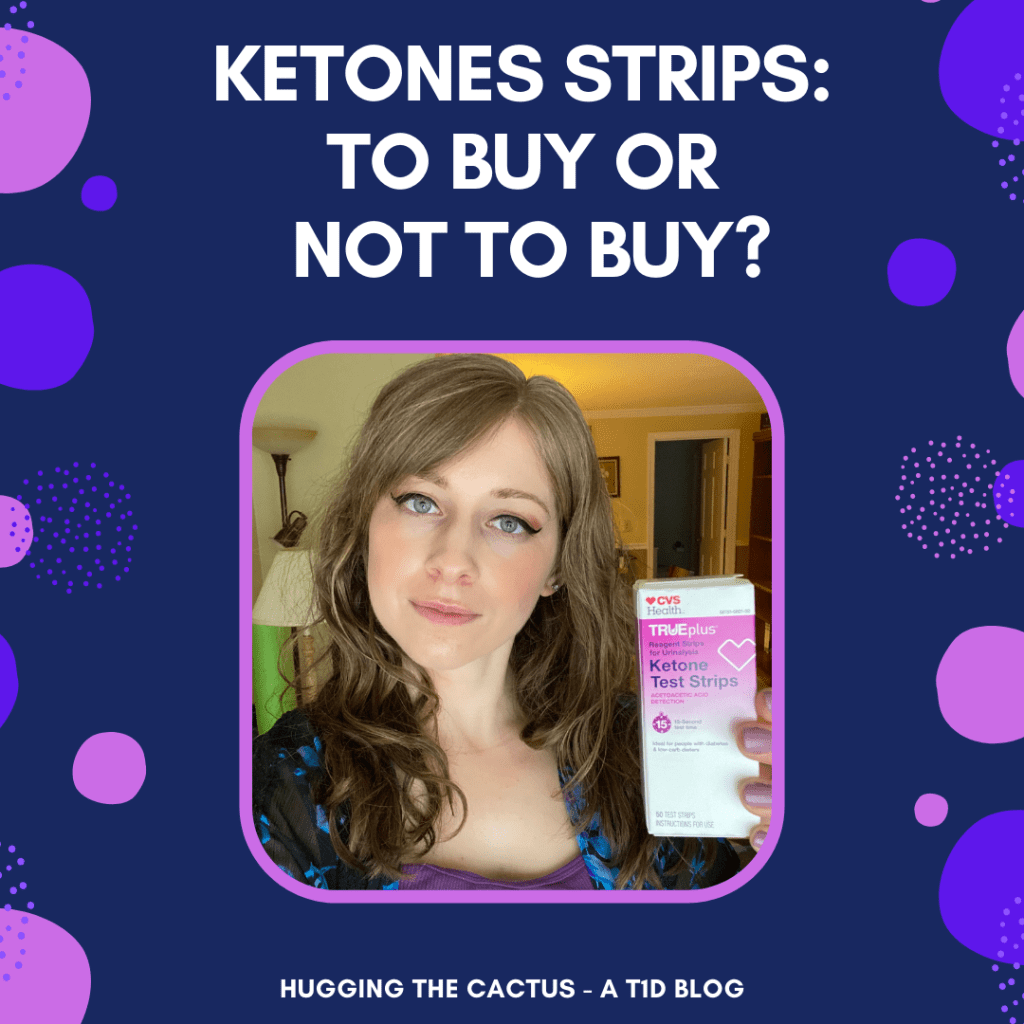
Ketones Strips: To Buy or Not To Buy?

I popped into a CVS store on my way home from picking up groceries to pick up something very important…Starburst jellybeans, because naturally, I “needed” them.

When I was in the store, I wandered over to the diabetes aisle, curious to see if browsing the shelves would remind me of any supplies I should pick up.

My eyes fell on a box of ketones testing strips and I paused, pondering whether or not it was worth it to buy them.

Are ketones testing strips a must-have or no-need item for you?

I admit that I scarcely ever check my ketones when my blood sugar is above 250. I know that I should, but a combination of laziness, anxiety, and lack of unexpired strips usually stops me from checking. And when I do have strips on hand that aren’t expired, it seems that I’m only able to use a couple out of the 25+ strip bottle before the whole dang thing expires, which is frustrating. In fact, prior to this CVS trip, I had a vial of ketones strips sitting in my bathroom that expired more than 4 months ago. I hadn’t trashed them yet because I stubbornly hang onto things far longer than I should.

So I stood in that CVS aisle, my hand hovering out in front of me over that box containing the ketones strips. To buy or not to buy? Do I spend the money knowing that I’ll probably only use a few strips? Or do I save the approximately $12 and walk out the store knowing that I don’t have useable strips at home?

Ultimately, I bit the bullet and bought the strips. I know myself well enough to know that I’ll take comfort in knowing that they’re available to me if and when I decide to use them. Besides, $12 is a fairly small ask when it comes to monitoring something as important as this and granting myself peace of mind.

If only we could have a price like that for life-saving insulin…

How My T1D and I Handled My First COVID Vaccine

Imagine my surprise when I went to write about today’s new blog post on my Instagram account and swiftly realized…I didn’t have a new post! Life’s busy and as a result, I’ve fallen a bit behind my blogging schedule.

Luckily, I have the day off from work today, so I’m able to whip up a quick post on something that people might be wondering about: How did my diabetes and I fare after receiving dose 1 of 2 of a COVID vaccine?

I am officially halfway there on the vaccine front.

I’m going to rapid-fire this one and sum it all up with some bullet points:

  • I got the Moderna vaccine
  • I felt 0 pain when I was injected – in fact, I didn’t feel anything and was surprised when the nurse told me I was all set
  • I had to wait 15 minutes after the dose was administered to make sure I didn’t experience any type of reaction
  • I had no reaction whatsoever
  • About 18 hours after I got the vaccine, I noticed some slight pain around the site
  • I could not see any marks around the site – no redness, no apparent injection location
  • The pain was only noticeable when I was changing my clothes
  • My blood sugar within the first 24 hours was mostly fine (I wasn’t eating super healthy so any high blood sugars can be blamed on my poor diet)
  • My blood sugar was fine 48 hours later, leading me to believe that the vaccine had 0 impact on my blood sugar levels (I had somewhat anticipated elevated blood sugar levels because my mother, who also got the Moderna vaccine, said her levels were higher 2-3 days later post-vaccine)
  • I felt absolutely normal! I got the vaccine three full days ago as of this writing and I can’t say that I’ve noticed anything different

That was my experience; remember, all people with diabetes (and without diabetes) are different and may experience different things. If you have any questions after reading this post, I highly recommend reading this post from Beyond Type 1 that tells you what you want to know about the vaccines. And here’s my little disclaimer to talk to your doctor about any concerns you have.

I’m glad that I got my first vaccine and that it was a hassle- and pain-free experience. I’m looking forward to getting dose number 2 at the end of April and will be sure to recap what it’s like then. In the meantime, I’m happy to continue masking up and practicing social distancing – after all, we’re in this together, and just because I got one vaccine doesn’t mean that I can’t do my part to help protect others.

The Comparison Culture and How I Tune It Out

We all know that social media can be…damaging.

Scroll through Facebook, Instagram, or any other social network and 99% of what you see is the idea of “perfection”: Beautifully dressed and made-up individuals showcasing their gorgeous homes or families or possessions. Usually, some sort of caption will accompany the post and it might say something like “so blessed to do life with my dream partner” or “we just bought our first home, can’t wait to fill it with joyous memories” or some other gushing, effusive language that is followed by a series of exclamation points and emojis.

There’s nothing wrong with this…except for the fact that, obviously, people’s lives aren’t as “perfect” as they seem.

Life is messy, but we don’t get to see that side for many people on social media.

This is true not just about life events, but something as specific as life with diabetes.

I think that our community has gotten a lot better about it, but I used to see so many posts that showed “perfect” blood sugar graphs and “perfect” A1c readings.

And I used to obsess over these posts.

I’d wonder why I wasn’t achieving the same levels of success as these other individuals. I’d convince myself there was something wrong with me, and that I’d never have blood sugar graphs or A1c levels that were “good enough” to share online.

Between diabetes perfectionism and real-life perfectionism (Why aren’t I married yet? When will it be my turn to start a family? What’s wrong with me that I haven’t met all the other adult goals that so many of my friends have met?), I was starting to drive myself insane.

Social media was breeding a culture of comparison for me.

I couldn’t log onto an account without immediately comparing myself to the images I saw and the stories they told.

It’s taken time, and I’m not always good about it, but I’m learning to tune out the noise on social media and how to stop comparing myself so much to others.

So how did I start to unsubscribe to that culture of comparison?

For starters, I came to terms with the fact that I didn’t want to leave social media altogether. I like how it keeps me connected with family and friends on top of connecting me with individuals all around the world. I like how it functions as a support system when I need to consult my diabetes online community for wisdom and guidance.

But I knew that I needed to take a step back. So I started slowly and gradually: I removed the Twitter and Facebook apps from my phone, telling myself that if I really wanted to check the feeds for either, I could do so using my Internet browser. I also spent less and less time scrolling, a habit that was addicting to me because I wanted to see as much content as possible, but also one that I recognized as damaging because more content meant more comparisons to others.

The most important thing that I did, though (and continue to try to do) is repeat a few mantras to myself:

This is just one page of this person’s story.

You don’t know the whole picture.

You don’t want to be anyone other than yourself because you truly do love the people and things in your own life.

It might sound silly, but reminding myself that social media is designed to show off the “best” parts of our lives really did help me come to terms with the fact that I needed to stop comparing myself to everyone. Just like I have plenty of bad things that happen in my life, I have a hell of a lot more good, and just because I don’t choose to showcase everything on my feed doesn’t mitigate the good.

And one last thing that I’m trying to do? I’m simply trying to be happy for others who revel in their successes and choose to share them online. I’m also trying to pay closer attention to those who are brave enough to showcase their failures online, diabetes-related or not. In fact, it’s not uncommon for me to open up my Instagram app, scroll through my feed, and see the most “perfect”, straight-lined Dexcom graph followed by an “imperfect” topsy-turvy Dexcom graph. I’m training myself to react to the former graph not by comparing myself, but by feeling good for the person who posted it. And in terms of the latter graph, I also don’t want to compare myself to it (I’m not proud of it, but I’ve taken a look at “bad” graphs before and said OMG, my numbers are sooo much better), but instead offer words of encouragement or commiseration – because we’ve all been there.

The comparison culture is toxic. It’s taken time for me to realize just how much it was affecting me, but now that I have, I’m glad because removing myself from it will help enrich the relationships I have online and in real life. When it comes to diabetes specifically, it’s difficult enough managing my own, and that much harder when I compare how I take care of it to how other people with diabetes live their lives. Learning to appreciate our diabetes differences instead of stressing over them makes it so much easier to support and uplift one another when we need it most.

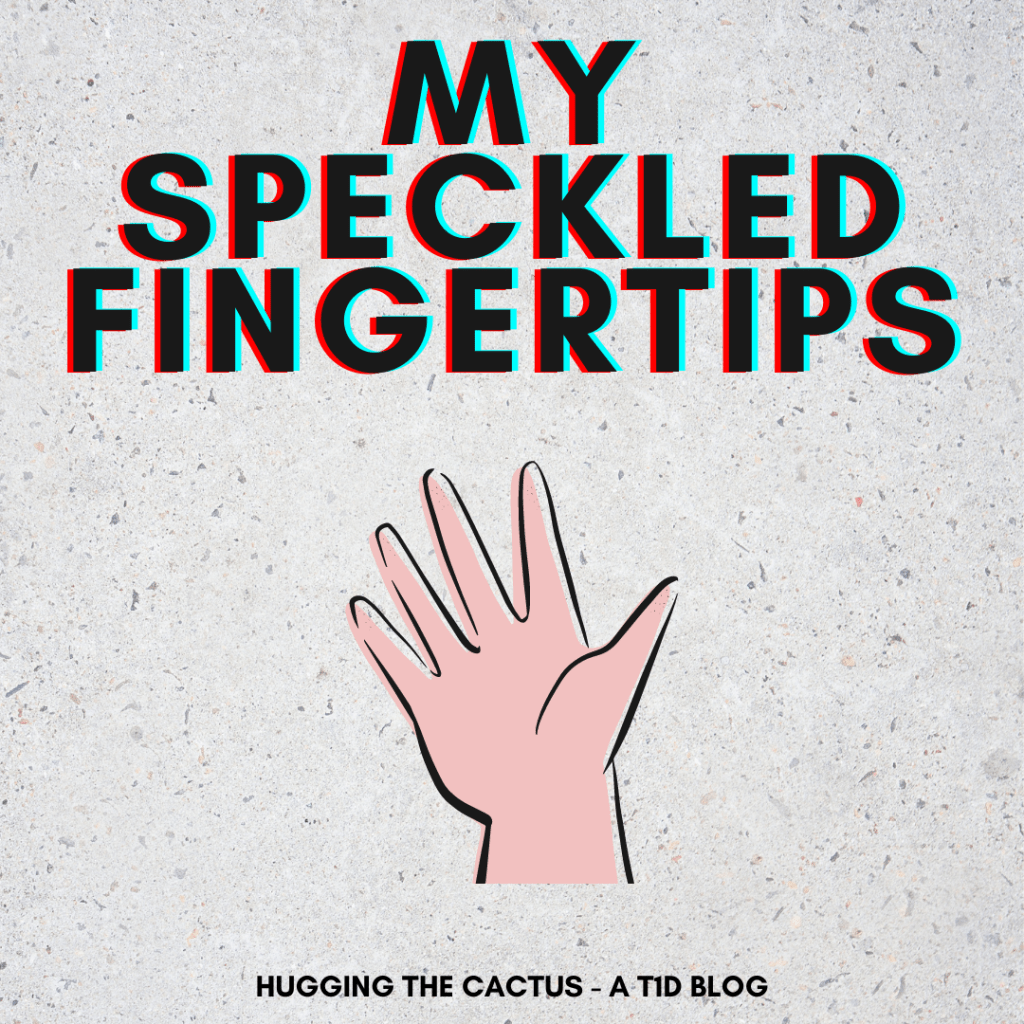
My Speckled Fingertips

A lesser-known fact about me: I used to love writing poetry. I wrote tons of it when I was a middle schooler and sometimes used it to explore the emotions I associated with my diabetes. I even won a prize in a poetry competition once for a poem that was about my journey to accepting my diabetes. Today, I revisit my poetry roots in this short piece about the scars that years of fingerstick checks have left on my fingertips.

If you squint reeeeeeeal hard, then you can see the careful placement of fingertip scars that I put onto this graphic hand. (I tried to take a picture of my own with less-than-satisfactory results, so a cartoon representation will have to do.)

Tiny black dots
Littered across my fingertips
These fingertip freckles are
Constant reminders of
Decades of life with type 1 diabetes
My speckled fingertips
Rough from the scars
Worn from thousands of pricks
Poked and prodded and pinched
Countless times
As part of the process to
Help keep me alive
Blood droplets
Flood scarlet, startlingly red
In contrast to my fair skin
Temporarily masking the marks
When wiped clean
They reveal themselves
Unashamedly
Loudly
Proudly
Maybe I should be
Proud of them, too.


4 Ways Diabetes Motivates Me

Life with diabetes can be inconvenient, unpredictable, and downright frustrating. But it’s not all bad. In fact, after living with it for more than 23 years now, I’ve actually identified a few different ways in which it helps motivate me.

And what, exactly, are those ways? Well…

#1: It’s constantly challenging me to strive for the better: Better “control” over my blood sugar levels, better management of my diet and exercise regimen, and better care of my entire body, in general. While it involves a lot of work, it’s extremely motivating because I know that anything I do for the better of my diabetes and my body now will pay dividends in the future.

#2: Diabetes encourages me to ask questions. I think that my diabetes is the reason why I’ve learned to be curious. It pushes me to want to know the who, what, when, where, why, and how of various scenarios, both relating to and not relating to diabetes. It’s natural for human beings to be inquisitive, but they don’t always do something to pursue answers to questions. My diabetes pushes me to do that, with varying degrees of success, and that’s something I’m grateful for.

After having diabetes for more than 23 years, I’ve realized that it can be highly motivating.

#3: It pushes me to prove people wrong. There’s so much stigma surrounding diabetes…”You can’t eat that! You can’t do this! You can’t do that!” are exclamations that I’ve heard my entire life from different people. Rather than nodding and smiling politely at these poor, misinformed individuals, I strive to show them exactly why they’re wrong. Whether it’s explaining the facts or going out and doing the very thing they said I wouldn’t be able to do because of diabetes, it’s empowering for me to smash down diabetes misconceptions.

#4: Diabetes inspires me to seek more out of life. This goes hand-in-hand with point number 3, but it counts as a separate notion because this is all about how I view my life with diabetes. I didn’t fully accept my diabetes until I was a teenager. That acceptance represented a turning point for me during which I realized that just because I was dealt this card in life, it doesn’t mean that it should stop me from accomplishing my hopes and dreams. Over the years, my diabetes has made me want more: opportunities, experiences, relationships…you name it and I’m hungry for it.

Sure, diabetes can be my biggest headache…but it can also be my greatest motivator, and I think it’s important for me to embrace the beauty of that.

Luck O’ the Irish Diabetic

Happy St. Patrick’s Day!!!

Last week, it occurred to me that in more than 3 years of running this blog, I’ve never written anything about St. Paddy’s Day here…so I sought out to rectify that immediately; hence, today’s blog post.

I love St. Patrick’s Day. Always have, always will. I celebrate it each year decking myself out in head-to-toe green. I eat a traditional Irish dinner – always prepared by my mother, until this year when I will attempt to cook the meal myself – that consists of corned beef, cabbage, potatoes, carrots, and Irish soda bread. We eat it while listening to Irish music and more often than not, we’ll have a Guinness or an Irish coffee along with the meal. My family’s attended St. Patrick’s Day parades in various locations in years past, though obviously, we didn’t go to any last year and we won’t this year, either. But we’re still proud of our Irish heritage and we made the most of it in 2020, as I know we’ll do today.

My parents’ dog, Clarence, and I certainly made the most of the day last year. I was dressed up like this for all of my work video conference calls, which made my colleagues laugh at a time when we all needed one.

So you know my plans for St. Patrick’s Day, but what does this have to do with my blog that’s about diabetes?

Let me explain.

The common denominator between this holidays, all the others, and my diabetes is…food.

Foods consumed on holidays are often special and laden with carbohydrates. Rather than deprive myself, I like to indulge on holidays, and worry a little less about my topsy-turvy blood sugar levels.

You might be thinking, “But the food you described isn’t even that carb-heavy!” and you’d be right, for the most part. Corned beef, cabbage, carrots…those are all easy to bolus for seeing as the carbohydrate content is negligible.

It’s the combo of potatoes – which normally, I can bolus for without any troubles – and Irish soda bread – hellooooo, carbs – that really screws me up.

You see, the problem is that Irish soda bread is too delicious. It’s a quick bread that has a buttery exterior and a tender, mouthwatering interior that’s densely packed with raisins. It doesn’t sound like much, but my mother’s recipe is sheer perfection and I can’t resist helping myself to a big ol’ slice (and a couple of mini, just-one-more-taste slices) of the stuff every year.

So more often than not, my St. Patrick’s Days end with high blood sugars (which I suppose is better than ending with a trip to the toilet due to excessive…ahem, celebrating).

The Irish soda bread is worth the high blood sugar alone, but this year, I’m hoping for a little luck when I tuck into this festive feast. I’m tired of simultaneously welcoming holidays and high blood sugars…it’s about time that I make more of an effort to have better levels when I’m eating special meals. I know the extra work will make the day and the food that much more enjoyable and special.

With a little luck o’ the Irish (and some aggressive bolusing), this diabetic will finally have a St. Patrick’s Day filled with lots o’ green, Guinness, and great blood sugar levels.

The Days that Diabetes Bothers Me

The vast majority of the time, I’m relatively unbothered by my diabetes.

I accepted long ago that it’s not going away any time soon. While that acceptance has made it easier to live a full life in spite of diabetes, I definitely still experience the occasional day that diabetes bothers me more compared to other days.

The days that I’m unbothered by diabetes are enriched by the ones when it bothers me.

It’s the days that I’m trying to enjoy time spent with loved ones.

It’s the days that I want to eat whatever I want without any consequences.

Heck, it’s the days that I want to eat, period – I’ve had days in which diabetes has restricted me from eating much of anything at all.

It’s the days that I need a really solid night of sleep the night before, but don’t get it because diabetes interfered.

It’s the days that I’m feeling so burnt out from it all that I just want to be normal.

Obviously, I’ve learned how to power through these days that I’m truly bothered by diabetes. But the ones that I simply can’t find the strength to do so are the hardest, and that’s when diabetes really gets to me.

I think that after 23 years with it, I’m allowed to be bothered by my diabetes every now and then. I don’t have to radiate sunshine and positivity about life with diabetes 24/7.

However, I think it makes the times that I’m unbothered by my diabetes that much richer because that’s when I get to stick it to diabetes.

Take that.

My Thoughts on an Entire Year of Working from Home

One year ago today was my first day working from home due to the pandemic.

I remember my final day in the office like it happened yesterday. There were hushed conversations in conference rooms, cubicles, and the office kitchen in which we all wondered how serious things were – and how serious they might become.

We had no idea what we were in store for.

One by one, as individuals who tended to work earlier in the day left for home, I said hopeful, “see you in a month” farewells, as we were all under the impression that we could come back to the office in a month. I remarked to one colleague, who is a close friend outside of work, that I had a feeling we’d all be grateful to come back and that we’d marvel in being able to be in close proximity to one another again.

I knew then that this was the start of something unlike anything most of the world had faced before, and I even documented the strangeness of it all by taking one last selfie at my cubicle (to be fair, I’d spent my lunch break at the hairdresser’s, so my hair was on point and IMHO warranted a selfie).

And here’s the aforementioned selfie, taken on March 12, 2020 at 5:38 P.M…during my last few minutes in the office.

That would be my final selfie, for certain, in that office. Because just five months later we’d all return to it one last time in small groups to pack up our desks, as our company decided to break the lease and save money on office space.

So I’ve worked from home for a year, and will continue to do so for the foreseeable future. I’ve got so many emotions tied to that: gratitude, sadness, loneliness, anger, resentment, wistfulness…

Let me go over the positives of working from home: I’m so grateful for my job and for how deftly my colleagues and I got used to full-time remote work. Several aspects of life are made easier by working from home, such as managing my diabetes (for example, if I ever experience a pod failure, I have every and any back-up supplies I could need at home as opposed to my desk drawers, which weren’t always stocked up all the way). I save time on a commute which allows me to fit in more tasks at the start and end of my day, and honestly, working from home full-time gave me the ability to get a puppy and feel confident knowing that I would be around to take care of her.

But there are some negatives; mainly, I miss the office camaraderie like crazy. I’m lucky enough to work with a group of people that I truly enjoy being around, so it’s been tough to maintain my connections with them virtually. And truthfully, I get lonely in my condo. Going into the office five days a week not only ensured I had contact with other humans, but it also guaranteed that I’d actually leave my home during the week. I’ve never felt so sheltered in my life, and it’s a weird feeling.

I guess that if I’ve learned anything in the last 365 days, it’s how to be adaptable. Honestly, not to connect it back to diabetes – okay but this is what my blog’s about so that’s to be expected – but it’s a lot like figuring out how to deal with change as it inevitably happens. Over the years, I’ve taught myself what to do when lows and highs happen, and how to manage certain situations if and when they occur in my diabetes life. And that’s what’s happened in this last year: a whole lot of learning how to handle life’s curveballs, in general, along with the ones that diabetes tosses my way.