How a Normal Pod Change Turned Into a Bloodbath

WARNING: If you are at all squeamish when it comes to blood…then this blog post is NOT for you! I will not be posting any graphic photos or anything, but I’ll be telling a bloody tale that might make the faint of stomach a bit queasy. Read on if you have no fear…

There’s nothing quite like waking up and doing a routine pod change…only to have blood literally pour out of your body the moment you tear your old pod from its site.

Okay, so using the word “bloodbath” in the title might be a gross exaggeration (LOL at my pun because yep it was GROSS), but I digress…blood really did stream in a rivulet down my arm. It sounds wild, but it’s true!

This happened to me a couple of weeks ago. I don’t often change my pod first thing in the morning, but every now and then, I’ll time it so that my pod is set to expire (like, really expire – pods expire for good 8 hours after receiving the initial “pod expired” message on the PDM) as soon as my wake-up alarm goes off. My only goal in prolonging the pod like that is to use up as much insulin as possible that’s left in the reservoir…naturally, I don’t like the idea of tossing a pod when it’s still got 50+ units of insulin left in it.

So I literally woke up on this particular morning at 6 A.M. to my pod screaming because I’d hit the 8-hour mark. I rolled out of bed and stumbled over to my mirror so I could have a better view of the pod, which was sitting on the back of my arm, and proceeded to rip the pod off. That’s when I saw blood – not just a tiny drop, but a full-on stream running down my arm!

The ‘betes can get bloody from time to time.

I was surprised, but still had my wits about me to the extent that I was able to run into my bathroom and grab some tissues so I could start wiping up the blood and apply pressure at the site. I barely made it in time – the blood was coming out so fast that drops were falling on the floor and my sink was getting dotted with red. I wasn’t really freaked out, per se, because I knew that if I just pressed hard enough with a tissue, then I’d be able to staunch the wound. And sure enough, within 5 minutes or so, I’d successfully done just that. I peeked under the last tissue I’d used and noticed a purplish mark at the old pod’s site, which indicated to me that I must’ve hit some sort of vein when I had put that pod on. Definitely not intentional, but something I hope to avoid going forward.

And undoubtedly…definitely not my favorite way to start the day!

How My ‘Betes Behaved During Bachelorette Weekend

Last week, I shared that I was going on my first overnight trip since being fully vaccinated. I also explained that it was a very special trip that I was taking: It was my childhood best friend’s bachelorette weekend!

Fun fact: We took hundreds of photos this weekend and my diabetes devices aren’t visible in any one of them. This was done on purpose: I just didn’t feel like having my devices out on display for all to ogle at.

As much as I was looking forward to it, I was also a little apprehensive because packing for trips with diabetes can be tricky. I’ve learned, courtesy of too many mistakes made over the years, that it’s extremely important to pack not just back-up supplies, but back-ups for the back-ups, and maybe even then some extra extra extra back-ups. It involves lots of careful thinking and planning to ensure that nothing is accidentally left at home.

And somehow, I managed to remember basically everything! I had plenty of supplies on me at all times and was more than adequately prepared to treat any scary high or low blood sugars.

But while I’m pleased to share that I didn’t need any single one of my back-ups over the weekend, I’m less than thrilled to divulge that my blood sugars were pretty rotten the entire time. I’m mostly to blame for this…it’s because of the food and beverage choices that I made. For example, foods like quesadillas and pizza are rare indulgences for me, and I not only consumed both, but I ate them in the same day. What was I thinking?! They can be tough enough to bolus for on a normal basis, but throw alcohol into the mix (I confess that I was, indeed, drinking) and I basically set myself up for failure.

In hindsight, I should’ve opted for lower carb drinks like vodka with seltzer water or whiskey mixed with diet soda. But I wanted to be like everyone else and enjoy a margarita or two and have the pretty pink drinks that we made at the Airbnb. And maybe I could’ve made smarter food choices, but truly, I didn’t have many options because we chose to eat at one restaurant with a limited menu and order takeout from a pizza joint that didn’t have anything like cauliflower crust.

To be fair to myself, I was carefully watching my blood sugar all weekend long. I was running temp basal increases. I was stacking insulin to bring my high levels down. I was drinking plenty of water and I was avoiding snacking on the delicious, tempting treats that all of the girls brought – I didn’t even eat one of the chocolate mocha cupcakes that I’d baked. And I did have great blood sugars overnight, which I had been really worried about. I was nervous about my CGM alarming and waking up everyone when we were all trying to sleep, but that never happened because I was in the low 100s for most of the night…much to my relief. (Side note: Even if I had gone low, I wouldn’t have been worried about getting support/help if I needed it. Basically, three-fourths of the guests are medical professionals so…I couldn’t have been in better hands!)

So yeah, my blood sugars could’ve been better this past weekend. But you know what? There are hundreds of times in my life that my blood sugar could’ve been better. It could, pretty much, always be better! For me, though, diabetes just wasn’t my main focus. My friend was my focus all weekend long. I wanted to celebrate her and this next chapter in her life and put my diabetes on the backburner.

And I know for a fact that the bride-to-be had an incredible time. We laughed as we told stories, we played games, we enjoyed yummy food, we visited a beautiful winery, and most importantly, the other ladies and I honored my friend and made memories together. That’s what matters, and as hard as it might try to interfere, diabetes can’t take that away from me.

Congratulations, R & T! I love you guys.

Diabetes and the Blame Game: Time to Stop Playing It

This post originally appeared on Hugging the Cactus on June 13, 2018. I’m sharing it again today because the blame game is played far too often in life with diabetes. People pass judgment on others for how they choose to manage diabetes, and it does more harm than good. Read on for my thoughts on why we need to stop shaming others.

Here’s a little disclaimer: This post is highly personal. I’m going to dive deep here and talk about a few things that bother me when it comes to how others perceive T1D. My opinions are strong, but I’m entitled to them – just like you are.

“I can’t believe his blood sugar got that low. He really needs to have better control over his diabetes.”

“Why wasn’t she carrying a snack with her? That’s so irresponsible, she should know better!”

“They’re unhealthy. The way they manage their diabetes isn’t okay and it’s no wonder they go to the doctor so much.”

These are words that others have spoken about people with diabetes in my presence. While these thoughts and feelings aren’t necessarily about me, it doesn’t mean that I don’t take them personally.

Why do they bother me? Because they’re dripping with judgment.

The blame game can cause a whole lot more harm than good in the life of a person with diabetes.

It’s easy for someone who simply doesn’t understand diabetes to make assumptions based on a couple of observations they make about someone with diabetes. But just because it’s easy to assume things, it doesn’t make it okay.

Just because you see someone have a tough diabetes day, it doesn’t mean that’s what it’s like all the time.

Just because someone forgot to carry a low blood sugar remedy on them, it doesn’t mean that they always forget one.

Just because you know of someone who frequently visits the doctor, it doesn’t mean their diabetes is “out of control.”

Just because you blame someone for not taking “proper care” of themselves, it doesn’t mean that they don’t try their damnedest.

That’s what’s so wrong about making assumptions about how someone manages his/her/their diabetes: It’s impossible for anyone to know the full story about that individual’s diabetes, because they are the one solely in charge of it. They know how it behaves 24/7/365. They know it better than their doctor, spouse, family, friends, and coworkers. And the funny (and by funny, I mean really shitty) thing about diabetes is that sometimes, you can’t predict what it’s going to do next. So you have to be prepared to roll with the punches at a moment’s notice. And you’ve got to be that prepared all the damn time: when you’re awake, asleep, traveling, exercising, working, and just plain living.

Sounds exhausting, doesn’t it?

So that’s why I think the blame game is especially cruel when it’s played to cast judgment on people with diabetes. We have the incredibly difficult task of taking care of something that most other people never have to worry about, and blaming someone for not “doing what they should be doing” is heartless and does nothing to help them.

I challenge anyone reading this to think twice before they jump to conclusions about how a person with diabetes takes care of themselves. Remember that just because you may have witnessed them going through a difficult diabetes experience, it doesn’t mean that it’s like that for them all the time, or that they aren’t doing everything they can to take the best possible care of themselves. The world is occupied by enough critics – do your part to be supportive, not shameful.

Packing for my 1st Trip Post-Vaccine…Diabetes-Style

I’m going away this weekend!

It’s just a one-night trip, but one that I’m super-excited about for a few reasons: 1) It’s for my best friend’s bachelorette weekend, 2) it will be the first trip that I’ve taken since I got vaccinated, and 3) it will be the first time in just shy of a year and a half that I will be gathered in-person with a group of people.

My anxiety and nerves are starting to kick in, but it’s not because I’ll be under one roof with nine other people (every person attending has been vaccinated, in most cases completely, and each individual will be taking a rapid-result COVID test to ensure the health and well-being of everyone for the duration of the weekend). Rather, I’m on edge because I feel like I’ve forgotten how to adequately prepare for an overnight trip.

Packing for a trip during a pandemic in which vaccines are becoming more and more available is just…uniquely different compared to how packing for trips used to feel.

Let’s be real, prior to the pandemic, traveling with diabetes could get tricky. Even if I was only going to be an hour away from home, I’d still pack back-ups for my back-ups, or at least do my very best to do so (let’s pretend that I did during that near-DKA episode a few weeks back). In addition to normal overnight trip things like clothing and toiletries, I’ve always had to leave extra room in my bags for spare pods, alcohol swabs, insulin vials, my meter, and the like. But for this trip, not only do I have to be cognizant of packing the “normal” stuff and the “diabetes” stuff, but I also have to take care to remember the “bachelorette” stuff – snacks, paper goods, and alcoholic beverages that I signed up to bring. And extra masks, hand sanitizer, and such because I want our group to be protected and to help protect others. There’s just so much to remember! I’m positively terrified that I’ll forget something, but I can’t let my stress cloud my thinking because that won’t lead to a positive outcome.

As a result, I’ve come up with a strategy to make sure that at the very least, the diabetes aspect of traveling is well covered. I started packing earlier in the week and made out a list of the must-bring items as well as the just-in-case items. I went to the store to buy extra juice boxes and snacks so I won’t have to worry about access to food at all times. I’m definitely erring on the side of cramming so much into my bag that the seams will split, but you know what they say – better to be safe than sorry.

So when I head out of the house tomorrow morning, my arms will be laden with so much stuff that it’ll appear as though I’m going away for much longer than one evening. But such is life – not just with diabetes, but with people you care about who make it worth it to bring so much to a weekend getaway.

What to Do When a Loved One with Diabetes is Struggling

This blog post was originally published on Hugging the Cactus on March 20, 2019. I’m sharing it again today because as tough as diabetes can be for me, it can be even harder on my loved ones who can’t do anything about it – especially when diabetes struggles turn into emotional struggles. Read on for my opinion on how you can help your loved one with diabetes overcome difficulties.

If you have a partner/spouse, relative, or friend with type one diabetes, it can be difficult to know how to best support that person when they’re experiencing struggles related to diabetes. You might try to offer a shoulder for your loved one to lean on, but that might not always work. Your loved one might push you away or continue to internalize their issues. It can create turbulence in your relationship with one another, and it’s frustrating all around.

So what can you do?

Emotional support is incredibly important when it comes to helping a loved one with diabetes get through a difficult time.

As someone who both has T1D and loves others with T1D (my mom, my aunt, many good friends), I believe that the best way to react is to just listen. Whenever I’ve faced serious struggles or emotional turmoil due to diabetes, nothing has helped me quite like a person who spares time for me to listen to me. Whether I just need to spew out an angry diatribe (LOL at the pun), cry about my problems, talk through issues, or seek advice, it’s worked wonders on me to know that I have individuals in my life who are willing to listen to me. Let me emphasize the listen part once again – listen, not tell me that I’m right or wrong, or offer advice (unless I specifically ask for it).

I get it; sometimes, it’s easier said than done to just listen. A few people I know are so determined to help me fix the problem that they can’t help but react emotionally along with me when I’m dealing with diabetes drama. But trust me, that usually heightens (rather than alleviates) the tension.

It’s all about teamwork. Give and take is involved. Often, enormous amounts of patience are required. Sometimes, it takes awhile for the struggles to subside. But one thing that is certain is that your loved one with diabetes will always thank you and be grateful for your support in their time of need. It’ll strengthen your relationship as well as function as proof that diabetes can’t break your bond, no matter how hard it might try.

Dodging DKA: What Happened and What I Learned From It

In 23ish years of life with type 1 diabetes, I’ve never really experienced DKA…and I feel wildly fortunate to have avoided it.

But the other day, I came extremely close to it, and it’s something I won’t soon forget.

Here’s what happened: It was the wee hours of a Sunday morning. I woke up because I had to use the bathroom. My pod was on my thigh. I was due to change it that Sunday evening. I noticed that the pod’s adhesive folded up in the exact wrong way (it was crinkled up by the cannula), causing the cannula to bend and dislodge itself from my body…

…except I didn’t make that super-important observation until around 11 A.M., after several hours of tossing and turning in bed, unable to sleep because I was battling both a headache and stomachache.

What’s more is that around 10 A.M., I noticed that my CGM had been reporting a high blood sugar since about 5 A.M., and I simply hadn’t heard it alarming. When I saw that I was high, I took a bolus, but I didn’t bother checking on my pod because to my knowledge at that point, there was nothing wrong with it. Fast-forward to one hour later to when I did discover the dislodged cannula and I was feeling downright terrible: My stomachache turned into full-blown nausea, my head was pounding, my throat was drier than the Sahara, I couldn’t unfold myself out of the fetal position, AND I was feeling incredibly stupid for 1) missing my CGM’s blood sugar alerts and 2) not checking my pod to make sure it was secure to my body.

What bothered me more during this whole ordeal: my headache, my stomachache, or my anger at myself for letting this happen? (If you guessed the latter, then you’d be right.)

Fortunately, I did have a back-up pod and insulin with me, so I went about activating the new pod as quickly as possible. I felt a fleeting sense of relief when it was on me, but that relief turned into panic when I felt a swooping sensation in my stomach that indicated I was about to be sick. I ran to the bathroom and retched once, grateful that nothing actually came up, then sank down on the floor in shame, wondering how I could let myself get to this point of obvious borderline DKA.

The next few hours passed in a blur as I crumbled back into bed. I drank as much water as I could stomach, gave myself bolus after bolus, increased my basal rate, and tried to settle into a comfy position. I was extremely lucky that I wasn’t alone during this whole ordeal: My significant other was very concerned and doing everything he possibly could to help me. I was and am still so grateful for his care and attention. I didn’t admit it to him, but I was a little freaked out by the whole experience, but I took consolation over the fact that it didn’t come down to him having to bring me to the hospital.

By 4 o’clock that afternoon, my blood sugar was finally below 180 again and I was able to eat a little food, though I wasn’t overly hungry. I spent the remainder of the day beating myself up for letting this happen, but I guess that if I learned anything from it, it’s that I need to remember to 1) keep the volume turned up on my CGM so I can hear the alarms going off overnight, 2) check my pod immediately after hearing a high alarm so I can rule out any obvious pod issues, and 3) bring a syringe with me wherever I go so I can inject myself with insulin/get it in my system faster than a pod would be able to.

The experience also taught me a couple of other things…DKA is very real, very dangerous, and should be taken very seriously. The fact that I just barely dodged it is a jarring reminder that I should never underestimate it. On a much lighter note, though, I also proved to myself that I’m able to take control of a situation like that the moment I become aware of what’s going on. Thank goodness I was at least prepared enough that I had an extra pod and insulin on hand. I hope there isn’t a next time, but if there is, I know exactly what to do in order to take care of it as quickly as possible, thanks to this icky experience.

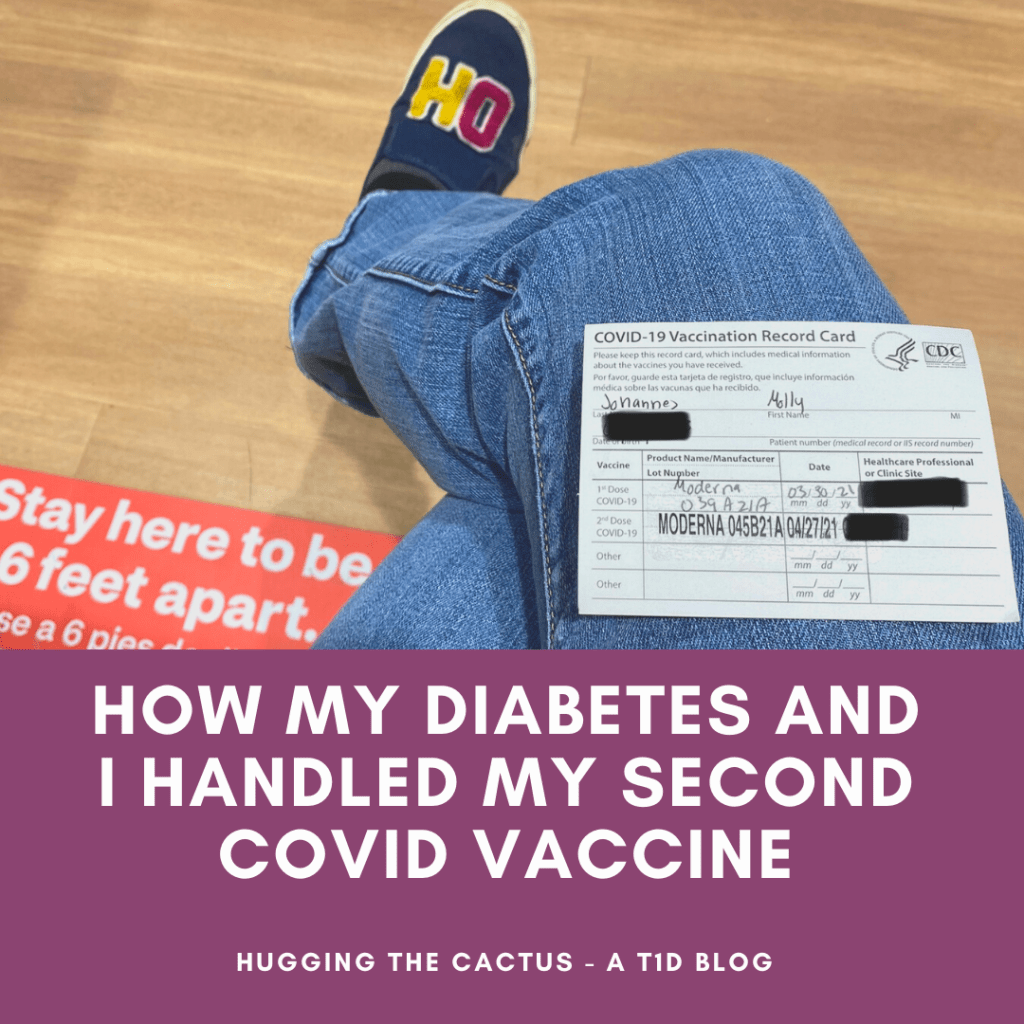
How My Diabetes and I Handled My Second COVID Vaccine

Last week, I received my second dose of the Moderna COVID-19 vaccine.

Dose number two was definitely different compared to dose number one.

Hanging out in CVS after my second dose. Don’t mind my cheeky shoe – from this angle, my footwear looks sassy, but it’s supposed to say “oh” (the other shoe says “hey”)

How so? Let me start by going over the fatigue I felt. It started to hit me around 9 P.M. on Tuesday evening, several hours after I received my shot. I just felt sleepier than I normally do at that time, and as a result, I went to bed as early as I could.

I woke up a few times in the middle of the night because of the pain that I felt radiating throughout my upper arm. I couldn’t believe how sore it felt! In fact, the site was so tender that sleeping on the left side of my body was a no-go – I didn’t want to do anything to increase the ache in my arm. Other than that, the only other disrupter to my sleep was feeling a little chillier than usual, though that was quickly fixed with the addition of another blanket.

So that was how I fared overnight. What about the morning? I slept later than usual, only rousing to turn off my alarm and drink a bottle of water (I’d heard that staying hydrated would help). I got out of bed around 10:15 A.M., only because I couldn’t sleep anymore and wanted to try to get some work done. But when I stood up for the first time, I recognized that my body was achy, like it was trying to recover from an intense workout I’d done the day before. It was nothing too terrible, but definitely noticeable.

I ate a small breakfast and logged onto my work computer, convinced that I could power through my soreness and grogginess and work the rest of the day. Boy, was I wrong. By the time I got out a meeting that went from 12:30-1:30, I was incredibly tired. Pressure had built in my head and behind my eyes to the point that they were very heavy, and I was so cold that two blankets and a cup of tea were doing nothing to warm me up. My mom (bless her) retrieved a heating pad for me which helped me get warm enough to comfortably fall asleep and take my first nap of the day.

The rest of the afternoon and evening was a cycle of waking up, trying to get out of bed, realizing I was too fatigued to do anything other than lay around, and either succumbing to more sleep or snuggling with my puppy and my parents’ dog. By the time I went to bed (for real) that night, I was starting to wonder whether I’d wake up feeling the same, or if my symptoms would subside come morning.

And guess what? I was 100% back to normal the next day! The moment I opened my eyes, I knew that I was back in commission. The only side effect I still felt was soreness in my upper arm, but even that went away about 48 hours or so after I got the shot.

The very best part (besides being fully vaccinated, of course) is that my blood sugars were not seemingly impacted by the vaccine. Maybe they ran slightly higher than usual, but I’d chalk that up to my lack of movement throughout the day rather than blame it on the shot (I wasn’t feeling well enough to go on my daily walk or do my exercise circuit; that, coupled with laying around all day, meant that I’d run a little high whether or not I’d just been vaccinated).

So yeah, I was mentally and physically tired the day after I got my vaccine, and my arm was a bit sore. Those side effects were more than worth it. Now that I’ve received both doses of the Moderna vaccine, I’ll continue to mask up and practice social distancing in public, but I’ll also now gather with fully vaccinated family members and friends to make up for lost time…and do so with far less anxiety and fear now that we’re all more protected.

28 and Feeling Great

I turn 28 years old today!

As I say farewell to 27 and welcome a new year of life, I can’t help but reflect on how different the world was this time last year.

The pandemic was in full(er) force. The new normal was just establishing itself. Each day was scary and uncertain as hopes for a vaccine any time soon were somewhat bleak.

Fast-forward to the present: As the weather gets warmer, social distancing and masking guidelines are easing. More and more people are getting vaccinated on a daily basis. While we’re far from returning to life before the pandemic, we’re definitely much closer to being able to enjoy the simple pleasures in life (such as hugging a family member or friend) with less anxiety.

So even though the milestones I met in my 27th year (buying my first home, getting my puppy, surviving heartbreak and falling in love again, to name a few) are things that I celebrate daily, I’m also really looking forward to the minutiae of the next 365 days…seeing my family and friends in-person more frequently, breaking out of the bubble (safely, of course) that is my home, going to new and old places for both familiar and unknown experiences…in other words, I’m excited to embrace the things that I took for granted pre-pandemic.

Me with one of my favorite parts of 27

I’m hoping that year 28 brings a whole lot of “great” with it: lots of love, joy, adventures, and hugs from all the people that I’ve missed hugging in the last year or so. Just like with everything else in my life, I’ll bring my diabetes along for the ride and celebrate it, too, because it just makes me appreciate all the things that make life worth living that much more.

3 Things That Make Low Blood Sugars More Tolerable

This post was originally published here on Hugging the Cactus on August 21, 2019. I’m sharing it again today because it’s the perfect little companion to Monday’s more hateful post geared towards high blood sugars.

Okay, to be TOTALLY honest, low blood sugars aren’t – and won’t ever be – fun. Nine times out of ten, they can be inconvenient, upsetting, and even scary (depending on how low it is). But like most things associated with diabetes, I try to look at the bright side every now and then to remind myself that it could be worse. So even though I don’t welcome low blood sugars in just about any circumstance, I decided to look at them, and their less-than-pleasant side effects, from another perspective. Hence, this three-item list that explains what makes low blood sugars slightly more tolerable to me.

#1: The sweat. I detest sweating. I don’t care if sweat is the result of a good workout or a day spent at the beach – it’s gross either way. And it’s definitely not an attractive low blood sugar symptom. But…on the other side…I tend to sweat a LOT when my blood sugar is low and it makes me feel like I’ve just had an excellent workout without any effort or exertion on my part. So I guess it’s kinda like gleaning the health benefits that you’d get from sitting in a sauna for a bit? IDK…it’s a bit convoluted but just agree with me on this one.

#2: The excuses. I’ve made it a personal mission to try to avoid using my diabetes as a scapegoat. There are times, though, that it really does prevent me from doing something in a timely manner/when I’m asked. For example, if I’m experiencing a low blood sugar at work and a colleague comes by to talk to me and ask me for something, I do find it’s best to let them know that I can’t attend to it right away because of the blood sugar. Nine times out of ten, people understand, and they let me treat it accordingly. And it gives me time to just relax and deal with it, taking the stress away from a situation by simply being honest about it (so I guess it isn’t really an excuse, but sometimes I feel a little guilty about using a low as an out on something. Low guilt is real, people!).

#3: The cake. (Or really any food when you’re low. Because it all tastes delicious. But nothing is quite as satisfying as cake.) I think the inspiration for this blog post came when I was enjoying a big, fat slice of cake in order to bring my blood sugar back up. My goodness, some foods just taste beyond amazing when I’m using them to treat a low. The sweeter it is, the more satisfying it is to both my taste buds and blood sugar levels. And anyone who has experienced a low blood sugar before (people with and without diabetes) can attest to the fact that food is simply a million times better when it’s being consumed at a time that your body is URGENTLY telling you to feed it.

Alright…now that I’m looking back at these three things, I’m kind of laughing at myself. Because I can TRY to make low blood sugars a more positive thing, but let’s be real, they still kind of suck. But I guess there’s no harm in trying to be upbeat about them.

How I Realized I’m Experiencing a Bout of Diabetes Burnout

Diabetes burnout is the generic term used to describe a state in which a person with diabetes becomes tired of managing it and may become neglectful of one or more aspect of diabetes care.

I say “generic term” because diabetes burnout doesn’t look the same for every person, though, so it can be tough to recognize it when it’s happening. I know this from personal experience: I’m going through a bout of diabetes burnout right now.

Diabetes burnout is just a part of having T1D.

It took me weeks to realize it, but I finally came to the conclusion that I was burnt out because several things dawned on me at once:

  • It was taking me longer to respond to CGM alarms. I would hear them going off, but I didn’t necessarily care to even look at them, let alone correct them. As a result, I let a lot of high blood sugars linger much longer than I should have, which made me feel frustrated and bad about myself for causing harm to my body.
  • I wasn’t eating healthy foods. The Easter holiday brought an abundance of chocolates and sweets into my kitchen, so instead of choosing fruits or veggies to snack on, I was going for high-carb items with zero nutritional value…and I didn’t bother bolusing for them, which of course, wreaked havoc on my blood sugar.
  • I did the bare minimum to keep my blood sugars in check. I was still bolusing for all my meals, but the snacks in between? The little desserts I’d have? The alcoholic beverages I’d enjoy? Nope, certainly wasn’t taking those into account when I took mealtime boluses.
  • I got lazy with carb counting. I kept gravitating toward bottomless bags of snacks when I did my weekly grocery store trips, even though I knew that I have no restraint when it comes to highly addictive, faux-healthy foods like Annie’s cheddar snack mix or cute little teddy graham cookies. Whenever I’d crack open a fresh box or bag, I’d dig in and wouldn’t stop digging in, going way over the recommended serving sizes and not bothering to slow down and count out my carbs.
  • I was allowing my emotions to influence my diabetes care (or lack thereof). I’m a self-professed emotional eater. That, coupled with excess stress/anxiety levels, shifted my attention away from my diabetes.

So, yeah, there’s no question that I’m in a period of diabetes burnout. Joy.

As tired as I am of taking care of my diabetes, though, it doesn’t compare to how exhausted it makes me to beat myself up over my burnout day after day.

I’ve been through burnout before. I know I’ll make it through, just like I have in the past, and I am also aware that I’m likely to experience it again in the future. And rather than come up with a super-specific action plan to conquer it, or give myself a timeline to overcome it, I’m just going to ride it out knowing that I’m trying my best each and every day, and that’s what matters most.