Switching Jobs Means Switching Health Insurance: My 4 Tips on How to Make the Transition Easier

Hi, my name is Molly and I have type 1 diabetes, and although I am extremely grateful for health insurance, I also hate every aspect of it.

When I aged out of my parents’ health insurance plan two years ago, I was completely lost and overwhelmed by choosing my new plan. How much would I have to pay for my supplies? Would everything be covered? Could I keep my doctors? How much money should I put into my FSA? The answers to these questions took me a good chunk of time to figure out, and I only started feeling good about my knowledge of my old job’s health insurance plan in the last year or so.

As a result, the only thing that made me less excited to start my new job was the burden of having to figure out a new health insurance plan. And for good reason, it turns out, because it has been a challenge to say the least. But there are a handful of things I’ve learned along the way that I don’t think I’ll ever forget so that I can have an better experience the next time I need to change health plans. Here are my tips for making the transition from one health insurance plan to another as easy as possible:

1. Take stock of ALL my supplies before starting the new job (and before losing my old job’s health coverage). This was, without a doubt, the best thing I could’ve done for myself before I started my new job. In my last few weeks with my former company, I looked through all of my diabetes supplies and inventoried them. I kept a running list of the most important items (things like insulin, Dexcom sensors/transmitters, and pods) and decided that even if I had plenty of those things, I would still place an order for them before losing my health insurance. This ended up being a fantastic idea because it took me a solid couple of weeks at my new job to figure out which health plan would work best for me, and in that span of time, my supply stash was dwindling. On top of that, it took several more weeks for me to get all my prescriptions straightened away (more on that in tip 3), so I was especially grateful that I had seriously stocked up before leaving my old job.

2. Compare plans extensively. Like I mentioned above, I spent a couple weeks reading through my plan options before I finally settled on one. It took me so long because I wanted to feel 100% comfortable with my new plan, and I knew that I had a 4-week period to complete my research before committing to a new plan. Plus, my new job uses a website that offers a health insurance plan comparison tool (a super cute one, to boot, that explains all things insurance in layman’s terms) that I was happy to take advantage of during the decision-making process.
What tips would you have for someone who is switching health insurance plans?

3. Send as many messages and make as many phone calls as it takes until everything about the new plan is crystal clear. For me, this including calling my local pharmacy and sending toooons of online messages to my doctor’s office, as well as my new health insurance provider. I honestly felt like I was playing a game of telephone – you know, that game that kids play where they have to whisper a message into each other’s ears as a test of listening and communicating effectively – because it seemed that nobody would take accountability for sending my prescriptions to the right place or understanding exactly how I needed help. So in the last few weeks of July (leading into the first few weeks of August, really, ‘cuz I’m still working on this), I made a vow to myself that I’d get to the bottom of everything and get my prescriptions fully straightened away. I’m happy to report I’ve made substantial progress, but I’d be lying if I said it didn’t require a lot of my spare time and energy.

4. Talk to coworkers and ask for their feedback on plans. This might be unique to me because I work for a diabetes organization and my colleagues have an intimate knowledge of health insurance hurdles combined with a chronic illness, but even so, I remember asking coworkers at my previous job about their thoughts on the health insurance offerings and I got some solid feedback from that. So that’s why I decided to ask around at the new job, and of course I was met with helpful replies that made my transition a little smoother.

The biggest lesson I learned throughout this process? I realized I need to give myself a little grace. This stuff isn’t intuitive to anyone (unless you’re some sort of health insurance guru). I shouldn’t beat myself up because the system is more complicated than it needs to be. And bottom line is that I need to focus on the fact that I have choice when it comes to health insurance, period, because I know that there are too many people out there who can’t say the same.

So I guess in a way I am glad for the challenges presented to me by my health coverage.
How I React to People’s Diabetes “Horror Stories”

I attended a family reunion earlier this month and got into a conversation with a relative who’s well into her 90s. She was asking me what I do for a living and I kept my explanation fairly high-level: “I work with college students who have diabetes”.

(Which, side note, I help handle the communications side of things for CDN and so far, I don’t often interact with the students…but I figured this was still a semi-correct answer that spared me from getting into the social media aspect with someone who’s probably never even heard of Instagram.)

Her response to my job description was…interesting. She started telling me the story of a “young bird” she once knew who had diabetes, needed dialysis, and then got her foot amputated. And then died.

This is a classic diabetes “horror story” that people often seem to tell when they discover that the person they’re speaking with has diabetes. It’s a story that’s told as a knee-jerk reaction: Either the person expresses their sorrow for the fact that the other person has diabetes, or they tell the tale of someone they knew who had diabetes and suffered immensely from it.

It’s a strange phenomenon, for sure, but one that happens across the board to people with diabetes.

You might be wondering…how do I react in situations like this? Is there a right or a wrong way to handle them?

Diabetes horror stories are not among my favorite kind of tales.

I chose to navigate this particular interaction by nodding sympathetically. While I truly was sorry to hear about this “young bird” and her fate, I was also very uncomfortable by the story. I’ve never felt “okay” about discussing diabetes complications because they scare the living daylights out of me, and I also was completely caught off-guard that a simple question about my job was enough to trigger the telling of this vignette. So for me, this wasn’t exactly a teaching moment in which I could correct this distant relative of mine and explain why it can be harmful to tell these horror stories; in fact, this whole incident made me realize that I don’t think I’ve ever truly reacted to a diabetes horror story when it was told to me.

And I think I’ve finally figured out the reason why…I just don’t want to engage with a person who’s going to react to my diabetes by telling me about the terrible outcome experienced by someone with diabetes who they may or may not directly know. What’s the point? What else am I supposed to say besides I’m sorry? I can’t really think of a graceful way to turn the conversation around, so for me, it’s always felt easiest to just nod, smile, say something compassionate, and then end the conversation by walking away or changing the subject completely. It’s not right or wrong, per se, but at least I know that I’m doing right by myself and my comfort levels.

This tried-and-true tactic of mine just goes to show that not every diabetes anecdote can be turned into a teachable moment – at least, not in my opinion or experience.

Diabetes in the Wild: Go-Kart Edition

Diabetes in the wild moments happen when they’re least expected.

I mean…I never go out anywhere in public assuming that I’ll run into another person with diabetes, or a person who will recognize my Dexcom sensors or OmniPods as diabetes devices. It just happens organically and it’s always a unique encounter. But given that my other most recent diabetes in the wild experience left me feeling awkward and uncomfortable, I wasn’t exactly looking forward to having another one any time soon.

But on my vacation, I did indeed have one that I’m pleased to share was much more pleasant than the last.

Yes, this is a graphic of an insulin pump taking a trip around a racetrack.

I was waiting in line for go-karts – as one does on vacation – when the woman in front of me spotted my Dexcom and asked me if I was type 1, to which I replied that I am.

This launched a short conversation about diabetes technology in general. She expressed knowledge of the OmniPod and I told her that I was wearing one, and she nodded eagerly and said how much easier it makes her life in the summertime, when she’s frequently swimming and doesn’t have to worry about disconnecting her tubing before going for a dip (a comment which I wholeheartedly agreed with). We exchanged a few more words about our diabetes devices, and before she turned her attention back to her group, she thanked me for taking the time to chat with her.

I couldn’t help but smile after the whole interaction. After all, it was kind of nice knowing that another person who just “gets” diabetes was standing inches away from me and looking forward to a carefree go-kart race, too.

How I Learned the Importance of Carb Counting

This blog post was originally published on Hugging the Cactus on April 6, 2018. I’m reposting it today because most people know that carb counting is important to a person with diabetes, but they might not understand exactly why. This post features an example that demonstrates all too well the negative implications associated with neglecting to carb count. Read on to learn how I figured out the importance of carb counting…the hard way…

One recent evening, I was rummaging through the kitchen pantry and noticed a bag of “veggie stix” stashed away, waiting to get opened. The sight of the bag instantly brought back memories of a time I was blatantly irresponsible with my carb counting and insulin dosing…

I learned the hard way that neglecting to count carbs can lead to scary high blood sugars…

…It was my junior year of college. I had plans to meet with a friend for dinner at seven o’clock. While that’s a standard suppertime for many people, it was kind of late for me. So that explains why I decided to treat myself to a snack a couple hours before it was time to go, just to hold me until I had my meal. My snack of choice? A bag of veggie stix just like these were sitting in the kitchen of my on-campus apartment. I thought I’d help myself to a few, believing (naively) that I had enough self control to know when to stop shoveling them down my gullet. That’s right, instead of doing the right thing and counting out a bunch before stowing the bag away, I was blindly consuming handful after handful without dosing for a single stick.

I can’t even use the defense that these veggie stix are strangely addicting – they really are, they taste a little like those potato sticks that used to come in cans – because I knew what I was doing wasn’t good for me. I just didn’t care. I had munched my way through half of the bag when it dawned on me that it would probably be smart to stop myself from eating more. I rolled up the bag, returned to my room, and did some homework until it was time to meet with my gal pal.

Little did I know that my blood sugar was rising to potentially dangerous levels.

I didn’t find out how high I was – over 400 mg/dL – until I reached the sandwich shop and had a plate full of chicken pesto carb-y goodness waiting to be consumed. My face must’ve shown my shock, because my friend asked me if I was alright. I quickly explained to her my mistake, and took an extra large bolus to cover my food and correct my blood sugar. Once that was done, I somehow managed to stop panicking long enough to enjoy the dinner with my friend, even though I couldn’t eat a bite of mine until an hour or so after injecting my insulin.

Although it sucked to go through this, I’m kind of glad that it happened because I learned a major lesson from it: ALWAYS count my carbs. It doesn’t matter if I WANT to be lazy or pretend that my diabetes doesn’t exist, I HAVE to hold myself accountable. It may be mentally draining and a bit of a nuisance, but it’s my own health here. It’s up to me, and me alone, to manage it.

And by the way, I did just help myself to the above bag of veggie stix. I had exactly 24 pieces, which equals exactly 5.4 grams of carbohydrates – a much smaller amount than what I ate that one night five years ago.

My Close Encounter with the Keto Diet

Remember that time that Oprah Winfrey did a Weight Watchers commercial and proclaimed loudly and proudly before the cameras that she loves bread? (If you don’t know what I’m talking about, here’s the link to the ad with a little doctoring done to it – it is worth a watch.)

Well, I can relate to Ms. Winfrey – except my obsession with carbs extends beyond bread. I love cake, candy, chocolate, pizza, pasta, sushi…and just about every other carbohydrate-laden food that exists. So while I think it’s awesome that many of my peers with T1D choose to follow low or close to no-carb diets, that’s not the kind of thing that works for a girl like me: I’m happy managing my diabetes in tandem with a moderate carb intake. But that’s not to say that I don’t eat lower carb sometimes or that I don’t have an interest in the principles of the keto diet, just because it’s so restrictive.

At least, that’s what I used to think about it.

Would my love of carbs prevent me from trying out aspects of the keto diet?

When my boyfriend decided to go on the keto diet back in May (he’s had experience with it before), I was simultaneously impressed with his dedication to it, but also a little worried. We have dinner together a few times each week and since I wanted to show him that I support him 100%, I knew that I’d have to change up my cooking so it adhered better with the dietary guidelines of keto.

So for the last two months, I’ve had a lot of exposure to the keto diet, and this is what I’ve learned about it:

  • It’s not as restrictive as I thought it would be. I figured that eating strictly keto meant that the only food groups we could eat were meats/proteins, fibrous vegetables, and cheese. That wasn’t 100% true. While we stuck to proteins and vegetables for most dinners, we also had plenty of snacks that kept things fun and interesting. I developed a mild addiction to cheese crisps and chicharrons (otherwise known as pork rinds). I also had a lot of fun trying different keto dessert options out there, including cookies, ice creams, and peanut butter cups (the latter being my absolute favorite).
  • Snacks can get expensive. One of the keto peanut butter cups that we ate cost $10 for a bag of 7. That’s an insane price. When you factor in the cost of other more expensive grocery items, like beef jerky or nuts, things add up quickly, which is definitely a downside to the keto diet.
  • My blood sugars tended to respond well when I ate keto…for the most part, anyways. Eating keto dinners was mostly great for my blood sugar and it stayed relatively steady more often than not. On the occasions it didn’t, it was because I was trying to bolus for the amount of protein or the negligible amount of carbs in the veggies I was consuming at dinner, and I would go low as a result. There’s an art to bolusing on the keto diet, for sure, but since I was half-assing it (really quarter-assing it) and not following it all the time, I never got a grip on how to account for minimal carbs.
  • Keto can inspire creativity in the kitchen. The best thing I made, ate, and loved throughout my experience with the keto diet was cauliflower crust pizza. I found the best recipe for it that was so easy to make and yielded delicious results. I always assumed that cauliflower pizza crust would be too difficult to make or not satisfying in the same way that pizza is, but that isn’t accurate at all. I grew to appreciate the challenge that keto presented me to come up with new things to eat that were tasty and filling, which I didn’t expect but liked.

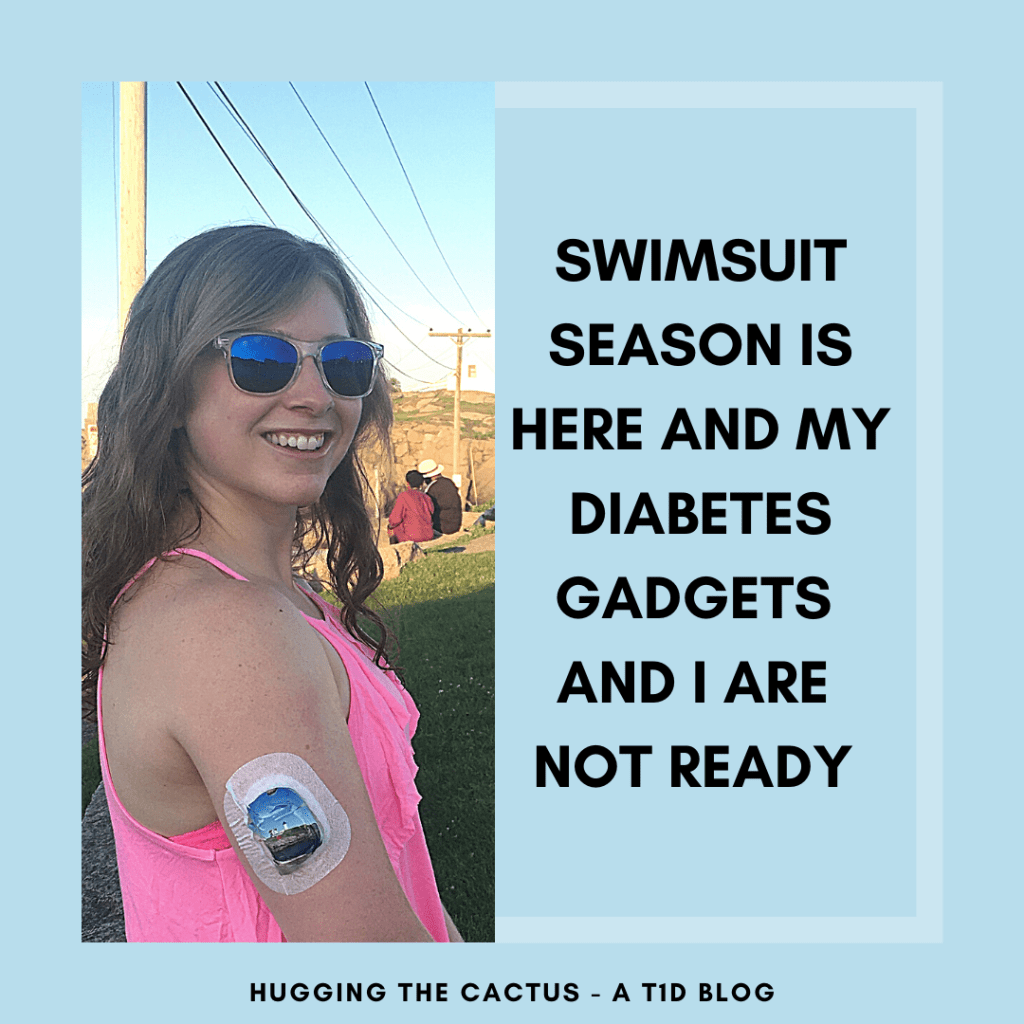
Swimsuit Season is Here and My Diabetes Gadgets and I are Not Ready

A “yay”: Summer is here!!! Hooray for warm weather, beach trips, and backyard BBQs! (Not to mention VACCINES!)

A “nay”: My pods and my CGM sensors are about to bare themselves for the world to see and we are NOT READY for it.

My confidence in my appearance is rarely, if ever, high. But I like to fake it ’til I make it and act like I’m rocking my summer wardrobe instead of stressing about how my legs or arms look in the staples of the season that are designed to show more skin.

Usually, I have a lot more success in feeling good about how my medical devices appear on my body. Whether they’re hidden under my clothes or out for the world to see, I typically don’t care because these gadgets are keeping me alive!!! And that’s a lot more important than any negative body image connotations they may create.

A picture from a time during which I was very okay with PDA (public displays of my arms).

But something about this year feels different to me. I am so not looking forward to the extra stares that my diabetes technology attracts. I’m not sure if it has to do with being sheltered in the last year and a half because of the pandemic, but whatever the cause may be, this is something I’m grappling with as the temps creep up and the temptation to hit the beach grows stronger.

I know I’m not the only one dealing with this. In fact, I was in Maine for a couple of days with my parents and I was wearing my pod on my leg, whereas my mom had hers on her arm. And we had multiple people approach us about our pods! They weren’t necessarily rude in their approaches – curiosity drove them to speak with us and that’s innocent enough – but it’s still weird to know that people are looking closely enough at our bodies to see our devices and feel comfortable enough to ask us about them. Plus, I felt extra self-conscious about it because in typical Molly fashion, I had a sunburn all around my pod thigh site…when applying sunscreen, I almost always miss the area directly around my pods because I’m afraid of the sunscreen making my adhesive weaker or interfering with the pod’s functionality. So not only did I have this big chunk of plastic sitting on my leg, it was also red all around the site, drawing even more attention to it. It was a relief when I was able to put shorts on over my swimsuit and cover up both the burn and the pod.

So while I’m not loving how wary I’ve felt lately about baring my diabetes devices, I’m also coming to terms that it’s just a sort of phase that I’m going through right now. And that’s okay. I’m also trying to remind myself that I don’t have to feel obligated to go into detailed explanations when people ask me about my pod or CGM. It’s a natural tendency that I have to use it as a teaching moment and be a good diabetes advocate, but sometimes I just don’t have the energy for it. I’m keeping my fingers crossed that as the summer season goes on, my comfortability with my diabetes devices increases and I worry less about the looks they tend to draw.

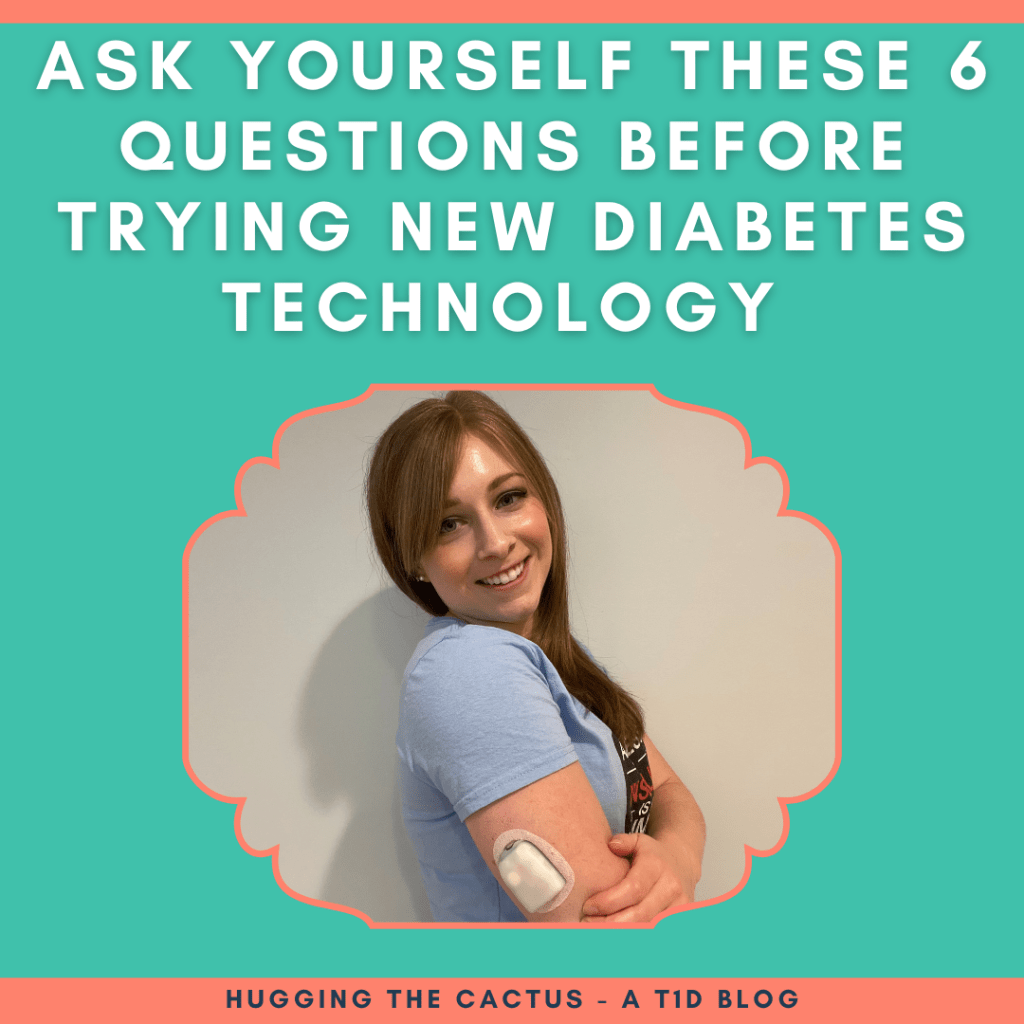
Ask Yourself These 6 Questions Before Trying New Diabetes Technology

This blog post was originally published on Hugging the Cactus on May 13, 2020. I’m sharing it again today because I think it’s super important to weigh the answers to these questions before deciding to try new diabetes technology. This is coming from someone who waited 17 years before she tried her first insulin pump, and even though it has had an enormously positive influence on my life and sometimes I wish I’d tried it sooner, I’m ultimately glad that I waited that long! Read on for more details…

So you want to try your first continuous glucose monitor. Or maybe you’re ready to leave behind multiple daily injections and switch to insulin pump therapy. Whichever diabetes device you’re looking to start using, there are some questions you’ll probably want to have answers to before decide that now’s the time to introduce new diabetes technology into your daily routine.

The following is a compilation of the questions that I thought long and hard about (literally for years) and that I wish I’d thought long and hard about before I made the transition to the OmniPod insulin pump.

1. Am I ready for it? It took me 17 years before I decided that I was ready to try an insulin pump. 17 freakin’ years!!! I spent most of that time being too afraid of introducing such a drastic change to a routine I’d had down pat for such a long period of my life. There are times when I wish I’d gone onto my insulin pump sooner, but ultimately, I’m glad that I wasn’t swayed by my family or doctors to go on it before I truly felt ready. By the time I started using my OmniPod, I had the maturity, responsibility, and emotional intelligence that I felt that I needed for an insulin pump.

2. Will I be able to afford it? Obviously, this isn’t a question that I wondered about when I was younger, but it’s one of the first things that comes to mind as an adult on her own health care plan. We all know that diabetes supplies are expensive, and it seems that the more technologically advanced something is, the more money that has to be forked over in order to obtain it. This isn’t right or fair, but it’s a simple truth and an important one to think about before choosing one pump or continuous glucose monitor over another.

3. Why do I want to start using it? I wanted to start using my OmniPod because my mom experienced great success when she started using it. And I decided to get a Dexcom CGM because I fell in love with the technology after undergoing a trial period with my endocrinologist. In both situations, I felt very much in control of my decision to start using these devices and I didn’t really listen to anyone else’s opinions. But I am very aware of the fact that social media and real-life friendships with other people with diabetes can often sway people in different directions. After all, if I saw a post on Instagram from a dia-influencer who was singing the praises of a Tandem T:slim pump, then I might seriously start thinking about switching to it (this has actually happened to me). But the bottom line is to think about the why – will this device enhance quality of life for me? Will diabetes be easier to manage with it? Will it help me achieve my A1c and/or blood sugar goals? Do I need to add something new to my routine because I’m feeling burnt out by doing things the same way all the time? Knowing why I wanted to use an OmniPod or a Dexcom CGM made me feel that much better during the whole process of learning how to use them – I felt like I had clear goals that would help me navigate the integration of these new technologies into my daily routine.

Did you know that Insulet/OmniPod has demo pods that you can wear? They don’t hold insulin or deploy a cannula, but they can give you a good sense of what it’s like to wear a pod on a daily basis!

4. Will I be comfortable wearing it 24/7? This is a big one! Pods, pumps, and CGMs are very visible, and it can be jarring to go from being “naked” to having bumps and lumps underneath clothes that can get caught on doorknobs, chairs, and the like. Personally, the benefits of my OmniPod and Dexcom outweigh something like this which is a bit superficial, but that doesn’t mean it’s not something to think about. But it’s also worth thinking about comfort and what is least painful when it comes to insulin delivery, so that’s why this is an important question to ask.

5. Do I know anyone else using it who can provide feedback from a patient’s perspective? I’ve talked about this before, but I’m not sure when, if ever, I would have seriously considered using the OmniPod if my mother hadn’t tried it first. The fact that we both have diabetes has probably made us a little closer and strengthened our bond, so if there’s anyone’s opinion that I’m going to trust when it comes to something like this, then it’s hers. I can actually remember her first few weeks on the OmniPod – in which she learned a lot of valuable lessons – and how pleased she was with it once a few months with it elapsed. She taught me the ins and outs of the OmniPod when started to use it, and I’d argue that her advice was more helpful than that of my diabetes educator. So I’d advocate gathering opinions from family and friends (if either is applicable) or the diabetes online community before going on a new diabetes device, in addition to the research component below…

6. Have I done enough research on it? …Like any smart shopper, it’s crucial to really consider all options and research them thoroughly, especially when it comes to the top contender. I definitely did not complete sufficient research before going onto the OmniPod or Dexcom; rather, I trusted that they were just right for me. If I were to switch to something else tomorrow, though, you can bet that’d I’d spend a lot of time scouring the web for every last bit of information on the device so I could make the most informed decision possible.

New diabetes technology can be both scary and exciting. But more than anything else, it can really make life with diabetes much more carefree, and I’m glad that in this day and age there are so many options available to people with diabetes that continue to be technologically impressive

What My Dog Thinks About My Diabetes

The other day, I decided to ask my puppy, Violet, what she thinks about my diabetes…

…and she just stared at me, nonplussed, because obviously she’s a dog and she can’t respond to me with anything other than tail wags, barks, or playful growls.

Violet’s expression when I asked her about my diabetes.

But really, I’ve been thinking about how much she notices my diabetes. I know that she sees my devices from time to time – and sheer curiosity causes her to poke and prod them with her nose in what I perceive to be an attempt to dislodge them from my body.

I know that she wakes up in the middle of the night when I’m experiencing a low blood sugar and have to come downstairs to correct it.

I know she watches me during every pod change, gazing up and tilting her head from side to side whenever my PDM beeps throughout the process.

I know that she gets excited when I get a box of insulin or Dexcom sensors in the mail – she’s right by my side, jumping up and down as I tear into the packages, thinking that it might be a special delivery for her.

I know she waits patiently when I have to pay more attention to my diabetes in a given moment than I can pay to her.

It’s just interesting to bunch all of these moments together and mull over the fact that she is definitely aware of my diabetes, though her understanding of what it is and why it takes up so much of my time is just as likely to be something she’s not aware of.

For her, it’s blissful ignorance.

For me, it’s blissful knowledge that my dog is seemingly patient and understanding when it comes to all diabetes matters.

I’m lucky to have her.

5 Ways Hot Weather Affects Diabetes

This blog post was originally published on Hugging the Cactus on August 6, 2018. Call it an “oldie but goodie” because the ways in which hot weather can affect diabetes haven’t changed in the last few years and they won’t be changing any time soon…and with summer just around the corner, it’s good to remind ourselves of the extra precautions we might want to take in order to combat the heat. Read on for more on the ways summer weather can affect people with diabetes…

The summer heat seems to be here to stay in Massachusetts. We’ve experienced several weeks of soupy, high-heat weather that *almost* makes me long for cooler, autumnal days…but not quite, because that just means winter (and snow – blech) is right around the corner.

Truly, I do enjoy the summertime. To me, summer is about trips to the beach, ice cream consumption (and lots of it), barbecues with family and friends, long walks in the neighborhood, and endless outdoor adventures. Aside from all of those lovely things, summer also means that it’s time to be a little more diligent when it comes to my diabetes. That’s because hot weather can play some cruel tricks on a T1D’s body. What do I mean by that? Here’s five ways diabetes can be affected by hot weather.

Mr. Sun, Sun, Mr. Golden Sun, please shine down on me (and don’t make me go low or high…)
  1. Dehydration can lead to high blood sugar. Everyone knows that it’s important to stay hydrated when it’s hot out, but it might be less common knowledge that dehydration can directly affect blood sugar. There’s a scientific explanation for this: If not properly hydrated, the body sees an increase in blood glucose concentration because blood won’t flow as easily to the kidneys, making it difficult for the kidneys to get rid of excess glucose in urine. The best way to prevent this, naturally, is to drink plenty of water and monitor blood sugars.
  2. Sunburn can drive up blood sugars. I’m very familiar with how a sunburn can result in higher blood sugars; in fact, just last week I was dealing with a particularly gnarly sunburn on my thighs and belly that not only made my numbers higher, but also really hurt. My skin was literally damaged, so the stress from the injury lead to retaliation from my blood sugar. Luckily, it only lasted about 48 hours, but those couple of days were challenging as I dealt with sticky highs that were practically resistant to insulin. And for the record, I DID apply sunscreen – numerous times – when I was at the beach. Next time, I’ll seek shade under the umbrella.
  3. Sweat can make it difficult for devices to stick. I don’t know a single medical device that’s immune to prolonged exposure to moisture/water, but that doesn’t prevent me from spending as much time as I can outdoors/at the beach/by the pool in the summer. Thank goodness for Skin-Tac wipes and medical adhesive tapes that help preserve my precious pods and sensors!“
  4. Insulin can overheat. There’s a reason why insulin vials come packaged in cartons with directions that specify what temperature insulin should stay at in order for it to be safe to use. Insulin can spoil easily when it reaches a certain temperature, so it’s important to store it in a cool place when the weather’s warm. I alternate between a mini portable cooler (that can hold 3 vials of insulin) and a pouch from FRIO – both do an excellent job at keeping my insulin cool.
  5. Low blood sugars can occur more frequently. Summertime is prime time for outdoor activities that result in higher energy expenditure. So it’s no wonder that blood sugar tends to plummet in hot weather. Looking at it on the bright side, it’s an excuse to eat even more ice cream – but it also means that monitoring how I feel and checking blood sugars often is that much more important.

Regardless of the diabetes challenges it may cause, I love summer weather, and I know I’ll miss it the moment the first snowflake falls this year.

Diabetes in the Wild: Caught-Off-Guard Edition

“Diabetes in the wild” is a phrase I first learned about several years ago from, of course, the diabetes online community.

The phrase refers to those moments when you’re out in public and suddenly, randomly, you happen to spy another person with diabetes. Perhaps their pump site gives them away, or maybe they’re doing a fingerstick check. The person could have a diabetes tattoo, or they might be doing an injection. Whatever the scenario may be, these moments can be kind of exciting because they often trigger me to think, hey, there’s someone just like me right over there – it’s like that instant knowing that this person knows better than anyone else what daily life with diabetes is like that results in an inexplicable comfort, that feeling of realizing you’re never alone. And it’s truly a powerful feeling.

More often than not, these diabetes in the wild moments also come with some level of interaction with the other person. Maybe I’ll toss a compliment their way (nice Omnipod!) or the other person might ask me a question about my diabetes devices, because they’re curious about them and considering whether or not they should try it. These interactions are almost always super polite and the awkwardness is minimal…

…but naturally, there are times when diabetes in the wild moments are not so nice and just plain weird.

Here’s the story behind my most recent, bizarre, and mildly uncomfortable diabetes in the wild experience.

This particular diabetes in the wild incident made me feel like an ogled animal at the zoo…not a pleasant feeling.

I was at the grocery store on my lunch break, taking great care to somewhat hustle up and down the aisles because I had a short window of time in which to complete my shopping. The store was pretty empty and for the most part, I was able to go from aisle to aisle without bumping into other people.

Until John and Jane (not their real names, I actually have no clue what their names are) appeared.

John and Jane were what I like to call…spatially unaware. They had zero regard for my personal space and apparently, no manners, which I deduced from the fact that I had to move my cart and my body so close to the shelves of one aisle that I was practically touching the shelves in order to make way for them as they trod down the aisle in a wide berth as opposed to walking down single-file (like I would’ve done had I been with another person).

I was mildly annoyed, but it definitely wasn’t a big deal. I continued shopping and was dimly aware of the fact that John and Jane were going down a haphazard path, ignoring the arrows on the floors of the grocery store that indicated how to navigate up and down the aisles.

As I made my way to the next aisle, I realized that they were approaching me again, and even though we were the only three people in the aisle, they got extremely close. This time I was absolutely annoyed. I couldn’t understand why they felt the need to encroach on my personal bubble like that, but it got worse when I heard Jane say to John, directly behind my back, “Look, that’s a Dexcom like Stevie wears.”

I could feel my cheeks redden as two pairs of eyes ogled at the Dexcom sensor that I was wearing on my arm. I froze, wondering if I should acknowledge the comment, but before I could do so they were both wandering away.

The incident left me confused and a little angry. I couldn’t understand why they felt the need to discuss my Dexcom right within earshot of me – really, they literally talked behind my back. They could’ve waited until they were further away from me to talk about it if they wanted to, when I couldn’t overhear them and feel uncomfortable by the whole exchange, which left me feeling like I was a caged animal at the zoo. I can’t remember a time when people had so openly stared at my Dexcom like that, and it’s a weird feeling…and it’s one thing to stare, and a whole separate issue to comment on it without addressing me directly.

I don’t know, maybe I was being overly sensitive about the whole thing, but I can’t help how it made me feel. It would’ve been a much different story had they maybe talked to me about it – I can imagine spending a couple minutes talking with them about their little Stevie and ending the exchange by telling them to take care or sharing some other pleasantry. Who knows how it could’ve been different. But one thing it taught me is that diabetes in the wild moments, as fun as they can be for me, they can also be not so great for others. I’d hate to think that I ever made anyone else feel awkward or strange about their diabetes because I called them out on it.

I think that context is key when it comes to experiencing diabetes in the wild…sometimes it’ll be totally appropriate to talk about it in public, other times not so much. We all just have to be a little more careful about determining the right contexts.