In my humble opinion (and experience), the best kind of diabetes conversation happens when it’s least expected among a group of people who are willing to listen and learn about it.
I was fortunate enough to have this exact type of conversation with my newly formed volleyball team after our first match of the season. (Side note that until then, I’d never played volleyball in my entire life. I was a ball of nerves the whole time, but I think that joining the league will have a positive impact on my mental health, social life, and diabetes, so I’m excited to see where the season takes me.) We were gathered around the table in a bar, enjoying a pitcher of beer and learning more about one another, when diabetes entered the conversation – as it almost always does, eventually, when I meet new people.
It’s not always easy to have a conversation with new people about diabetes.
We probably spent less than 10 minutes on the subject of diabetes, but the whole time we did talk about, I felt extremely thankful to be surrounded by people who asked thoughtful questions, demonstrated curiosity to learn more, and made a pointed effort to ensure my comfort throughout the whole conversation. The energy that the group was emitting made me feel good as I shared my experiences and showed them my Dexcom and Omnipod devices, the latter of which isn’t always easy to do around new people because I can be a little self-conscious of how they appear on my body. But it felt natural to be open and upfront about all things diabetes, as I’ve experienced it, because everyone genuinely cared to learn more.
That’s what made it such a lovely conversation; in turn, it will also serve as a great reminder to me that telling new people about diabetes doesn’t always have to be an intimidating or stressful ordeal.
Turns out, living with type 1 diabetes means that I’m testing a whole lot more than just my blood sugar levels…
…I’m testing my memory, too – and rather frequently.
As a person with T1D, it’s on me to remember to do basic things like bolus for meals, be prepared with back-up supplies at all times, get prescriptions filled before I run out of anything, and so much more. More often than not, I pass these memory tests.
But naturally, I’m bound to fail one every now and then.
Case in point: I forgot where I left my PDM the other day. I had prepared my dinner and went to take a bolus for it when I realized that I couldn’t remember when or where I last saw it.
When the “Find my PDM” feature fails, there’s nothing to fall back on other than memory…and maybe a bit of luck, as well.
It was an infuriating scenario. I knew it was somewhere in my home. I hadn’t left the house all day, other than to take my dog outside to do her business. I spent the better part of a half hour wandering up and down the stairs, searching with an increased sense of franticness, for my PDM. The urgency to locate it only heightened when I tried to use the “Find my PDM” feature on the Omnipod Display app and it wouldn’t work. That was a first – up until this day, I’d always been able to use it to track down my PDM when I’d misplaced it. It showed no indication that it was going to suddenly start working again any time soon, so I gave up and was forced to retrace my steps in order to find my PDM…which was going to be difficult considering in the middle of my search, my Dexcom went off, alerting me to an impending low blood sugar.
Think, think, think…I could practically feel the wheels turning in my head as I tried to recall where I last saw my PDM. I’d bolused for lunch earlier in the day, most definitely. That much I knew. I had eaten lunch downstairs, so I surmised that I brought my PDM upstairs with me when I was done so I could have it nearby as I continued on with my workday.
I looked high and low, all around my bedroom, without success. That’s when it dawned on me that there was a slim chance that my PDM fell outside of my pocket when I took my dog out just before I’d made my dinner. So I ventured outside, sweat starting to bead on my forehead as I grew shakier from my low blood sugar. I scoured the parking lot and the lawn for my PDM and no dice. That was when I decided to head back inside, drink a juice box, and take a moment to really contemplate the time and place I last saw my PDM.
That’s when it hit me – it had to be on my bedroom floor, next to my bed, because I suddenly remembered how it had accidentally slipped off my bed when I’d placed it there after lunch! I raced back upstairs, feeling triumphant and relieved when I saw the PDM in that precise spot and could confirm that my memory had finally served me correctly.
Now, this might sound like some silly, random anecdote about how I had a forgetful moment. But to me, it actually demonstrates just how much a person with diabetes needs to remember to do on a daily basis. It’s so much more than the finger stick pokes or insulin injections – it’s a lot of accountability. It shows that diabetes tests a whole heck of a lot more than blood sugar…it tests patience, responsibility, and yes, in this particular situation, memory. This is why I think people with diabetes deserve recognition for dealing with these daily, innumerable tests as gracefully as we can.
A woman enrolled in the self-defense class that I took this month approached me, remarking on our shared condition, with a knowing look on her face. She glanced down at my pod, which I had marked with red duct tape to signal to others that this area of my body couldn’t engage in some of the movements that we’d be asked to do.
Diabetes in the wild moments happen when they’re least expect – I certainly didn’t anticipate this interaction when decked out in protective gear!
I smiled widely at her and we launched into a brief, but friendly and supportive conversation about diabetes in which we covered everything from devices to years lived with diabetes. We spoke for a few minutes before we wished one another well and parted ways.
Diabetes in the wild encounters are always interesting because they either spark instant camaraderie or, on the complete flipside, a flurry of ignorant questions/comments that prove to me just how much diabetes stigma is still alive.
Encounters like this one, fortunately, fall in the former category.
It’s just nice to know sometimes that I’m not alone, even in the most random of circumstances. That I don’t have to explain myself, or the nature of my fragile pod, to a person who actually understands why it needed to be protected. That I have someone who totally gets why I was in a panic the week before when I didn’t have a functioning CGM or my meter as a back-up when my blood sugar went low.
It’s a form of support that might not last more than 5 minutes or so, but still has a meaningful impact on me and my diabetes.
Carbohydrates. Insulin intake. Exercise. These are things that most obviously impact blood sugar levels. But things like sleep, time of day, medication interactions, environmental changes, and yes, stress, might be more surprising factors that can wreak havoc on blood sugar in much stealthier ways.
Stress, in particular, is the one that’s been driving me (and my blood sugars) up the wall lately.
Truth be told, I’ve invited most of this stress into my life by committing to one (or seven) too many things this month. My calendar is positively overflowing with meeting invitations, hangouts, classes, and appointments, making the one or two evenings a week that I have to myself feel incredibly precious. Honestly, I kinda knew what I was doing when I flooded my schedule with so much because a significant part of me thrives under pressure and needs to stay busy. This is the same part of me that misses working full-time in an office because it broke up my otherwise fairly mundane routine; ergo, I felt justified in amping up my recent social activity.
Yet, there is another (smaller but still powerful) part of me that wishes I knew when to say “enough is enough”.
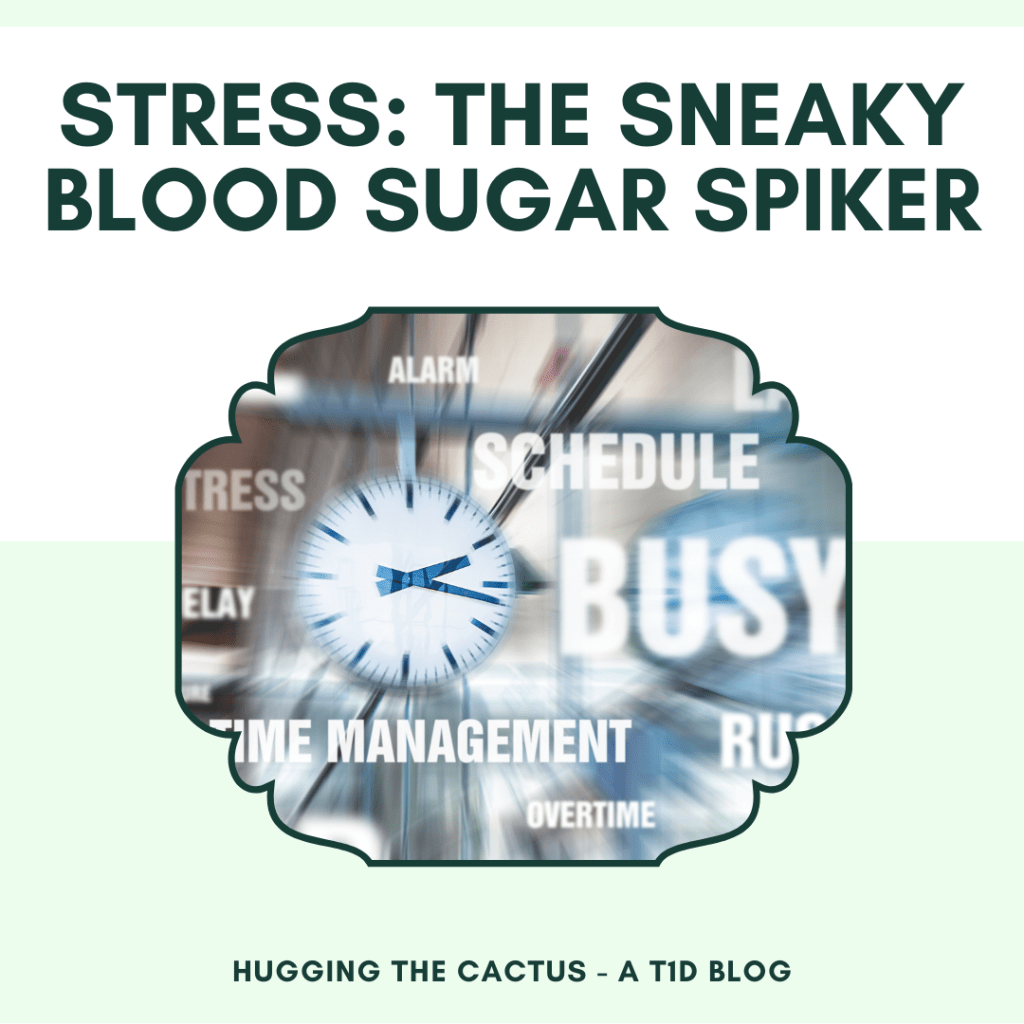
This image sums up the month of March perfectly for me: a bit of a time warp.
And now, that smaller part of me is standing with her hands on her hips, looking at the busy bee part of me defiantly, and saying “well, what did you expect?” in regards to the stressed-out feeling I haven’t been able to shake lately, as well as the high blood sugar levels that have been a direct result of that.
I’ve been doing everything I can to combat them – increasing my temp basal rate, lowering my carb intake, staying hydrated, getting daily exercise, and taking (nearly) double mealtime insulin doses at times. Some of these things have worked better than others, but as I sit here and write this post, I’m wondering if taking time to actively destress, in addition to prioritizing sleep, are the missing pieces in the puzzle.
Between jetting off from one thing to the next, I’ve barely had enough time to breathe, let alone practice self-care such as meditation or just…sitting on the couch and just being. And I’ve definitely not been getting as much sleep as I should. My teenage tendency to stay up late has collided with my adult habit of getting up early, which is an unpleasant combination.
So I’m thinking that the best way to evade stress, the sneaky blood sugar spiker, is to tackle it head on by addressing my lack of sleep and self-care. I know that my diabetes, and the rest of my body, will thank me once I take the chance to slow down.
This was originally published on Hugging the Cactus on January 6, 2021. I’m sharing it again today because there seems to be a lot of stigma about people with diabetes who live alone. I wrote this post because I wanted to reassure other people who live with diabetes and who might be nervous about living alone. I was definitely scared when I moved out of my parents’ home for good, but I’ve learned lessons along the way that really helped me become comfortable with it and enjoy it more. Read on for my perspective…
For the first time in my entire life, I’m living alone. (Well, I have my puppy Violet to keep me company, but no other humans.)
The prospect of living by myself always freaked me out a little bit, mainly because of the fears I have about diabetes and the “what ifs”: What if my blood sugar goes too low and I can’t get help? What if I’m sick or spilling ketones and need someone to assist me? What if “something bad” (pick any bad scenario here that you can think of) happens, and because I live alone, I can’t take care of myself?
With these questions lurking in the back of my mind, I decided to do something about my worries. I moved into my new place a couple of months ago and since then, I’ve come up with some strategies on how to manage my concerns about living alone with diabetes that have provided both peace of mind and confidence in my ability to thrive in my new home.
Tip #1: Utilize the Dexcom Share feature. This is the best thing that I have done since moving out of my parents’ home. I had a conversation with them after a particularly frightening middle-of-the-night low, and we all agreed that it would be wise for me to invite my dad to follow my blood sugars using Dexcom Share. My favorite part about this arrangement is that my dad and I discussed what we were both comfortable with in terms of data sharing – we decided that it wasn’t necessary for him to view my blood sugar graph at all times, but that he should get alerted when I’m below 50 or above 400. It makes me feel so much safer knowing that he will know if and when those situations should happen, and that he will be able to help me (albeit, from a slight distance) if I can’t help myself.
Tip #2: Keep low snacks all over the place. I keep low snacks on every floor of my condo (the main floor, upstairs, and in my basement) and right next to my bed on my nightstand. It might seem like overkill to have juice boxes, gummy snacks, and glucose tablets all over the place, but the point of that is I never know when a bad low blood sugar will strike, and it’s much easier to walk a few steps to get a low treatment than to walk up or down a set of stairs. I’m able to treat lows very quickly using this method, and since my fear of low blood sugars is one of my biggest concerns about living alone, this helps me make sure that I can handle them efficiently when they occur.
A bonus tip: Get a dog! Violet helps me manage loneliness and has a (mostly) positive impact on my mental health (I say “mostly” because my pup can be naughty).
Tip #3: Stay organized. It might sound strange that staying organized is a big help when it comes to living alone with diabetes, but I’ve found that it ensures that I’m able to access any of my supplies within seconds, if needed. I don’t have to rifle through drawers or cabinets to find out how many pods I have left, I simply have to walk into my bedroom closet and look at my shelf to see. I also have all of my medical paperwork – receipts, prescriptions, health plan information, etc. – stashed away in a clearly labeled folder in the filing cabinet by my desk, which again makes my life much easier when I need to find particular documentation at a moment’s notice.
Tip #4: Have emergency contacts identified and readily available. Nobody likes to think about something bad happening…least of all me. But I give myself peace of mind by having emergency contacts labeled in my iPhone using the Medical ID feature. If I needed to call one of them, it would simply take the push of a button (and a quick swipe).
Tip #5: Seek support over social media. When in doubt, I’ve had great success turning to my different social media platforms and chatting with others about issues surrounding living alone. Whether I add a story to my IG profile or send out a tweet when I have blood sugar concerns, I know that the diabetes online community will respond with guidance and insight to help me through whatever issue I may be experiencing. There’s something extraordinarily comforting about knowing that even though I’m living alone, I’m never truly alone because of the support I have.
I’m in an interesting phase of my life right now where I don’t like to say no to most things.
I think this has a lot to do with the fact that I’ve let fear and anxiety hold me back in many different areas. But if there’s anything I’ve learned as I’ve gotten older, it’s that life is too short to not jump at opportunities when they’re presented to me and to do my best to abandon my assumptions before deciding how I feel about something.
So when my boyfriend asked me if I wanted to go snowboarding with him last month, I enthusiastically said yes. I’ve never been a winter sports person, per se, but I’ve definitely spent too many weekends in the last couple of months cooped up indoors – so spending an afternoon outside at a nearby ski resort trying something completely new sounded like an awesome way to beat winter blues.
I should’ve expected it would also be a literal crash course in snowboarding with diabetes! Literal in more ways than one, because I fell…a LOT. Like, so many times that I lost count. But I was also learning how to navigate a brand-new physical activity with diabetes, which can be daunting. I handled it by preparing as best as I could, and practiced these tips and tricks that worked wonderfully for me when I hit the slopes:
#1: Set a temp basal. In the days leading up to snowboarding, I did a little research online to see what kind of tips other people with diabetes had to share about what to expect when snowboarding with diabetes. The most interesting piece of advice that I found and wound up taking was setting a temp basal with my pump. The physical activity of snowboarding, combined with the mountain’s higher altitude, meant that my insulin could be absorbed in my system at a more rapid pace. So I reduced the amount of basal insulin by about a third for a few hours, which worked out great because I didn’t have to worry about impending low blood sugars and could instead focus on trying to glide effortlessly across the snow like all the other skiers and snowboarders (I had little success in that, but that’s besides the point).
#2: Wear ALL the layers. The night before the snowboarding trip, I laid out all of the clothes that I would layer on the next day. I had thermal pants and a thermal undershirt that I wore for layer 1. I wore jeans and a sweatshirt for layer 2, followed by a fleece zip-up for layer 3. Before heading out onto the slopes, I put on my snow pants, winter jacket, waterproof gloves, snowboard boots, scarf, hat, helmet, and goggles…and yes, even though I resembled the Michelin man with all that clothing on, it was worth it because I didn’t feel the sting of the cold not even once. Plus, my diabetes devices, snacks, and other personal items were extra protected under all those layers, which gave me a sense of security throughout the day.
#3: Protect diabetes technology. This was my main concern for the day. I’ve heard horror stories about PDMs falling victim to particularly nasty skiing and snowboarding collisions. I refused to run the risk of smashing my screen by protecting it as best as I could. So I brought an extra sock with me that I used as a pouch for both my PDM and my cell phone. Once they were safely nestled in the sock, I placed it into a plastic baggie, which served as an extra layer of protection that was waterproof. I then put the plastic baggie into the pocket of the fleece I was wearing under my snow pants and zipped up the aforementioned pocket so there were zero chances of anything falling out of it. It was probably a little extreme in terms of protection, but my devices stayed completely dry and intact (despite the many, many falls I experienced over the course of the afternoon), and that was what mattered most to me!
If Shaun White (the pro snowboarder) is known as the Flying Tomato on the slopes, I want to be known as the Rainbow Wonder – I loved rocking my bright snowboarding accessories on the mountain!
#4: Be smart about packing snacks. I knew I would be limited in terms of what I could carry up and down the mountain – it’s not like I could safely snowboard with my purse or backpack strapped onto me (that would’ve added extra weight that would’ve made me even more wobbly on my board) – so my many pockets definitely came in handy and helped ensure that I had plenty of snacks stashed on me at all times. In addition, I chose to pack things like glucose tablets and granola bars because they were more likely to hold up in the cold weather/not freeze like a packet of honey or a juice box might.
#5: Stay hydrated. I think what surprised me more than anything else was how thirsty I felt after only about an hour of attempting to snowboard. In hindsight, though, it made sense – I was outside in the dry wintry air and trying to partake in fairly strenuous exercise, so of course I would be thirsty. Since I couldn’t carry around a water bottle with me, I made sure that any bathroom breaks that I took at the lodge also included trips to the water fountain – a strategy that kept me well hydrated out on the bunny slope.
#6: Monitor, monitor, monitor. I must’ve pulled out my phone to check my Dexcom graph a dozen different times over the course of the 4-5 hours we were snowboarding. That might sound like a bit much, but I had no idea what to expect in terms of the impact of snowboarding on my blood sugar. Watching my levels like a hawk helped me determine how much to eat at lunchtime, what kind of temp basal I should set, and how long I could stay committed to the activity before having to stop to treat a high or a low blood sugar. I felt extra grateful for my Dexcom on this day, because it would’ve been a pain and very inconvenient to check my blood sugar with a finger prick that many times.
Even though I wasn’t quite as badass as I wanted to be on the slopes (more like bruised-ass), I’m still really happy that I gave it a try and proved to myself that this is yet another thing that diabetes can’t stop me from enjoying. I look forward to my next attempt, which will hopefully include similar diabetes-related success as well as a lesson or two from an experienced instructor – because goodness knows I could benefit from that!
Dungeons, dragons, and diabetes…one of these things is NOT like the other! And add “drams” into that mix, and you’re likely very confused and wondering what kind of bizarre, alliterated laundry list this is supposed to be – and why on earth I’m talking about it here on Hugging the Cactus.
Well, let me start by saying that one of the hobbies that I started to explore in the early pandemic days is Dungeons and Dragons! Yup, the fantasy role-playing game that’s been a staple of pop culture nerd-dom since the mid-70s. One day in Fall 2020, my boyfriend (who is extremely well-versed in DnD) invited me to play with a small group of his friends. I agreed to give it a try, though I admit that I went into it knowing nothing about it other than what I’d seen on the television show Stranger Things – which, quite frankly, is a highly stereotypical depiction of how a DnD campaign is run that resulted in me thinking that DnD was super limited in terms of gameplay.
Very quickly, every assumption that I had about DnD, who plays it, and how it works was shattered.
Over the course of the last year and a half or so, I’ve been involved in a handful of different DnD campaigns. All of these campaigns have varied drastically in terms of storyline, characters, and players, and to me, that’s the most exciting part about the game. Besides its ever-changing nature, I also enjoy that DnD allows me to explore my imagination – I get to come up with the entire backstory for original characters, and the creative writer within me is thrilled to be stretching those storytelling muscles that I’d long thought were atrophied.
But the best part of DnD, for me anyways, is how it’s brought me closer to friends and strangers alike. DnD has been a great way to meet new friends for the first time, as it’s something we can automatically talk about and refer to whether or not we’re actively playing a game. It has also strengthened my friendships with some of my coworkers from my last job who, like me, were newbies to DnD but willing to learn how to play during the pandemic because all of us generally like games and fantasy realms, and we were happy to have something to do virtually that wasn’t just another boring Zoom session.
And I can’t neglect to mention that DnD has been a wonderful escape from the reality of our world in the last couple of years. In DnD, the horrors going on in the real world don’t exist (unless you want them to, but nobody’s dared to do that in any of the games I’ve played). This means DnD is a nice mental break from not just the soul-sucking 24/7 news cycle, but it’s also a temporary vacation from diabetes. Any character that I’ve played in a campaign doesn’t have to worry about checking blood sugar or taking insulin injections before slaying bugbears, displacer beasts, or flameskulls. It might seem like an unconventional way to find reprieve from diabetes, but it’s a challenge to find something that can get me to stop thinking about my diabetes for even a short window of time. This is one thing that works for me and that makes me grateful for it.
So, coming full circle here and getting to the point of this blog post: I am participating in a new DnD campaign called Dungeons and Drams! The game runner (called the Dungeon Master) is actually an aforementioned former coworker and good friend of mine who delved deep into the DnD universe over the course of the pandemic. He’s combining his knowledge of the game with his extensive YouTube experience as a whiskey reviewer (hence the “drams” element to our game) to create the ultimate campaign that I’m honored to be part of. I’m joined by a few of his fellow whiskey YouTubers and I’ve got to say (shoving my obvious bias to the side here), the characters we’ve created are a thrilling combination of hilarious, badass, adventurous, and entertaining…so whether you’re a fan of DnD and/or drams of whiskeys, and the diabetes-related content that I feature here on Hugging the Cactus, you’re going to want to check this game and our channel out.
The adventure begins tonight, March 14, 2022 at 9:30 P.M. ET…looking forward to seeing you there.
This blog post was originally published on June 12, 2019 on Hugging the Cactus. I’m sharing it again today because when you live with T1D, it’s inevitable that you’ll attract stares – and sometimes questions you’d rather not answer – from people who are befuddled by your diabetes gadgets and gizmos. This one encounter in particular is a great reminder that not all oglers have ill intent…read on for more.
“Yo, I don’t mean to be rude, but what’s that thing on your arm? Looks pretty cool.”
I turned around to face the stranger who was looking at me and asking me this question. It was well after midnight and we were on the rooftop of a fairly crowded bar. It was a balmy, summery night and I was enjoying the atmosphere with my boyfriend and my best friend. I’d had a few drinks over the course of the night, but judging by the state of everyone else on the rooftop, I was probably more sober than most of them.
That “thing” on my arm is basically my pancreas – please don’t stare at it, bro.
I could’ve answered his question in a scolding manner; it wasn’t a “thing”, it was a device that keeps me alive.
I could’ve totally dismissed him and told him to mind his own beeswax, because really, it is sort of rude to point out something on another person’s body.
I could’ve lied and told him it was something that it’s not to get him to stop bothering me.
I could’ve launched into an educational breakdown of what an insulin pump is and why my OmniPod looks the way it does.
I could’ve done any number of things, but instead I decided to say, “Oh, this is my insulin pump. I’ve got it decorated right now with a picture of a lighthouse because I like adding some style to it.” I smiled at him as a way of reassuring him that I really didn’t care that he was asking me, because I didn’t.
My straightforward answer seemed to please this random man. He told me again that he thought it was cool, and then we chatted a bit about where the lighthouse is and discovered we both have a connection to Massachusetts. Within a few brief moments, the conversation was over as we went our separate ways.
It was a perfectly harmless interaction that could’ve went a number of different ways, but to me, it’s all about context. This guy was just asking out of curiosity, and I truly don’t think he was trying to be rude about it. So I answered his question succinctly but good-naturedly, because I felt that was the only way to go about it in this busy party environment. Plus, let’s be real here…had I delved into a discussion about diabetes and devices, this drunk man probably wouldn’t have digested a single detail of my description. (Ahh, I love alliteration.) And another important point? He was damn right, my pump did look cool because of the lighthouse sticker!
But man, how much simpler it’d’ve been if I’d just been wearing my “THIS IS MY INSULIN PUMP” sticker on my pod that night.
“Get comfortable being uncomfortable” is a phrase I first grew familiar with when I developed a more serious workout regimen a few years ago.
My daily exercise usually consists of walking my dog, then spending 30-45 minutes completing a workout video of some sort. While these workouts vary in terms of exercise type, one thing remains consistent among them all…and that is the ferocity of the trainers, who besides showing me proper form and technique, also do their part by shouting motivational phrases as I sweat.
“It doesn’t get easier, you just get stronger!”, “You don’t wish for it, you have to work for it!”, and of course, part of the title of this blog post…”Get comfortable being uncomfortable!”
During a particularly challenging workout, that saying stuck out to me. Suddenly, it was dawning on me that this was an extremely good way of summing up life with diabetes. After all, nobody asks for diabetes to happen to them – it just does, and it’s up to people with diabetes and their care teams (loved ones, healthcare providers, and so forth) to accept it and adapt to it.
Life with diabetes is sort of like walking barefoot on rocks…adapting to and getting comfortable with being uncomfortable.
And let’s be real here: There’s nothing comfortable about diabetes. In fact, there’s a lot of uncomfortable things about it. Constant pokes and prods from sharp needles, interrupted nights of sleep, gadgets that alarm at inopportune and sometimes awkward times…and these are just a few of the things that keep me and other people living with diabetes walking on a tightrope at times.
Despite the often-disagreeable ways of diabetes, it’s important that those of us who live with it find comfort in embracing it for what it is. We can’t change diabetes itself, but we do have the power to change how we perceive life with it. So while diabetes has the ability to make me physically uncomfortable (and frustrated, sad, annoyed, anxious…a whole laundry list of emotions), it’s on me to get comfortable with these feelings and live my best life in spite of them. And like exercise, though it can be an exhausting, challenging, and the very last thing I might want to do sometimes, it’s also something that benefits my body and mind in the moment and in the long run. Why not think about diabetes in the same way, or even move past comfortability with it and into embracing it?
At this point in my diabetes journey, I think I’m mostly there…and therefore happy to say that I am comfortable being uncomfortable.
This post was originally published on Hugging the Cactus on June 5, 2020. I’m sharing it again today because I’ve had myfair share of moments lately in which I’ve genuinely felt like ripping out my hair (or punching the wall) over my diabetes! Read on and find out if you agree with this list – and leave a comment to let me know what you’d add!
Life with diabetes can be the opposite of a cakewalk. In fact, it can be so frustrating at times that I seriously consider ripping my hair out due to sheer agitation.
When thinking about the things that drive me nuts about diabetes, I came up with a list of 8 occasions in which I come this CLOSE to losing my freakin’ marbles:
1. When low blood sugars refuse to come up…
2. …And when high blood sugars refuse to come back down.
I’m considering these first two as separate list items because the scariness of a lingering low and the frustrating nature of a stubborn high can be two very different types of “GAAAAAAAAHHHH!” But both can be especially suck-y when you feel and know that you’ve been doing everything right to treat them without experiencing the expected results.
3. Pod and CGM sensor failures.
Oooh, any sort of device failure can be so exasperating any time of day. But they’re worse when they happen at inconvenient times, such as in the middle of the night or during an important conference call. All diabetes technology should work flawlessly at all times, but that’s not always the reality that we live in.
4. Inaccurate results.
I can’t stand when my blood sugar meter or my CGM report false readings. Sometimes, I’ll check my blood sugar two times in a row just to see how close both readings are to one another, and it makes me want to throw my meter across the room when I see that they’re off by 20+ points. Once, I had a reading that was off by more than 50 points! That makes a major difference in how much insulin I give myself in that moment in time, so inaccurate results can really derail my blood sugars for hours after.
When I first found this illustration, I could’ve sworn the lady was flipping the bird…which would also be an accurate depiction of what these 8 things make me feel like doing!
5. Folds in the adhesive.
Whenever I apply a fresh sensor or a pod, I try to be super careful and make sure that the adhesive sticks smoothly…but despite my best efforts, that doesn’t always happen. Folds in the adhesive are far from the worst thing in the world, but they do make it more difficult for my devices to stick on for the full length of time that I need to wear them, and I usually end up having to add tape around them to reinforce the hold. More tape = more folds = more irritation!!!
6. Unexplained blood sugars.
Anyone with diabetes has been there, done that. You could follow the exact same routine from one day to the next, even eating the same foods at the same times, and get totally different blood sugar results. Or maybe you thought that you bolused perfectly for a meal, only to find out hours later that you’re much higher or lower than you anticipated. Whatever the reason behind them may be, unexplained blood sugars are just obnoxious.
7. Screeching alarms.
Speaking of things that are obnoxious, let’s talk about wailing OmniPod or Dexcom alarms for a hot second. There’s nothing like a resounding BEEEEEEEEEEEEEEEEEEEP to ruin your day!
8. The INSANE costs of our supplies.
Undoubtedly, the thing that most makes me want to rip my hair out when it comes to diabetes is the cost of supplies. I’ve blogged more and more recently about the criminal cost of insulin – since the 1990s, the cost of insulin has increased over 1,200% (!!!) – and I’ll continue to do so until EVERYONE with diabetes can afford this life-saving medication. We never asked for diabetes to happen to us. But it did. And the fact that many people with diabetes have to make sacrifices in order to, well, survive, is simply not okay, and the most infuriating thing about living with this chronic illness.










 Hugging the Cactus