Shout-out to Diabetes Social Media Advocacy (DSMA) for prompting me to write a post about this!
Often, I tell people that anything can affect diabetes. Factors like exercise and stress may seem obvious, but more subtle variables include the weather.
The winter season began less than a month ago, but it’s already been a brutal one for much of the country. In New England, we’ve had more than a foot of snow, subzero temperatures, bitter wind chill, and a surplus of ice glazing over all outdoor surfaces.
Winter weather looks pretty, but it sure can be a pain in the ass.
Besides being unpleasant to experience, harsh cold weather like this also has a bit of a negative impact on my diabetes. How? There’s a few different ways.
Cold weather limits (or increases) the types of physical activity I can do. Snowstorms make it difficult to travel, so more often than not, I’m stuck at home during wintry weather events. This means I get less movement in, which has an adverse affect on my blood sugars. I rely on getting a certain level of exercise daily, so I have to be creative when it’s snowing in order to meet these requirements. On the flip side, depending on how much snow falls, I need to shovel the driveway. This is a highly strenuous activity that can make my blood sugar drop in 15 minutes or less. As a result, I’ve got to be careful and plan accordingly when a blizzard is in the forecast.
Cold weather impacts the foods I consume. Let’s be real, when it’s freezing outside and you can’t go anywhere, healthy eating isn’t really a priority. Nothing is as comforting as a home cooked meal, whether it’s chili or chicken pot pie. And a hot chocolate is a wonderful pick-me-up post-shoveling. But the problem is these foods are heavy, rich, and laden with carbs. I have to work harder in the cold weather to attain balance with my eating and resist the temptation to fill up on starchy, satisfying food.
Cold weather affects my insulin intake. This ties into the aforementioned points, because if I’m moving less and eating more, then I naturally need to compensate for this with higher insulin dosages. I get frustrated, because it seems like I have to deal with more high blood sugars this time of year. But I know if I keep these factors in mind, it’ll help keep the highs at bay and prevent me from under-dosing.
Cold weather can sway my mood. The winter blues is a real feeling this time of year. It’s much harder to feel motivated to keep up with exercise routines or other healthy habits when the weather’s got me stranded at home. I combat it by staying busy and keeping a routine as much as I can. And when I fall off the wagon, I acknowledge that it’s okay, dust myself off, and get right back on it.
Even though cold weather brings additional challenges with it, the season is fleeting. Before I know it, spring will be here along with better blood sugar.
Diabetes in the wild refers to a random encounter with another T1D when out and about. My favorite recent occurrence of this happened when I was in Disney World with my mom (also a T1D). We had just entered Animal Kingdom. I was sporting my pod on the back of my upper arm.
I don’t think Timon noticed my pod, but another T1D in the park sure did!
“Hey, Podder!” I heard someone yell. For a split second, I thought someone was saying, “hey, Potter,” you know, like the Harry Potter kind of Potter.
I looked around and saw a girl a few years younger than me waving her arms in my direction. When we made eye contact, she smiled and pointed at her pod. I gave her a thumbs up and the moment was over as quickly as it happened.
But it puts a smile on my face when I think about it, because it goes to show how awesome these chance meetings are – they serve as little reminders that even when I may feel like the odd duck in a crowd due to my pod, I’m not as alone as I think I am when it comes to diabetes.
Diabetes evokes curiosity for those who are not familiar with it. I’ve been asked many questions over the years – can you eat sweets, does it hurt when you give yourself shots, do you have to protect your pump from water, just to name a few – all relatively easy-to-answer, yes-or-no questions. But every now and then, someone will ask harder questions. And one that I’ve struggled to answer in a succinct manner is: What does it feel like to have low blood sugar?
There isn’t really a simple answer. I guess my textbook response is to rattle off a list of common hypoglycemic symptoms: shakiness, dizziness, sweating, slurred speech, weakness. But I know that other PWD experience slightly different symptoms, such as feeling cold instead of sweaty, or drastic changes in personality. And there are even some PWD who don’t experience any symptoms due to hypoglycemia unawareness.
So how exactly do I response to a question like that, one that’s more loaded than it appears?
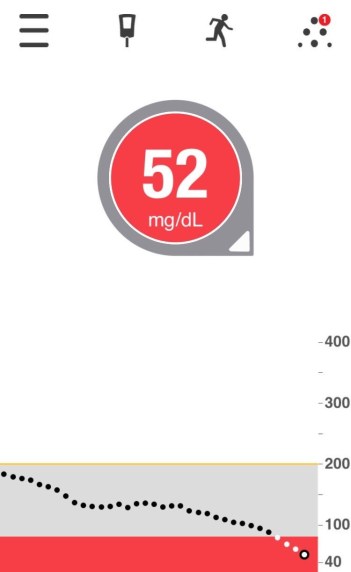
A graphical representation of a sudden low – I guarantee I was not feeling great when this one hit.
I could tell the asker to imagine feeling simultaneously ravenous and disoriented. I could tell them to picture walking into the kitchen and feeling like inhaling the entire contents of the pantry – that’s how intensely your body craves sugar.
I could tell them to think about what it’s like to wake up in the middle of the night drenched in sweat. It might seem like a reaction to a nightmare, but it’s the body trying to convey a message that is, by some miracle, supposed to be grasped by someone who was just trying to get a solid night’s sleep.
I could tell them to envision feeling like energy is sapped out of every pore in the body abruptly, with little warning.
I could tell them that sometimes, it results in pure panic, particularly when no fast-acting carbohydrates are on hand or when no one is around to help you.
I could tell them that low blood sugar is one of the biggest sources of anxiety for many PWD, that it causes a deeply rooted fear. That it can sometimes lead to a PWD making unhealthy choices just to avoid a low from happening in the first place.
I could say all of this to anyone who asked me this question – and I still don’t think it would completely convey what it’s like to have low blood sugar.
How would you describe it to someone asking you about it? Would you use the terse medical explanation, or would you try to talk about how it really feels?
Leave your responses in the comments – I’d like to know how you handle this. And if you thought this was an interesting post, let me know. I’m thinking of doing a series about how I answer the more complicated diabetes-related questions I’m asked.
Merry Christmas, dear reader! I hope you enjoyed a wonderful holiday yesterday. Thank you for your continued support of my blog. I’m looking forward to continue writing in the new year! Enjoy this new blog post about my favorite food weakness this time of year.
Hi, my name is Molly, and I have an addiction to cookies.
Not just any kind of cookies, though – Christmas cookies, to be exact. I think my obsession with them truly took shape when I was in eighth grade. That’s when my aunts, cousins, and I gathered for our first annual Christmas cookie swap, a joyous occasion during which we spend an afternoon sampling cookies we’ve baked. It’s just as glorious as it sounds.
Unless you’ve got diabetes, of course.
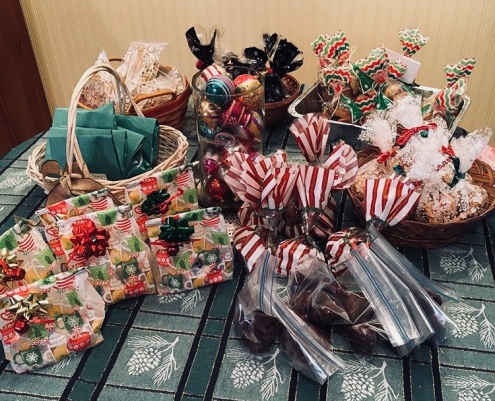
Bags and baskets filled with sweet little sugar bombs (A.K.A. cookies!!!)
I say that because it seems no matter what I do, my blood sugar always ends up high after partaking in the cookie consumption. And I’ve tried many different strategies to combat it, including:
Pre-bolusing
Breaking cookies in half to cut down on the carb intake
Running a temp basal rate
Exercising pre- or post-swap, depending on my blood sugar
I’m fully aware that I don’t HAVE to eat the cookies – I could go to the swap and watch everyone else try them and plaster a fake grin on my face – but honestly, how miserable does that sound? I fully believe that just because I have diabetes, it doesn’t mean that I should deprive myself. And as a disclaimer, I’m not sitting there wolfing down cookie after cookie like I’m the Cookie Monster: My family sets out just enough so that each person can try one cookie from all participating bakers. So usually, accounting for all the cookies I split in half, I eat approximately 6-7 whole cookies (which vary in size but are typically no larger than 3-4 inches in diameter). All that said, I still account for at least 45 grams of carbohydrates when I bolus for the cookies, which should have me covered…
…in theory, anyways.
Hence, my cookie conundrum, which occurred yet again when I participated in the 2017 swap. I spent a solid few hours in the late afternoon and early evening battling blood sugars in the high 200s and low 300s, which proved to be extra challenging without my CGM’s aid (I had to remove it because the dreaded ??? appeared and wouldn’t go away for several hours). But I handled it: I managed to get my numbers back down, try an array of fabulous cookies, and spend an afternoon with my wonderful family members.
Merry Christmas Eve, to all those who celebrate it! Christmas is one of my absolute favorite holidays. I love spending time with my family and friends, attending mass, baking (and eating) Christmas cookies, and decorating the tree. This time of year is pure magic; a time when I feel most joyful.
This Christmas Eve also marks my 20th year of living with type one diabetes. I don’t remember much from that night in 1997, seeing as I was only four years old. I recall tons of family members visiting me in the hospital and bringing gifts for me. One of the gifts I received was a honey-colored teddy bear that I particularly liked and hugged often throughout my hospital stay.
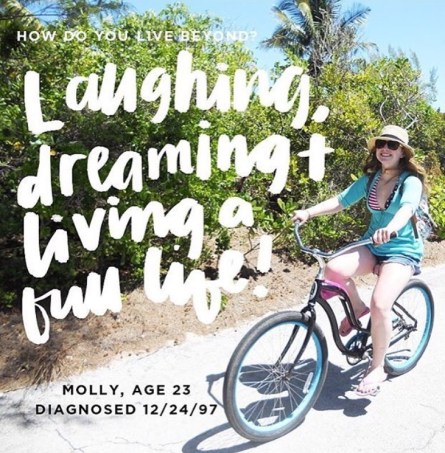
Beyond Type 1 featured me on their Instagram Wall of Warriors last year. This is how I #LiveBeyond.
Twenty years with diabetes is a long time. Too long, especially since every couple of years since my diagnosis I’ve been told that a cure would be found “soon”. I’ve come to accept the fact that “soon” just might not be within this lifetime, and rather than dwell on that, I choose to focus on the joy of life itself. How lucky am I to live a full life, surrounded by loved ones, employed full-time, with a roof over my head and food on my plate? How lucky am I to be able to have access to the insulin I need and to have a choice when it comes to the pump and meter I use? How lucky am I to have the knowledge and willpower it takes to manage a chronic illness every second of every day?
I’m extraordinarily lucky. I’m blessed.
That’s what I’m focusing on joy on this significant diaversary. I’m embracing the spirit of the season and recognizing the good in this life. Diabetes takes things away from me sometimes – a full night’s sleep, an occasional dessert, a missed trip to the gym – but I refuse to let it take my joy.
Today is my office’s 10th annual holiday potluck! I’m looking forward to sampling a wide variety of dishes prepared by my coworkers. I know that it’ll be a carb heavy feast, though, so I’m going to have to do a little planning in order to prevent my blood sugar from spiraling out of control.
I feel like I consume the amount of carbs that this gingerbread house contains on office potluck days (okay sort of exaggerating but that’s how it FEELS).
Honestly, my strategy for office potlucks is a little similar to what I do on other food-centric holidays: test often, extend boluses as needed, consume everything in moderation, and so forth. But there’s a few additional things I like to take into account when it comes to potlucks:
Request labels for the food. I want to know precisely what’s in front of me. No, I don’t expect or want someone to write down every single ingredient they used to prepare a dish, but I do think it’s not too much to ask for the name of the dish. Labels are everything!
Ask the cook if more explanation is needed. Case in point: At our last potluck, I tried noodle kugel without knowing what was in it. I mean, it’s obvious that NOODLES are a main ingredient, but pasta aside, I had no clue that sugar, cinnamon, and raisins were also used to make it. Needless to say, my blood sugar was sky high after sampling this (delicious) carb bomb, and I think I could’ve mitigated the situation if I’d only spoken up.
Find someone to share the sweet stuff with (or save it for later). Chances are, I can find a coworker who’d gladly split a cookie with me so we save ourselves from the calories and carbs in a whole one. But if I truly can’t resist having a big piece of cake to myself, then there’s no problem in saving it for later – I never know when my next low blood sugar will strike!
Load up on low carb options. Typically, I take as much as I want of the veggies, salads, cheeses, and meats that people contribute to the potluck spread. I know that if I fill up on lower carb items first, then I won’t overdo it as much on the heavier pastas, breads, and cakes.
Be upfront with coworkers. My colleagues are very understanding when it comes to my diabetes, which is awesome in certain situations – like a potluck! But every now and then, I encounter someone who just doesn’t get my diabetes (even if I’ve tried to explain it to them). They’ll insist upon me eating whatever they’re offering to me, and take it personally if I turn them down. So I’ve decided that the best way to cope with this is to be totally honest with my coworkers and tell them why I can’t or don’t want to have what they are offering. So if Edgar* is begging me to try a slice of the chocolate torte he slaved over, I’ll straight-up tell him my reasons for skipping it (whether it’s due to high BG or simply being too full!). There’s a reason it’s said that honesty is the best policy, and this certainly applies in an office setting.
Either way, I look forward to this potluck every year and I won’t let my diabetes prevent me from enjoying it. Here’s to an afternoon filled with food and festivities!
*Edgar isn’t a real coworker. I just made him up for the purpose of this post. But I bet his hypothetical chocolate torte is amazing.
…What could those three things possibly have to do with each other?
Turns out, a lot more than you think. At least, if your name is Molly, you have diabetes, you do workouts in the mornings, and on top of all that, you have a paralyzing fear of bugs.
All of these things created a bit of a perfect storm last week during the early morning hours. My day started out normally: My alarm blared at 6:15, I rolled out of bed, changed into exercise clothes, and hit the play button on my DVD player. I completed a grueling half hour “Total Body Cardio Fix”, a series of exercises that are a part of the 21 Day Fix program. By the end of the workout, I was sweating profusely, but proud of myself for keeping up with this relatively new addition into my morning routine.
I proceeded getting ready (take shower, get dressed, do make-up). Towards the end of my make-up application, as I was blending concealer under my eyes in an attempt to cover up the dark circles, I happened to spot something on my carpet out of the corner of my eye. I hunched down to take a closer look and initially though it was a clump of stray threads on my floor – but I very quickly discovered it was something else. A nasty, ugly stink bug!!! Ugh, I hate those things. They’re so icky to look at, they FLY, and they release a horrible odor when you smoosh them. There is legitimately nothing to appreciate about them.
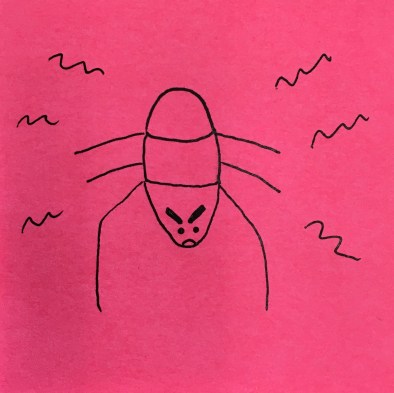
My hyper-realistic rendering of what stink bugs look like. Those little squiggles represent their malodorous manner. The evil expression, though, is pure speculation on the artist’s part, as she has never gotten close
If you know me well enough, you know that I have what my parents kindly refer to as the “bug scream”. That’s how much I dislike creepy crawlies of all varieties. So as it dawned on me that I was looking right at one, I blood-curdling one escaped my lips and I ran as fast as I could out of my room. Unfortunately, though, I had to scamper back in to grab my test kit, PDM, and CGM so I could figure out what to do while I had my breakfast.
As I paced back and forth in the kitchen, trying to come up with a bug elimination stratagem, I heard a “BUZZBUZZBUZZ” from the other room. No, it wasn’t another bug – thanks heavens for that – but it was my CGM. The combination of early morning cardio and bug-induced mania must’ve done the trick. So there I was, in my absolute prime (not!): shaking, sweating, and most probably looking like a crazy person as I blended a breakfast shake together. Not cute.
Of course, the blood sugar issue was taken care of pronto. The bug issue, however? That was addressed. Eventually…
…meaning that my mother was my savior and eliminated the BUGger (sorry for the terrible pun*) later that evening. Thanks, mom.
*Not actually sorry for terrible puns because I love all puns!!!
Only 21 more days until Christmas! I’m so excited that the most wonderful time of year is here. To celebrate, I’ve changed the header on my site to…
…this dorky T1D dancing lady (me)!!!
It was like kismet when I saw this sweater in the store a few days ago. It’s a cactus that lights up and has the phrase “hug me” on it. How could I not buy it?! Hence, I decked myself out with the sweater and danced gleefully with my OmniPod PDM in hand to bring some Christmas cheer to my type 1 diabetes blog, Hugging the Cactus.
I want to take a moment to say how special HtC is to me. Truly, the first two months I’ve spent putting this blog together and writing new material have brought me, in the spirit of the season, joy. It makes me so happy to share with readers, near and far, who take time out of their days to click through my posts. I’ve learned quite a bit from the DOC in the years that I’ve spent blogging, and I know that I will continue to do so!
Besides the holidays this month, I’ve got a major milestone coming up: 20 years with type 1 diabetes as of December 24th. What do you think I should do to mark the occasion?
Again, thank you for reading my blog. I have some big plans in the works for it in 2018, so stay tuned! And if you want to make sure that you don’t miss any of my new posts, please feel free to subscribe – the widget to subscribe is located on the right-hand side menu on the homepage here.
About five months ago, I turned to my mother and asked, “Want to go to Disney World with me?”
“Just the two of us?”
“Yup.”
And just like that, a girls’ trip was born! I was so excited about the prospect of going to Disney World with my mom – the first and only other time she’d gone was back in 2000 – that I didn’t really think about some of the logistics; namely, that it would be somewhat daunting to handle a couple parts of the trip due to both of us having type 1 diabetes. I couldn’t help but wonder and worry about really minor issues, like:
How would we handle pod changes?
How many extra medical supplies would we need between the two of us?
What about food – did I schedule all of our dinners at appropriate times? Would we find healthy options in the parks?
How would we keep our insulin vials cool?
It’s not like I haven’t been to Disney World in recent years – in fact, this was my fourth time going in the last five years – but it was just different going with my mom. I was the only T1D there in the recent trips, so I only had to worry about taking care of myself. My mom certainly doesn’t need me to take care of her, but I just get anxious when it comes to making sure we’re both adequately prepared when we’re away from home (and from my dad)!
But I was absolutely not going to let diabetes get in our way. And truthfully? It didn’t, for the most part. After all, we’ve encountered just about every kind of diabetes scenario possible. And we’ve dealt with all of them. Just because we were away from home didn’t mean that all of our knowledge on how to take care of ourselves was going to disappear. Plus, traveling with another T1D comes with a major bonus: They know just as much as you do about diabetes. They’ll understand if you need to have a snack while waiting in line for the Haunted Mansion or if you can’t drink a beer in Germany because you’re too high. They just get it.
Of course, a vacation to Disney World is unlike any other getaway. There’s a lot of considerations to make, particularly if you have T1D. My mom and I made so many memories on our trip (most of them unrelated to T1D), but the following parts of our vacation stick out as I reflect on what it’s like specifically for two T1D girls to go to Disney World.
This picture sums up how our relationship is sometimes.
Meeting Cinderella!
The most exciting part was having the chance to do something like this with my mom in the first place. For various reasons, I never thought we’d get the opportunity to do a girls’ trip – so the fact that we went was really cool for me (and hopefully for her, too).
The scariest part was planning the trip. I took on this responsibility and was happy to do it, but it was a little added pressure to make sure our daily plans would accommodate our wish lists of what we wanted to do, in addition to both of our diabetes.
The most frustrating part was guessing the carb counts for most of our meals. This is something I would love for Disney to work on – offering nutritional information for as many food items as possible. For the most part, we had success making educated guesses, but it would still be awesome if Disney could be a little more accommodating in this respect.
The most difficult part was finding a good place for us to change our pods. Due to how we schedule our pod changes, they were set to expire when we’d be well into our days at the parks. And even more irritating was that between the two of us, we’d need to change our pods on four separate days of our vacation. So it was definitely inconvenient timing, but diabetes doesn’t care about that! However, we worked it out by asking a cast member (a Disney employee) for some help. She told us that a companion bathroom would be our best bet, so each time we had to deal with a pod change, we located the nearest one and did what we needed to do. It was a little stressful to do our pod changes in such a small space, but the privacy was worth it. And even though it was a challenge, we overcame it.
The most relieving part was what didn’t happen – no pod failures the entire trip! That meant we watched our favorite Beauty and the Beast show at Hollywood Studios without interruption and rode countless rides in Magic Kingdom (her favorite was the Little Mermaid ride, mine was Pirates of the Caribbean) with nary a BEEEEEEEEEEP to be heard.
The most tiring part was walking 10 miles every day of our trip. Yes, 10 miles! We actually made a bit of a game out of it, to see if we could beat our mileage as we traveled from one park to the next. But I can’t say that this part didn’t come without its perks – walking so much really helped our blood sugars! It came in handy if we didn’t bolus enough at mealtimes, and when we were running low from all the movement, we were happy to correct with Mickey ice cream bars.
The most magical part was having dinner at Cinderella’s Royal Table during the Mickey’s Very Merry Christmas Party. Seriously, we lucked out – it’s said that Cinderella’s castle is the hardest dining reservation to make at Disney World, and if you hope to snag a booking, you’d better try to do it at least six months in advance. I desperately wanted to make this happen for me and my mom because Cinderella is our favorite princess. So when I did get a reservation for us, I knew it would be one of the best parts of our trip. Rest assured that diabetes was far from our minds as we milked this once-in-a-lifetime experience!
The castle looked spectacular for the holidays.
From enjoying a glass of champagne over dinner at the castle to reveling at the gorgeous Christmas decorations adorning the Disney property, this trip was worth it in every way. Thank you to my mom for accompanying me, and an even bigger thank you to my dad for being cool with it. And at the end of the day, it was a pretty perfect way for a mother and daughter with diabetes to kick off National Diabetes Awareness Month, don’t you agree?
A holiday that promotes gratitude and eating…what’s not to love? As much as I enjoy Thanksgiving, though, I can’t quite say that my diabetes feels the same about it. Fortunately, I’ve developed a bit of a game plan as to how to handle diabetes when Turkey Day comes rolling around – here are my top 10 tips for making the most of a Thanksgiving feast with diabetes!
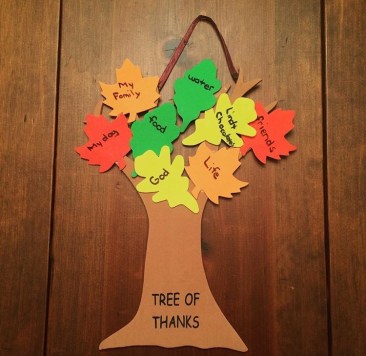
A tree of thanks I made many Thanksgivings ago – note my gratitude for Lindt chocolate, specifically.
10) Don’t skip breakfast on Thanksgiving morning. This helps me avoid over-eating when Thanksgiving dinner is served later in the day. Breakfast doesn’t have to be a huge thing, maybe just a bowl of oatmeal or a piece of fresh fruit – anything that will sate me for a few hours.
9) Volunteer to prepare a couple of dishes. If I’m going somewhere for the feast, I like to know what my host needs me to bring. If I have creative control over the dish, I prefer to make it something that I know won’t be too hard on my blood sugars, such as a side of veggies or a sugar-free dessert.
8) Familiarize yourself with what’s being served prior to sitting down for the meal. Before my family sits down to eat, I like to know what exactly we’re being served so I can plan accordingly. I can usually get away with strolling around the kitchen to get an idea, but sometimes the chef (my aunts or my mom) kick me out while they finish cooking dinner!
7) Don’t feel pressured to try everything. It all looks and smells so good, but I have to remind myself to use some restraint when piling my plate with Thanksgiving food. I’ll add staples like turkey and green beans (both of which are low-carb!) and take smaller portions of the heavy things, such as stuffing and potatoes.
6) If it’s necessary, extend my bolus. This all depends on what my blood sugar is before the meal, but sometimes, I’ll extend it in order to prevent lows or highs post-feast.
5) Check my blood sugar often. I’m not afraid to check my blood sugar as often as I need to throughout the Thanksgiving feast. I’d rather have an idea of where my blood sugar is headed than leave it to chance and guess incorrectly.
4) Go for a walk or organize another outdoor activity. The weather doesn’t always cooperate with this idea, but I’ve found that dragging my cousins on a 20-minute walk after eating helps my blood sugar and provides us all a chance to hang out while our uncles take control of the TV and our aunts chitchat over cups of coffee.
3) Wait a bit before having seconds or starting on desserts. I try to indulge a bit on the sweets at Thanksgiving, but I know that it never works out for me if I help myself to desserts too soon after consuming the main course. So I avoid the temptation by staying busy after eating dinner – my mom and aunts always appreciate an extra set of hands to assist with clean up!
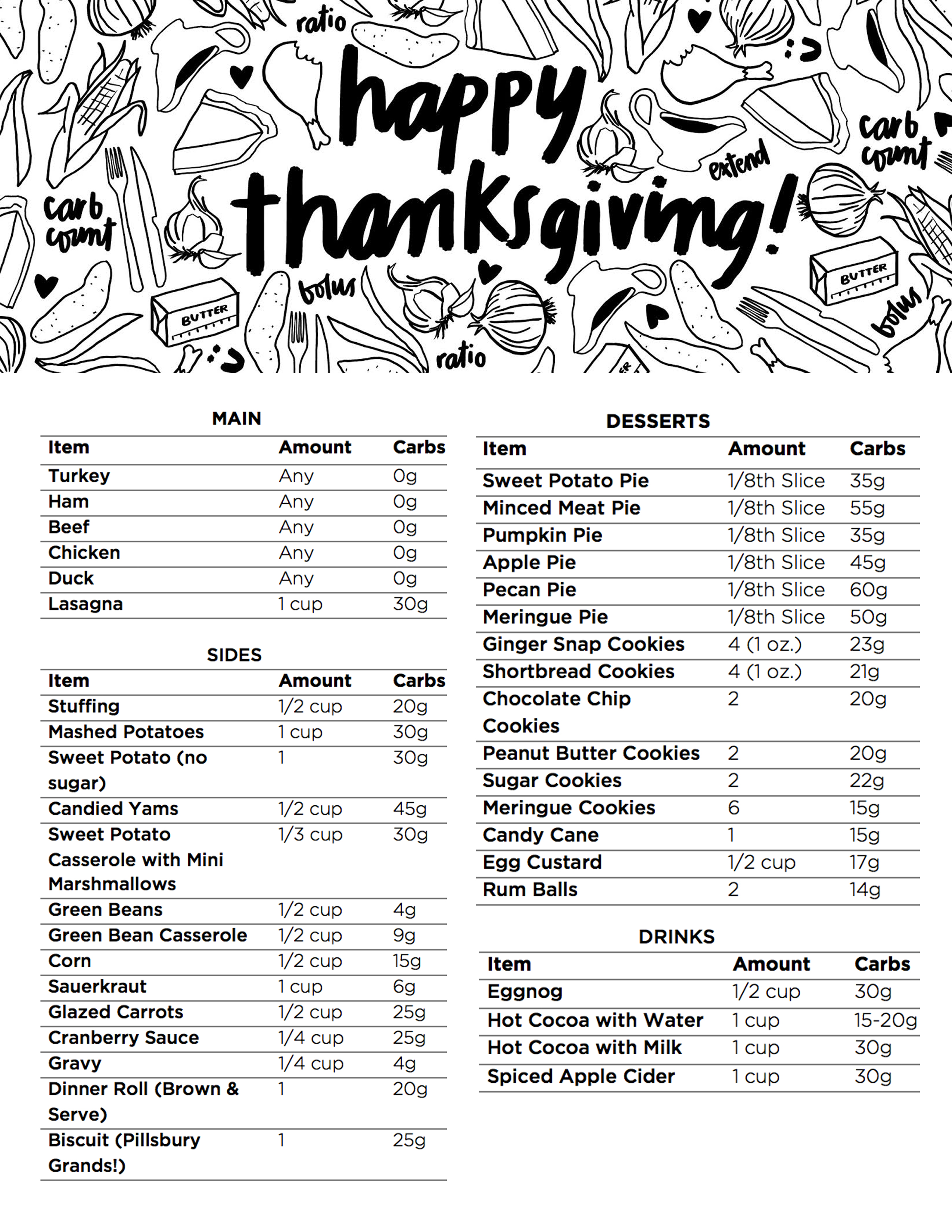
2) Look up carb counts if I’m struggling to come up with them on my own. Sometimes, I can’t quite determine how many carbs are in a serving of pumpkin pie – I’ll guess too low and end up high, as a result! But I know that there are tons of carb counting resources at the tip of my fingers, thanks to my smartphone. I rely on the MyFitnessPal app and the handy Thanksgiving carb chart from Beyond Type 1 to help me come up with complex counts.
1) Remember what the holiday’s all about: being thankful! Enjoy the day and time with loved ones! Whether you’re part of a large family like mine, a small one, or choose to spend the day with friends or a partner, just relish it for what you want it to be.








 Hugging the Cactus