I know a lot of people who have type 1 diabetes. And I consider many of them friends of mine.
You know what’s so cool about that? It’s that diabetes was merely the common denominator, something that we knew we shared, but not the sole reason for friendship. Diabetes provides a launching point into which we can find other shared interests: from TV shows to travel destination wish lists, the conversations we have don’t often linger on diabetes. But even when they do, it’s nice to talk about anything-and-everything diabetes with people who speak the same T1D vernacular.
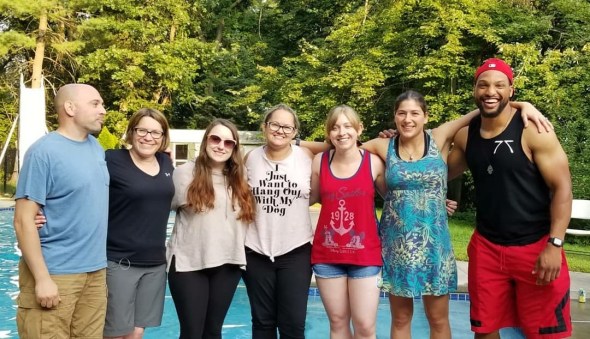
I’d met half of these people prior to this event, and I became fast friends with the other half, thanks to our common denominator: diabetes.
Case in point: An end-of-summer pool party I attended a few weeks ago that introduced me to a handful of T1Ds. Sure, we started off talking about things like medical research experiences and CGM trials, but then we moved on to the other topics we cared about and really got to know each other. It proved to me, for the umpteenth time, that it’s just so dang special that something as shitty as diabetes can bring so many good things into my life, including friendships with some marvelous human beings.
Type 1 diabetes sucks. It’s a chronic illness that is incredibly demanding, both mentally and physically. But it’s got nothing on Alzheimer’s disease.
I know this from experience because I watched my grandmother (and her sister) suffer through it.
I don’t have many memories of my grammy pre-Alzheimer’s, but by all accounts, she was an amazing woman. She raised six children alongside her loving husband. She was an active member of her community, working as a secretary for the Department of Public Works, a teller for the local bank, and a clerk at the neighboring city’s hospital. She was devoted to the local church and played the organ for it, and enjoyed singing. By the time she passed, she had eleven grandchildren and three great-grandchildren.
My beautiful grammy.
Alzheimer’s will never take away the contributions she made to the lives of her family, friends, and community, but it took away her ability to tell me stories, firsthand, about these experiences.
It took away her independence.
It took away her mind.
It took away her life.
Some facts about Alzheimer’s: It is the most common cause of dementia. It is a degenerative disease of the brain characterized by many symptoms, such as memory, language, problem-solving, and other cognitive skills. The most mundane activities, like walking or swallowing, cannot be performed by an individual in the final stages of the disease. As a result, they require 24/7 care until succumbing to the devastating disease.¹
In 2018, nearly 6 million Americans of all ages are living with Alzheimer’s. Every 65 seconds, another person in the United States develops the disease.²
I knew my grandmother when she was in the more severe stages of Alzheimer’s, and it was not easy to watch her experience them. It was even harder to watch how it affected her husband and children.
I wouldn’t wish it on anyone, just as I wouldn’t with diabetes.
This November marks nine years since my grammy passed away. She is missed every single day, but one way that my family celebrates her life and fights back against Alzheimer’s is by participating in the Walk to End Alzheimer’s. On September 15th, we’ll be partaking in our (sixth, I believe) Walk as Team Mary’s Little Lambs – a team name inspired by Grammy’s first name. I like to think that it’d make her smile.
The Walk is an emotional event for us in general, but especially when we hold up pinwheel flowers that represent our promise to remember, honor, care, and fight for those living with Alzheimer’s and their caregivers. Imagine how powerful it is to see the colorful pinwheels lifted into the air, with each color having a distinct meaning:
Blue for a Walker who has Alzheimer’s/dementia
Yellow for a Walker who supports or cares for someone with Alzheimer’s/dementia
Purple for a Walker who has lost someone to Alzheimer’s/dementia
Orange for a Walker who supports the cause and the Alzheimer’s Association vision of a world without Alzheimer’s
Just like with diabetes, imagine how incredible it’d be if one day, there was a white flower lifted into the air: a flower that would signify a cure.
If my grandmother’s story moved you, or if you want to show support for someone you know affected by Alzheimer’s/the cause, please consider donating to the Walk to End Alzheimer’s. You can use this link here, or click on the widget in the right sidebar of my blog – it’s the very first one listed. All donations advance the care, support, and research efforts of the Alzheimer’s Association. Thank you in advance, and thank you for taking the time to read this deeply personal blog post.
For more information on Alzheimer’s disease, visit www.alz.org. I recommend reviewing the report on their website, 2018 Alzheimer’s Disease Facts and Figures, to learn the most up-to-date statistics on the disease.
Not too long ago, the following message appeared in the inbox of one of my social media platforms:
I’m so sorry to bother with something like this. I down to my last pod. And.. currently I’m having insurance issues.. I was wondering if there were any pods you could spare? I’m trying to search around. Or if you know anyone that does have extras? Or samples? I would hate hate to return to multiple daily injections.. I know u understand that. If not it’s ok. Sorry to bother. I don’t know where else to try apart from everything else I’ve tried
When I read it the first time, my heart immediately sank. The message was fraught with desperation, as evidenced by the typos and fragmented sentences. My gut reaction was to reach out to this person and let them know that everything would be fine, that there had to be an option out there that would help them.
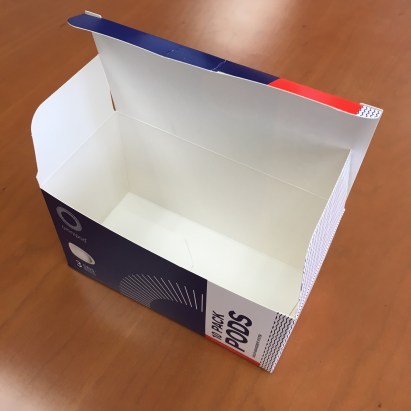
No pods to spare.
My next reaction, though, was pure skepticism. I’m not proud to admit that, but here are the facts that I was facing:
I did not know this person. I tried to look at their profile to see if I could learn more about them, only to discover that it was private. I couldn’t see any of their information, other than a minute profile picture and numbers regarding their followers/activity.
This person said they might be forced to go back to MDI. Personally speaking, if I ran out of pods and had to go back to shots, I wouldn’t like it – but if it was my only option, then of course I’d do it. I did it for something like 17 years before ever trying a pump. It sounded like this person wouldn’t want to do it, but…
Most importantly, I do not have any pods to spare. I’m not sure why this individual thought that I did. It seemed like they’ve been asking as many people as possible on social media for pods, which makes me believe that they’re exploring the #omnipod or #podder hashtags. Regardless, I rely on regular shipments (every three months) from Insulet in order to maintain the bare minimum of pods that I need. And I can’t exactly give up “spare pods” that I don’t even have.
As horribly as I felt for this person, I had to take into consideration the facts that were in front of me, as well as the unfortunate truth that you can’t trust everything on the Internet. I told them that they should try to reach out to Insulet for assistance, and that I would be hoping for the best for them. I know that my kind words probably brought little comfort, but it was all that I had to offer to this total stranger.
The whole exchange haunts me. That’s why I want to know…
It’s defined by finger pricks, drops of blood, infusion site bruises. Diabetes rarely leaves beautiful markings behind on the body; rather, it can make me feel unsightly.
Needless to say, diabetes occasionally makes me feel worse about my body. I try to project body confidence when around others, but on the inside, I’m terribly self-conscious about the way I look.
So that’s why it was wonderful to feel pretty with diabetes this past weekend.
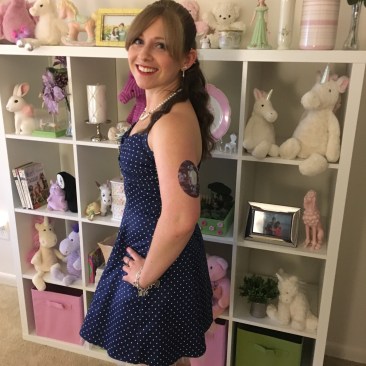
Unicorns on my patch and in the background. Because you can’t be surrounded by too many unicorns. If only someone would tell that to my blood sugar…
I got all dressed up to go to a “punk prom” that my friend helped organize. The night was all about singing along to the angst-filled tunes of our youth, listening to local bands jam out onstage, and getting glamorous so we could pose for an endless number of photos with fellow attendees.
In the hours leading up to the event, I was a bit anxious about wearing my insulin pump and CGM in visible spots. They didn’t exactly match the dress I’d dug out from the bowels of my closet (and that I’d last worn in the 9th grade). But as I applied hairspray to my carefully coiffed curls, it hit me that I should just own the look. Sure, nothing about boring medical adhesive or the words “Dexcom G6” screams formal wear, but I had a couple tricks up my sleeve that could doll up my gear nicely.
Namely, I had Patch Peelz. Created by the folks over at Pump Peelz, this patterned tape could make my CGM look fancy. Between the unicorn print and the dark purple and blue color scheme, the patch would look like it was styled to match my dress. I couldn’t help but beam once I was 100% ready for the evening. Coordinated aesthetics aside, I felt like one of the unicorns on my patch: magical, vivacious, and yes, pretty.
I’d just settled into my beach chair, ready to crack open a book, when I spotted her.
She was walking as quickly as she could through the sand to help her friend carry a cooler, but not fast enough for me to miss the CGM on her upper arm. I sat up in my chair and wondered whether I should say something to her – after all, not all T1Ds are excited to encounter one another in the wild.
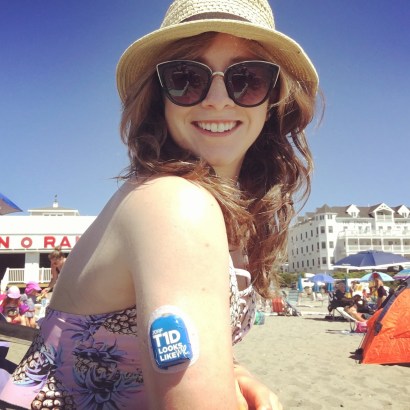
She caught up with her friend and grabbed the other end of the cooler. As they passed me, I saw she was wearing an OmniPod on her opposite arm. Not just any OmniPod, though: This one was decorated with some sort of emerald green design. I took that as a sign, a literal green light, that she probably wouldn’t mind if I said something.
“Nice OmniPod!” I called out.
She looked around, trying to locate my voice. My mother, who’d been reading the whole time and was unaware of a fellow T1D in our midst, shot a bemused look in my direction as the woman finally made eye contact with me.
“I have one too,” I said, pointing to my arm.
“Nice! I like your decoration. Do you have a Dex, too?” She asked, smiling at me.
“Yup – I’m wearing mine on my abdomen. I saw you had both and couldn’t resist saying something.”
“Well, we’ve got two OmniPodders over here,” She pointed to where she’d set up camp for the day.
Beaming, I told her that we had two in our group, as well. My mom offered her arm up to show her pod. I think that Mom was half entertained, half embarrassed over the whole exchange, so it made me happy to see her join in at the end.
The woman returned to her spot and we wished her well. Mom and I soaked up the sun for a few hours before deciding to pack up for the day. As we were getting our belongings together, a young woman approached us.
Proud to wear my pod.
“Excuse me, may I ask what is on your arms? I’ve seen numerous people wearing that sort of thing today and I can’t figure out what it is, for the life of me!”
I was going to answer for the both of us, but my mom beat me to the punch. She explained that it was an insulin pump, though other people may wear different medical devices that look similar to it. The girl, seemingly appreciating the response, remarked that it was cool and that she was surprised to see so many people wearing them on the beach. She wondered out loud if she was missing out on some sort of trend.
“Yeah, all the cool kids have them,” Mom said, and we all laughed.
I don’t know how many people on the beach that day were wearing OmniPods – or any other insulin pump, for that matter – but I do know for certain that my mom is right: All the cool kids have them, and they’re much cooler for wearing them with pride in full view of the world.
You want to know what went wrong during my annual eye doctor’s appointment last week? Just about everything, that’s what went wrong!
Okay, that’s being over-the-top dramatic. Nothing life altering happened, thank goodness. But the appointment started out on the wrong foot when I had to wait more than an hour to be seen by the doctor. Let me tell you, there is nothing pleasant about waiting in a room that hasn’t been updated since about 1982, with ancient stacks of National Geographic as the sole source of entertainment.
Anyways, after an agonizingly long hour and change, I was finally called in to see the doctor. He started the appointment asking the usual slew of questions: How are you? How are your eyes? (My answer to both was a short, but still polite, “good”.) Then he asked the annoying question: Is your diabetes under control?
I hate that – the “under control”. It makes it seem as though diabetes can be tamed 100% of the time, like it’s a savage beast that just requires domesticating in order to live a normal life. But I answered it anyways, knowing he wouldn’t care to hear why his word choice was bothersome. “I’m doing well,” I said, my eyes wandering over to the doorway. I couldn’t understand why he’d chosen to leave the door open – the hallway to the waiting room was very short, and based on what I’d heard when other patients went in to see the doctor, everyone in the waiting room would be able to hear the entire doctor-patient interaction. Definitely not cool in my book, but instead of confronting the doctor about it, I opted to speak in a much quieter tone of voice than normal. At this point, I just wanted the appointment to be over.
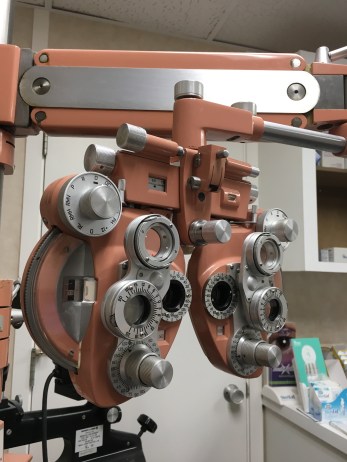
QUIZ TIME! Is this A) a medieval torture device OR B) a phoropter? (It’s B, which is the legitimate name of this piece of ocular equipment. Who knew?)
He spent 15 minutes running the standard eye tests (read the chart in front of you, does this setting make it better or worse, etc.), then dilated my eyes. I was sent back to that horrid waiting room for another 20 minute while the dilation took effect. When he called me back in to give my dilated pupils a final inspection, the following exchange happened:
Doctor: You know, I saw a patient the other day who was diagnosed with diabetes at birth.
Me: Yeah, I know a couple of people who were diagnosed as babies. It’s awful.
Doctor: Even though he’s had it his entire life, he doesn’t take very good care of it. He’s got diabetic retinopathy now. *shuffles paperwork*
Me: *Fidgeting uncomfortably in the chair, waiting for him to add to that. A long 20 seconds elapses before he finally says…*
Doctor: Fortunately, that’s not the case for you.
Um, WTF, Doc?! What’s up with that weird dramatic pause? Were you TRYING to freak me out? Mission accomplished, dude. But my oh my, such a sweet relief to hear that there is no diabetes in my eyes.
As I walked out of the building a few moments later, I couldn’t help but think about how this was a textbook example of how an appointment shouldn’t go. I left feeling an odd mix of emotions: disappointment with my doctor’s behavior as well as relief with his assessment that my eyes, at least, were proof of my well-managed (NOT under control) diabetes.
I really wish that I could write a blog post entitled “Bears, Beats, and Battlestar Galactica”, and have it relate to diabetes in some way…but I guess I’ll have to deal with the fact that it’s not easy to work quotes from “The Office” into a diabetes blog.
Guess that this title will have to do! Plus, it really does tie into the content of this post, so…
There’s nothing like a baseball game in summertime. I admit that I’m far from a sports fanatic, but I do take pride in my Boston teams (namely, the Red Sox and the Patriots). When I found out that the Red Sox would be playing against the Nationals when I visited Washington, D.C. last week, I was pretty pumped and decided to buy tickets. After all, what better way to break up the workweek?
An important note: The Red Sox crushed the Nationals at this game. Final score: 11-4.
It was a great choice. Even though it was a sweltering 100 degrees out, I had a fun time with friends. We drank beers, ate burgers/French fries/hot dogs, and cheered loudly for the Sox. My diabetes stayed far from my mind for once as my blood sugars played nicely, which was pretty surprising to me because I wasn’t exactly consuming low-carb items. I think that walking around the stadium in the heat helped combat the starchy foods, though I did have to bolus for a high blood sugar by the time we got home from the game.
But the point is, it felt wonderful to not worry about my numbers, even if it was for just a few hours.
You might be staring at the latter half of this post’s title and asking yourself, “What kind of acronym is THAT?”
Let me help you out: The title is meant to indicate that I’m suffering from a bad case of type 1 diabetes-specific fear of missing out. (T1D FOMO…if it wasn’t a thing before, it is now.)
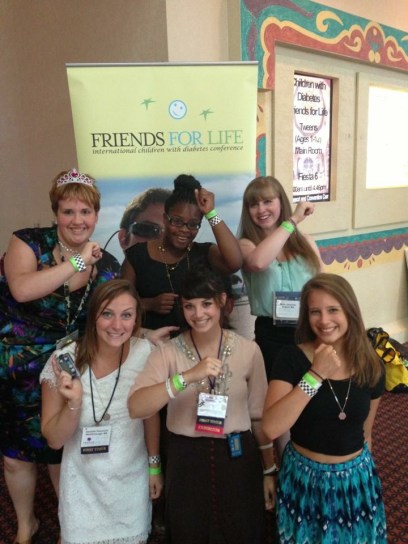
I decided that this was the best way to describe how I’m feeling about missing out on tons of excellent diabetes conferences, events, and meet-ups this summer. I think it’s striking me particularly hard this week because I know that the Friends for Life conference is about to kick off in Orlando. That one is special to me because it’s the first conference I ever attended, and it’s hard to believe that it was already five years ago.
#SquadGoals from my first conference, which was already five years ago.
Why am I unable to go to most of these gatherings? And what’s so great about them, anyways? Well, to answer that first question, there’s several reasons why I have to skip many of them. The biggest reason is financial: The cost of conference attendance can be astronomical. Between airfare, hotel, registration, and various other conference fees, you’re easily looking at spending a minimum of $800 – and that’s if you can find cheap and direct flights to the destination. The other side of the coin is that I’d have to reserve my limited vacation time for these events, and potentially sacrifice time off that I could’ve spent with family and friends. I understand that logistically speaking, it makes the most sense to have the majority of these events in the summer months – kids are done with school, generally good weather makes it easier to travel, etc. But having to choose between a diabetes conference that’s bound to be a wonderful time and a highly-anticipated vacation with loved ones is a choice I’d rather not make.
So you think that those factors would make my decision easy, but it isn’t. I hate not going to these events because I know firsthand how magical they are. It’s really neat to meet up with so many people from the T1D community all at once, and it’s even more incredible when you get to shake hands or embrace someone you’ve connected with online, but hadn’t met IRL (in real life) yet. Whether the conference is just a weekend or several days long, it’s awesome to feel “normal” throughout the whole thing. You’re among people who don’t look at you funny when you test your blood sugar before a meal, and the chorus of beeps and buzzes from medical devices never get mistaken for cell phones going off. Sure, I can virtually attend a conference by scrolling through my social media feeds and reading updates from T1D attendees, but it just isn’t the same. While it makes me happy to see them having a fabulous time together, reunited at last, I can’t help but feel slight pangs of jealousy – this is where the FOMO comes into play – as I imagine everything I’m missing out on.
I know I’m not alone in this feeling – there are many others in the diabetes community who can’t go to conferences for several different reasons, even though they want to go. And I can take comfort in the fact that even though I couldn’t go to a bunch this time around, there will always be more in the future, and some will be more affordable than others.
My bad case of FOMO will go away before long, and in the meantime, I know that there are probably tons of other T1Ds who are attending their inaugural conferences this summer, and who will experience what I did five years ago for the very first time. And that thought puts a smile on my face.
Today is the Fourth of July! I’ll be spending the day in our nation’s capital. While I’m not entirely sure what the day will bring, I do know that I’m bound to feel a swell of patriotic pride, as I imagine the vibe of Washington, D.C. this time of year oozes red, white, and blue.
The Stars and Stripes
As much as I love my country, I still think it has a long way to go. I promised myself I would refrain from getting overly political on my blog (for many reasons), but I will say this one thing: Many things about healthcare in America need to change. I found an article on the New York Times recently that opened my eyes to the dire state of the global insulin crisis. Here are some facts from that article:
One in four patients with diabetes are cutting back on insulin because of cost.
The typical cost of one vial of insulin is $130. One vial of insulin lasts no more than two weeks for a person with diabetes.
There is no generic form of insulin. This means that prices skyrocket since there is no competition among generics.
Why is this happening? Why do families find themselves being forced to choose between feeding their families or affording life-saving medication? It’s unacceptable that profits are valued over life in our great nation.
Things need to change. The politicians and policymakers who have the power to make right and just changes need to take a good, hard look at Americans who are crying out for help and struggling to simply live.
This topic is worthy of thousands more words, but I’ll leave it at that for now. Maybe it will open someone else’s eyes, too.
For now, have a beautiful Independence Day doing whatever it is that makes you feel free – and be safe!
“Consistency is key” is a well-known adage for a reason: It applies to many things in life, including diabetes.
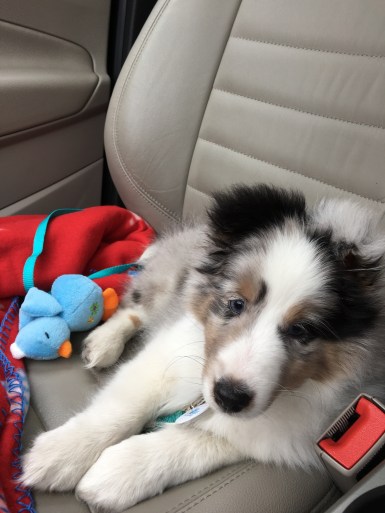
This has resonated more and more with me over the last few months, as I’ve experienced greater interruptions in my day-to-day routines. The most obvious change has affected my Monday through Friday lunch hour at work. I usually need to go home three out of five days to take care of my puppy – feed him, play with him, and make sure he hasn’t totally destroyed anything in the few hours since I last saw him. I don’t mind this at all, because I love my little Clare-bear, but on days that I have to be with him, my diabetes is definitely affected.
For starters, I have to eat my lunch much later than I normally do on non-Clarence days. Technically, I could eat my lunch when I go home to see him, but I have a very narrow window of time – approximately thirty minutes – to be with him. It doesn’t seem fair for me to go home, pour out his kibble, then spend the majority of our half hour together putting together and eating my own lunch. So I spend my lunch break giving the puppy my full attention, which makes us both pretty happy.
My Clare-bear certainly knows how to keep me, and my diabetes, on our toes!
Eating lunch during my allotted break is ruled out, so I have to decide whether to eat it before or after my stop home. I usually end up forcing myself to wait until I get back from feeding Clarence to eat, but this is easier said than done for a few reasons: Sometimes, my blood sugar will crash while I’m with the dog, so I have to eat a snack to correct it because my actual prepacked meal is waiting for me in the office refrigerator. Or I have to scramble from one meeting to home and then back to the office for another meeting and won’t have a chance to sit and eat until 2 o’clock, which means that I have to sit through an afternoon meeting without a full attention span because all I can think about is my grumbling stomach. On those days, I’m pretty hangry by the time I get to eat, and even more so irritated when my blood sugar retaliates at me later on for waiting so long to eat.
That being said, I’ve had to make peace with the fact that my weekday/lunchtime blood sugars will be a bit all over the place. I know that things will be easier when Clarence gets older, but for now, I’m determined to enjoy his puppy-hood without diabetes interfering too much. And if nothing else, it reminds me how important it is to stick to the basics with diabetes: Eat regular, healthy meals and the habit will reflect well on blood sugar and A1c.




 Hugging the Cactus