I still can’t believe that I broke my wrist…again. At least I changed it up a little this time and broke my left one instead!
A broken bone is a broken bone, but my healing experience has been very different compared to last time.
For starters, when I broke my right wrist a couple of years ago, it was in the middle of winter (I slipped and fell on ice in the driveway). I was put into a cast that I wore for 4-6 weeks that felt like 4-6 months because of the challenges I faced. Between attempting to become ambidextrous as I built up strength in my left hand and taking a solo trip to Atlanta, Georgia to film a commercial for Dexcom, I did my best to work around my injury…even though I felt incredibly defeated in the face of the limitations it imposed; specifically, I felt that I couldn’t keep up with the exercise regimen I’d worked so hard to establish. I feared that I’d exacerbate the injury, so I didn’t even try to work around it.
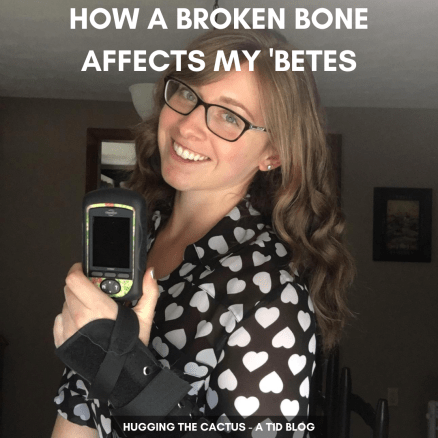
This time around, it’s summer. The break happened after I tripped and fell down some stairs (klutz, much?). I’m wearing a brace for 3-6 weeks instead of a cast: My orthopedist said it’d be much more comfortable versus a cast, which can get seriously stinky and sweaty in the warm weather. And rather than stressing about how I’ll continue to exercise while also allowing myself to heal, I’ve made modifications that have kept my body, broken bone, and ‘betes happy.
Can anyone else spot the lone strand of fur, courtesy of my dog, stuck to my brace?!
I guess I learned from the last broken bone that it’s better to keep moving in some way, shape, or form than dwell too much on the injury itself. In other words, I’ve been trying hard to focus on the things I can still do while I’m wearing a brace as opposed to the things I cannot do. For example, my broken wrist can’t stop me from taking daily walks or, when I’m feeling more ambitious, going for an occasional run. It can’t stop me from making the shift to lower-body-focused workouts or core strengthening routines. I refuse to let this injury be the reason that I get sloppy with my nutrition or workout routines, and it certainly isn’t an excuse to become unmotivated in terms of my diabetes care. If anything, it might just be the reason that I tighten things up and make some much-needed improvements.
They say that when life gives you lemons, make lemonade…so I’m going to try, because a broken wrist won’t stop me from getting something good out of this less-than-ideal situation.
I’m re-upping this post that I initially published on February 5, 2018, because…it’s happened again. I have another broken bone! This time, it’s a chauffeur’s fracture, which is just a fancy way of saying that I have a break along my radius due to falling on my outstretched hand. Fortunately, the X-ray process went much smoother this time around – I actually referred to this blog post so I could remember exactly what I was told about insulin pumps and X-rays! Hopefully, this helps other people who had the same questions as me.
“You have to remove your insulin pump before we can take your X-rays,” the technician said to me. I stared at him, and responded point-blank, “What? No, I can’t take it off.” I tried to hide the panic in my voice, but it quavered as tears stung my eyes.
“Well, let me check our insulin pump protocol…” his voice trailed off as he left me in the dark room with my right arm held up in the air in an attempt to mitigate the throbbing sensation going up and down my forearm.
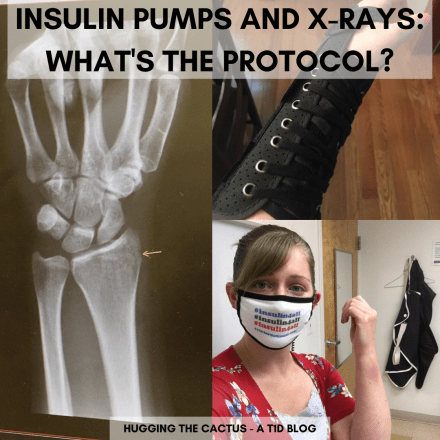
Here you can see an X-ray that shows where the break is (follow the yellow arrow), me looking miserable in the doctor’s office but still rocking my #insulin4all face mask, and my lovely new brace which I get to wear for 3-6 weeks.
When I fell and broke my ulna a couple weeks ago, my insulin pump was one of the last things to cross my mind as I was shuffled from doctor to doctor and one medical facility after the other. All I could concentrate on was the injury – how severe was it? Would I be able to work? Could I keep up my exercise regimen? Was I going to need surgery? My diabetes, for once, was far from my thoughts.
But this instantly changed when I went to get an X-ray. When the technician told me that I’d have to remove my pump, I wanted to shout at him, “No! If I do that, my blood sugar will skyrocket! You can’t expect me to do that!” It was hard to keep calm, and my emotions were already running amok due to the chaos of the morning so far. So even as I tried to fight the tears, a couple escaped and ran down my cheeks. When he came back into the room, the X-ray technician’s expression changed. He looked at me empathetically.
“It’ll be okay. Come on, let’s call your endocrinologist. We’ll see what she has to say and get this all figured out.”
Twenty minutes later, after a series of phone calls and a few accidental hang-ups, we received confirmation that I could, indeed, wear my pump for the X-ray. The nurse practitioner who I spoke with at my endo’s office said that it was safe as long as I wore the protective vest. “It’s really only a problem if you’re going in for an MRI or a CAT scan, because those involve magnets,” he told me.
Once I got off the phone, I ran over to the X-ray technician and explained it to him. He smiled at me and said, “Got it. Let’s get these pictures over with – you’ve already had quite a day so far.”
I nodded and thanked him for his patience. He was right, I was overwhelmed from the events of the day – it wasn’t even noon yet – but in hindsight, I’m glad that the technician didn’t try to fight me when I said I couldn’t remove my pump. His willingness to hear me out was huge. It’s not easy to be your own advocate in a high-stress situation like that. But I’m proud of myself for speaking up and getting the answers we needed. Everything worked out in the end – well, except for that pesky broken-bone bit.
I’ll never forget the first time I saw my mother’s bio in her high school yearbook: She’d listed “sleep” as one of her favorite past times. I though it was hysterically funny then, and I still do now, but I also think it makes her incredibly relatable. Who doesn’t love catching some z’s?
I may not be unique to others when I say that I love a good night of sleep, but only people with diabetes know the real struggles that we, without functioning pancreases, face virtually every night at bedtime.
Because that’s right, diabetes doesn’t just make life hard for us when we’re awake, it also disrupts our precious slumbers. How dare you, diabetes!
Here’s four ways in which diabetes can make it difficult to sleep:
1 – Beeping and buzzing devices. Nobody actually likes waking up to a blaring alarm clock. Imagine not only having to contend with that, but also the possibility of low and/or high alarms going off at any hour of the night. The shrill alarms built into my Dexcom are very rude awakenings and definitely serve as an extra incentive to do everything possible to try to stay in range overnight, but we all know that diabetes can be unpredictable, so this isn’t always possible.
2 – Rolling over on uncomfortable sites. I toss and turn throughout the night: Usually, I fall asleep on my back, then switch to my side, and roll over on my stomach…multiple times throughout the night. And I never seem to be able to do it without rubbing up on a site. It doesn’t matter where it is – my arms, legs, stomach, or back – any rockin’ and rollin’ I do in my sleep is almost always bound to push my CGM sensor or pod uncomfortably harder into my body, and it can be the reason why I wake up in the middle of the night to make yet another adjustment in how I’m sleeping.
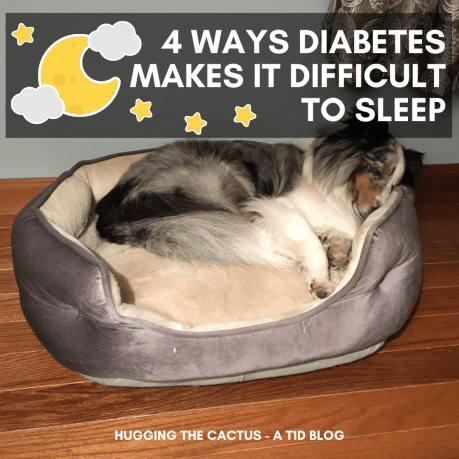
At least my diabetes has zero impact on Clarence’s ability to sleep. Was this another excuse to use my adorable dog as a good photo for this post? I shall neither confirm nor deny.
3 – Waiting for a high to come down. There have been a handful of occasions in the last year of life with diabetes ALONE in which I’ve been so, very tired but too afraid to go to sleep until my blood sugar has come down to a “safe” level. It doesn’t matter if the high was caused by incorrect carb calculations or a site that I’m not sure is working properly – I just want to avoid sleeping knowing that I have a hyperglycemic blood sugar because waking up to one in the morning is bound to start my day off on the wrong foot. And it even resulted in a trip to the ER one time, which I don’t want to experience again.
4 – Waking up to a low. Just like high blood sugar, low blood sugar can also delay and/or interrupt sleep. Whether the low happens just after brushing my teeth and I’m forced to ruin my fresh breath with something sugary (just thinking about the orange juice and mint flavor combination makes me wanna yak) or if it wakes me up from a sound slumber and I proceed down the stairs to eat the entire kitchen because I’ve run out of low supplies on the nightstand next to my bed…you get the picture. It’s downright annoying and honestly I bet that I’ve had at least a couple hundred nights of sleep in my 22+ years of diabetes disrupted to a low.
So you see, as much as a person with diabetes like me enjoys a full night of sleep, I’m always aware of the fact that my diabetes doesn’t sleep…and instead keeps me on toes.
You know that feeling you get in the pit of your stomach when you receive bad news? It’s like your heart falls to the floor and your stomach starts swirling from the perceived sensation.
That’s unpleasant enough on its own, but for me, it can also cause blood sugar issues.
The same thing can be said for when I’m on a literal roller coaster (which doesn’t happen often, but when it does, involves extreme coercion from family or friends) – I get that awful swooping sensation on top of some sort of blood sugar impact.
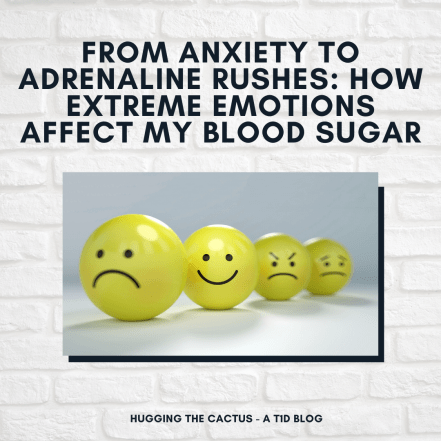
Do you know how difficult it is to find a picture depicting an adrenaline rush that isn’t a cliche shot of a roller coaster or skydiver? Hence…a slew of moody “smiley” faces.
Whether it’s anxiety, adrenaline, fear, or just a rush of unidentifiable feelings, there’s no doubt about it: Extreme emotions tend to make my blood sugar unhappy by causing it to spike.
I’ve always been somewhat aware of this phenomenon, but I started thinking about it more last week when I got some upsetting news. (I’m okay, please don’t start to speculate on what it was…just a personal matter that I don’t care to discuss in greater detail here. Love y’all for understanding and respecting that.)
Actually, it’s kind of interesting to think about how the sequence of events unfolded last Thursday. I received a message that caused me to instantly panic. I was going to learn the context behind the message about a half hour after I got it, so in the interim, I was pacing all around the house and trying to figure out what exactly was going on. My stomach was roiling, my palms were coated in a light sheen of sweat, and my already-unruly hair frizzed out even more….
…and my CGM trend started going up, up, up, ever so slowly but noticeably.
I didn’t do anything to correct my blood sugar – at least, not right away. I waited until after I heard the specific news that had gotten me so worked up to really pay attention to my rising levels. I probably could have made my high blood sugar less severe by running a temporary basal increase right after I initially freaked out, but obviously, I had other things on my mind than my diabetes at that moment in time.
The whole experience was a stark reminder that food and insulin are far from the only things that impact blood sugar levels. Raw human emotion did that to me, and it will do that to me again in the future.
It sucks, but isn’t it also fascinating to think about how diabetes is totally a physical and emotional chronic condition, in every possible way?
I thought about how I was going to write this post many, many times. I so wanted to come up with a cute or clever euphemism for what I’m about to discuss, but really, that old “Ant Flo” cliche is all I could come up with, and that’s so overplayed.
If that didn’t give you a clue as to what this is all about, then look at the title again.
Still nothing?
Okay, this post is about my period.
Yep, the menstrual cycle, that time of the month, the curse…whatever name you want to call it, I’m talking about it today. And if you’re already cringing, chill. I promise there’s no need to, I’m not about to get graphic on you or anything.
Rather, I’m about to write about a reality that many women with diabetes face: The week leading up to a period, or the week that it starts, can be hell. And I’m not just referring to cramps or mood swings.
This picture is actually a pretty accurate cartoon version of me…cacti plants, GameBoy, and pink included.
I’m talking about blood sugars, of course. I’ve thought about how my period and my diabetes interact more and more lately because of an “interesting” (that’s the nice way to put it) pattern that I’ve noticed each week leading up to my period for the last few months, and that’s how insulin essentially becomes as effective as water when I get it pumping through me: That is to say, my insulin intake has nearly doubled the week leading up to my period, and it’s something I never really noticed until recently.
I think I caught onto the trend in April. The week before my period started, I blamed my bad blood sugars and higher insulin intake on the fact that we were only a few weeks into quarantine, so it was natural that my body was having a tough time adjusting.
In May, I wondered whether I was dealing with faulty pods or bolusing incorrectly for my foods.
By the time June rolled around, though, I realized that there was something different at play here.
Last month, I dealt with the issue by raising my temp basal for most of the day – a 95% increase for 6-8 hours through the morning and afternoon – and giving myself 2-3 units more than I normally would at mealtimes. I still didn’t have great numbers, but they were better, and that was all that mattered to me.
But this month? I’m totally confused because this “periodic problem” did the opposite of what I expected it to do…the week before my period, it seemed like I need LESS insulin! It was simultaneously bemusing but exciting. I’ll never necessarily complain about having to take less insulin, or being able to eat an entire blueberry muffin without needing to bolus for it (yes, that really happened), but damn…some consistency here would be nice.
Who knows what my body will decide to do next month. At least I feel a little bit better knowing that there is some sort of pattern going on here that I need to pay attention to, so I’ll continue to monitor so I can try to anticipate what the week before my period will look like for my blood sugars.
Just one more reason why I kind of dread “that time of the month”, but also another justification to eat more chocolate in order to cope with it when it does come ’round.
Every summer, I spend at least a handful of days at the same beach town. These trips have created so many memories for me, my family, and friends over the years. But back when the pandemic started and travel came to a standstill, I wondered whether it would even be possible to head up to my ocean-side oasis this year. After all, many states have restrictions about visitors right now, and protocols aren’t always clear. Luckily, though, due diligence was done before it was determined that yes, my family and I could still go on our trip, though we knew it might look a little different compared to our trips in the past.
Based on my experience, I’ve come up with a few dos and don’ts when it comes to traveling with diabetes during this pandemic:
Do wear a mask. Please, for the love of everything you hold sacred in life, wear a mask when you’re out in public. It’s not about political leanings or agendas: It’s about protecting yourself and the ones around you. I kept a mask on at all times when I was out and about and only removed it when others were more than six feet away from me. It was the smart and sensible thing to do. Just because I was by the beach for a week doesn’t mean that the pandemic wasn’t a reality for me. As someone who has an invisible illness, I know that I appreciated it (and still do) when I saw others wearing masks because they were not only protecting themselves from exposure, but they were also protecting me from being exposed to them.
Don’t neglect what works best for you and your diabetes when you’re at home while you’re away. I exercise in some way, shape, or form almost every single day. So being on vacation didn’t mean I was taking a break from that and my job. On the contrary, I can’t remember the last time I was so physically active, and my blood sugars responded well to that…at first. Then I started to neglect the fact that my diabetes does best when I eat a moderate amount of carbs per day (maybe around 120 total)…I definitely ate way more than that and paid the price with some sky-high numbers. I wish I’d been more mindful of my diet, but oh well, I learned from it.
Do have extra supplies on hand at all times. Besides all of my extra diabetes supplies, I also had access to an abundance of PPE (gloves, masks, hand sanitizer) throughout my trip. It brought me peace of mind knowing that I was prepared and wouldn’t have to worry about running out of any of these items.
I wish I could say I was at this gorgeous-looking tropical oasis; instead, I was at a quaint New England beach town for a week…which was perfectly fine by me.
Don’t go somewhere or do anything that makes you feel uncomfortable. This is absolutely common sense under normal circumstances, but times are far from normal now. It was important to me that my family and I have discussions about what we did each day on vacation so we could make sure everyone was comfortable with the plan: the number of people that might be around to us, where to eat, what to do, how diabetes might come into play…we talked about it all and I think it helped assuage some of our worries.
Do think outside the box when planning daily activities. If you’re like me, you’re probably more than a little wary about spending prolonged periods of time around groups of people other than the ones you’ve quarantined with. This meant that I was not looking to eat inside at restaurants, go into stores, or even use public restrooms (which may or may not be an extreme view of mine). So what exactly did I do when on vacation? Well, for starters, I hit the beach nearly every day. I hit the jackpot weather-wise because it was a little too cool to be totally comfortable on the beach, so it was never crowded and I could easily stay more than six feet away from others. In keeping with the “outdoors” theme, I visited a state park, rode my bike around town, and went for a hike while I was away. I ate outside at a few different places that handled social distancing rules very well, and of course, I attended the Virtual Friends for Life Orlando conference. All of that kept me pretty busy, and I found that I didn’t really miss hanging out indoors.
Don’t forget to enjoy yourself. At the end of the day, a week off from work is a week off from work! Despite my fears about going on this trip, I’m really glad that I did because a break is exactly what I needed. My anxiety is much less intense when I’m by the beach, and I’m relieved that the weirdness of the world lately didn’t take that away from me.
This post was originally published on July 18, 2013, on the ASweetLife website. Since I’m away on vacation this week, and it also happens to be the week of the 2020 CWD FFL conference, I thought it’d be fun to look back on the diabetes conferences I’ve attended in the last seven years. I got very nostalgic when reading this old post – all the feelings that I had during that week rushed back at me. To this day, I feel so lucky that I got to go and meet so many amazing people with diabetes – many of whom have literally become my friends for life. Read on for my full conference experience…
Children With Diabetes Friends for Life Conference 2013: A First-Timer’s Report
I was the kind of diabetic child who refused to attend any sort of diabetes camps or events. I always told myself, I don’t need any diabetic friends. I can do this by myself. And I wasn’t exactly alone with my diabetes. My mother has type 1 diabetes, too. We’ve always had a diabetic partnership, and for most of my life that has been enough of a support system for me.
However, as years have gone on I have become more comfortable with the diabetic part of my identity, so much so that I joined the College Diabetes Network (CDN) last year, an organization whose mission is to empower and improve the lives of students living with type 1 diabetes through peer support and access to information and resources. Through CDN I started meeting other diabetics my age, and was blown away by how refreshing it was to chat with them about the daily challenges of living with diabetes as a college student. And thanks to CDN, I learned about an opportunity to apply for a scholarship to attend the Children With Diabetes Friends for Life conference in Orlando, Florida. The CDN team, Christina Roth and Jo Treitman, encouraged me to go for it. This past April I applied, and by May, I had received the news that I was chosen as a scholarship recipient. I was overjoyed.
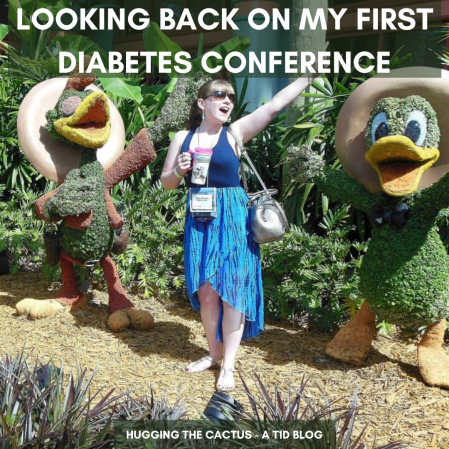
I recreated my overjoyed reaction to receiving the scholarship almost immediately upon arriving to Disney. Here’s the photographic evidence.
Fast forward to July 10th, when I found myself sitting next to my father, the most wonderful traveling companion, on a plane. Our destination was the Coronado Springs Resort located in Disney World, where we would spend the next five days taking advantage of all the conference had to offer. I wasn’t sure what to expect. Would I meet other people my age? Would I enjoy myself? Would I benefit from the conference? I was anxious, to say the least.
My concerns were allayed once I registered and saw a lobby full of conference attendees. I did my best to absorb the sea of faces before me: all of those people had something gigantic in common with me. It dawned on me that I would get to know some of them well over the course of the next few days, and I couldn’t wait to start the process of making some friends for life.
Before I go on, you might be wondering what exactly happens at a Children With Diabetes Friends for Life conference. In short, families or adults with type 1 gather to spend time together. Participants are are divided into groups by age. I was sorted into the college-age group, which was for 18-22 year olds.
For the duration of the conference, attendees are encouraged to participate in workshops that address a large variety of diabetes topics, like the latest technology for diabetics, dating and diabetes, starting a family with diabetes, and creating diabetes blogs. I had the pleasure of meeting Jessica Apple and Michael Aviad at the diabetes bloggers session, as well as fellow bloggers Kerri Sparling and Scott Johnson. As a relatively new diabetes blogger, I found this workshop to be enlightening as I listened to the advice other bloggers had to offer. I’m excited to explore the intriguing realm of diabetes blogs and gain insight that I can apply to my own blog.
As far as the social aspect of the conference was concerned, I hit it off immediately with several people at the college dinner that was held on Wednesday night. Each person I spoke to had a different perspective on what it was like to be a young adult with diabetes. I was impressed by the clear resilience and independence of the students around me, and I was truly pleased to learn that diabetes wasn’t the only thing we all had in common. Thursday night proved to be fantastic, too. We attended the Friends for Life banquet and ball, which was a full-fledged party with food, music, and dancing. Then my newfound friends and I ventured to Downtown Disney and had a blast soaking up the magic of Disney World and exchanging stories – both diabetes related and unrelated.
One story that I heard at the conference particularly moved me. I was at Brandy Barnes’ workshop about Women and Diabetes – another excellent session – when a diabetic woman sitting next to me became emotional as she spoke about her young daughter with diabetes. She explained how she was dealing with guilt, as she felt responsible for her daughter’s diabetes. She feared the consequences this would have on her little girl later on in life. I felt a compelling need to reach out to this woman and let her know everything would be okay. I spoke to her briefly after the workshop, and explained to her that my mom and I are a diabetic duo, too. I told her that when her daughter grows up she’ll be grateful for her support, knowledge, and perspective as a fellow diabetic with a deeper understanding of diabetes. My mom and I can attest to how even though diabetes has tried to knock us down over the years, we’ve taken control of it and become stronger as a result. I gave the woman my e-mail and the address to my blog, and if she is reading this now, I want her to know that I meant what I said: everything will be okay.
Looking back now with the eyes of someone who attended the Children with Diabetes Friends for Life conference I can say that I regret – to a certain degree – not attending camps when I was younger. Being around others with diabetes has given me greater awareness of what it means to live with diabetes. Additionally, I am feeling more inspired than ever as a diabetic and a writer to put my story out there and do anything I can help and impact others, all while listening to and learning from what others affected by diabetes have to say about it, too.
Starting tomorrow, I’m on vacation for a week – not from my blog, of course, but from my real-world job.
I’m headed to the beach for the week. It just so happens it’s also the week of the first virtual CWD FFL conference, which I plan on jumping in and out of throughout vacation.
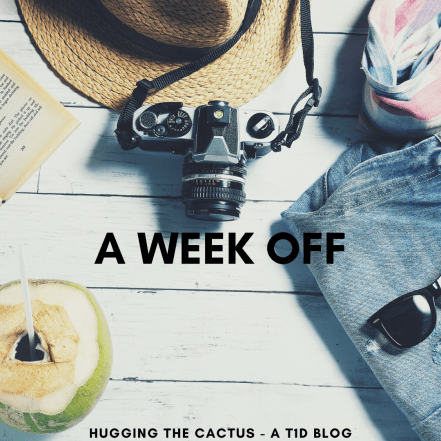
I HOPE my week off involves all of the things in this photo – I’m looking at you, fancy coconut drink.
Like many other 2020 CWD FFL conference registrants, I have many mixed feelings about the conference turning virtual. I’m sad and disappointed that after a seven-year hiatus from conferences, I’m not able to make my IRL return to it this year. But I’m also exceptionally grateful that the CWD FFL staff made the call months ago to turn virtual because they recognized it would be safest for our at-risk population. I’ve been in awe over how quickly they made the transition from an enormous in-person event to an enormous-er virtual event – they’ve proven how effective they are at organizing this sort of thing, and I applaud everyone involved for their efforts.
My original plan was to attend the conference in-person this year while my family was at the beach for the week. But obviously, when the conference became virtual, I decided to tag along to the beach with my laptop in tow because I wanted the best of both worlds: family time and diabetes online community time.
Normally, I wouldn’t dream of packing a laptop along with my swimsuits and sunscreen, but even a trip to the beach looks a little different this year. I have no idea if my family and I will be able to even go to the same strip of sand and ocean without having to worry about things like too many people and not enough masks. We probably won’t be able to eat at many restaurants like we typically do on vacation; instead, we’ll likely cook a significantly higher percentage of our food at home. And we definitely won’t be able to peruse the shops like we have done every year since going to this particular beach town – we’ll have to be a little more creative when it comes to staying entertained.
It’s a weird adjustment to have to make, but I think we’re all in agreement that we’re just happy to have a safe place to get away to for a period of time. And I’m very glad to have the option to soak up the sun while also soaking up support, information, and friendship from the diabetes community.
“Full disclosure: I have diabetes, so I have to be extra careful and wear a mask and gloves.”
“Full disclosure: I have diabetes and it can be tricky for me to handle it when I’m drinking alcohol.”
“Full disclosure: I have diabetes but I love baking treats using regular sugar instead of sugar substitute.
“Full disclosure” – what is it about this phrase that has made me utilize it several times when meeting new people in the last couple of months?
The term itself means to reveal the complete, factual truth to an individual or individuals regarding a particular matter. But why have I associated it with my diabetes? Why has it become a conversation crutch for me in which I rely on it to introduce my diabetes?
Hey, Cactus Huggers…did you know that I have…DIABETES?!
I guess that’s because I’m trying to let the person or people that I’m talking with know that my diabetes is something that I feel I have to reveal to them in my own time. I want others to know that a lot of the time, my diabetes makes my decisions for me, particularly in cases that my blood sugar might be directly affected because I did or did not do something.
I also depend on the phrase as a bit of a segue – it transitions the topic of conversation to diabetes for at least a couple of minutes as I answer any questions that someone might have for me about it. It’s casual enough to reassure the other person that it’s no big deal, but it’s also a contextual clue that I’m about to disclose an important tidbit of information about myself.
I’ve always been interested in the language of diabetes – the words and terminology that are innately part of this chronic condition – and I’m well aware of the power of using certain words over others (e.g., I try to use “person with diabetes” instead of “diabetic” because it’s important to separate an individual from the condition). So I’m adding “full disclosure” to my personal diabetes dictionary because of my realization that it’s become a mechanism for me in conversation that I can use to smoothly introduce my diabetes.
The summertime season is in full swing, and now that it’s here I’m thinking of the various ways my diabetes is more pronounced in the warmer weather. It’s much more visible, leading to many more questions, but what are the cues that give it away to others? I thought of four…
Visible sites. Shorts-and-t-shirts weather makes it much harder to place pods or CGM sensors in discrete locations. And if I’m going to the beach? There’s no way that I can even attempt to hide my devices. That’s probably why I make them even more obvious with…
…Pump and sensor art. I’ve written about Pump Peelz and GrifGrips in the past – they make adhesives and skins that are specially designed to fit pods, PDMs, pumps, meters, and more. The products they make are truly little works of art for diabetes devices, and I like to make sure all of mine are decked out in the summer months so I can show off tech that’s not only functional, but also stylish.
I’m looking forward to donning my best beach-y Pump Peelz on what I hope will be many trips to the beach this summer.
Gadget tan lines. Or if you’re like me, it’s more like sunburn lines. That’s because each summer, without fail, I somehow manage to neglect the space around my pod or my sensor, so when it’s time to remove it, there’s a huge red circle around the perimeter of where the device was situated. Maybe this year I’ll actually learn my lesson and take the time to apply sunscreen properly so I can avoid the very not-cute sunburn circles.
Travel coolers. This is probably the least obvious sign of diabetes in the summertime, but to those in the know, coolers meant to protect insulin are pretty recognizable compared to regular coolers. Whether it’s a Frio cooling pouch or another brand of insulin cooler, people with diabetes tend to carry these throughout the summer months in order to prevent insulin from spoiling due to heat exposure.




 Hugging the Cactus