Molly and the Terrible, Horrible, No Good, Very Bad Diabetes Day

(Gotta give credit where credit is due on inspo for this blog post’s title – Judith Viorst authored the children’s book Alexander and the Terrible, Horrible, No Good, Very Bad Day in 1972 and a movie that was loosely based on it came out in 2014. I admit that I’ve seen neither but as someone who has appreciation for books and movies, I can at least claim an awareness of both and a deep appreciation for such a memorable title.)

At the end of July, I had my worst 24 hours of diabetes in literal years.

I’m being a little dramatic, but really, everything that could go wrong pretty much did. And what made it that much worse is that it just happened to coincide with my girls’ weekend with my college friends.

It all started after dinnertime. I had flatbread from a local restaurant that I frequent, and I substituted traditional crust in favor of cauliflower crust – my hope being that this would have less of an impact on my blood sugar levels.

No such luck. In the 3-4 hours post-dinner, my blood sugar steadily climbed, reaching a peak of the low 300s at its highest. It just didn’t make sense! I had 4 pieces of flatbread. They weren’t massive. Veggies were the only topping. Maybe it was my pod? When I went to check my PDM to see how much insulin I had on board for what felt like the fiftieth time that evening, I discovered that I’d been burning through so much insulin that I only had a few units left in the pod, meaning that I’d definitely have to change it before I went to bed to ensure I didn’t run out of insulin overnight.

I was super annoyed as a result of my hyperglycemic state and the need to do a premature pod change, but apparently also exhausted by the ordeal as I lapsed into an early sleep in my armchair while my friends stayed up. By the time I snapped out of my slumber, I was groggy, thirsty, and upset that my diabetes was affecting my ability to hang out. When we all turned in for the evening around midnight, I went to bed hoping that my mood and blood sugars would be turned around by the time I woke up in the morning.
Except they didn’t. I woke up in the middle of the night with not one, but two separate low blood sugars. My broken sleep combined with the wild oscillations of my blood sugar caused me to roll out of bed with a stinging pain in my eyes and a defeated spirit that I tried my best to hide from my friends, but to no avail. In fact, I ended up in a heap on the floor, crying to them as I apologized for my grumpy mood and attempted to explain to them what had gone wrong in the last 12 hours. They were all very understanding and supportive, but I felt horrible for being so temperamental and curt with them; after all, none of this was their fault. I promised them that I’d cry it out, wash my face, get dressed, and spend the rest of my time with them with an adjusted attitude.

This mostly worked – we were able to enjoy bagels and lattes for breakfast, as well as a long walk in the first truly gorgeous morning of weather we’ve had since May. My attention was absolutely still partially focused on my diabetes, especially since bagels are notoriously tricky to bolus for, but my resulting spike from indulging in one wasn’t too bad since it was offset by the walk.

By the time my friends departed, my blood sugar was mostly back under control. This must be when things started turning around for me, right? Wrong! As I cleaned up my condo, I ripped my pod – the one that I had just applied the previous evening – clean off my leg. Cursing, I tried to calm myself down because this was something I could easily fix. I decided to call my boyfriend while I did the pod change routine, which was yet another mistake on my part as I accidentally deployed the cannula before the pod was even on my body.

It was like a comedy of errors. I shouted – yes, legitimately yelled – to my bemused boyfriend that I had to go. I needed to get this pod change done and over with, distraction-free. So I repeated the process, only to find that pod #2 was unusable because the cannula was poking out.

Was the universe laughing at me at this point? It sure felt like it.

Third time’s the charm, I told myself as I audibly sighed out of frustration. And thank goodness that it really, truly was – the third attempt at putting a new pod on was the one that did the trick. I remember falling back in my chair after the pod was securely attached on my body. The rollercoaster blood sugars and the unpredictable technology demands truly drained me, and this was just one 24-hour window of dealing with diabetes.

Thank goodness most days aren’t like this terrible, horrible, no good, very bad diabetes day!

Sniffles, Sore Throats, and High Blood Sugar Levels

The sure-fire sign that I’m developing a cold is when my throat begins to tingle.

It’s subtle, but unmistakable. It won’t go away with a few sips of water – it lingers, and worsens over the course of a day or two. That’s when I know that I’m coming down with something, and that I’d better brace myself for the symptoms that will come on next: a stuffy nose, aches, coughing, and so forth.

What I was less prepared for this time around (which hit me right on the heels of my Nashville trip) was much higher-than-normal blood sugar levels.

Let me back up a bit. It all started with the aforementioned sore throat on my second-to-last day in Nashville. I knew I was coming down with something, but I also knew I couldn’t do much about it other than try to have fun the rest of my trip (which I certainly did). By the time I woke up the day we were due to fly home, I was seriously struggling as congestion settled into my ears and head.

The next four days were a blur as I slept on and off, went through multiple boxes of tissues, and took both Benadryl and Tylenol to combat my symptoms. I also went through copious amounts of insulin as a new symptom emerged: high blood sugar levels.

I wasn’t surprised by the high sugars; after all, I was barely moving and not eating much more than the dusty cans of soup sitting in my pantry. But I was definitely frustrated as I couldn’t recall the last time that I had to deal with both “real people” sickness (also known as any type of sickness that is separate from diabetes) and turbulent blood sugars. That’s why I ended up contacting my doctor just to see if there was any advice (or medication) that I could take to make all my symptoms more bearable.

Fortunately, my doctor was able to confirm that I didn’t have covid, strep, or the flu – a major relief to me – but unfortunately, she had no other help to give me other than reassurance that continuing to stay hydrated, well rested, and on top of my levels would be the best way to beat this. So I doubled down and listened to my body’s needs (I think it was rebelling against me for the way I treated it with little sleep and too much overindulgence in Nashville – more on that later) by doing just that, even though it meant completing a couple of pod changes a full day earlier than normal because I was using so much insulin.

My perseverance paid off, and by day 6 or 7 of my cold, I finally started turning a corner. While my cough and the remnants of congestion are still hanging around, at least my blood sugar levels returned to normal, along with my daily insulin intake. A huge relief, and a solid sign that I’m doing a good job at taking care of my overtired immune system as well as my ever-needy diabetes.

Sluggish

Pasta for lunch. I knew it was a gamble, but on a snowy Friday afternoon when I had a bowl of leftover spinach-stuffed ravioli in the fridge that was begging to be heated up, I simply couldn’t resist it.

I took a larger-than-usual lunchtime bolus to account for the heavy carbs. Or at least I thought it’d account for the carbs. But I was way off. Roughly 45 minutes after I gobbled up my meal, my blood sugar was beginning to take off – with no sign of a smooth landing in sight.

Not that I noticed. Rather, I found myself feeling…slow. My eyes felt droopy with a gradual drowsiness that I couldn’t fight off. Normally, this would feel quite pleasant, especially if I was about to take a nap. But on a Friday afternoon, when I had some work items to wrap up, it was far from a welcome sensation.

As I sat there, staring blankly at my monitor and pretending I couldn’t hear my buzzing CGM that was trying to alert me to the current state of my blood sugar, I was falling deeper and deeper into a state of utter sluggishness. I craved the warmth emitting from my space heater by my desk, relishing how the heat lulled me into listlessness.

In that moment, I was the human equivalent of a happy little slug, oblivious to the realities around it and going about life at my own passive pace, without a single other care in the world.

A representation of me as a slug in a high blood sugar stupor, complete with pod.

I don’t remember what caused me to snap out of my stupor – perhaps I’d heard my CGM vibrate one too many times, or maybe common sense jolted me into realizing that I had stuff to do and couldn’t afford to be overcome by this sensation. But I did find myself peeking at the number that my Dexcom was reporting to me and being somewhat appalled by my hyperglycemic state, as well as being almost grateful for having a logical explanation for why I’d turned into a slow-moving shell of a person. It’s funny how even after 25 years of diabetes, a high blood sugar can still throw me off my game in such a dramatic way. Luckily, a solid correction bolus, change of scenery from my overly cozy desk in my bedroom to the cooler comfort of my downstairs setup, and a large bottle of water brought me back down to where I needed to be – maybe a bit more slowly than I would’ve liked, but hey, a slug can’t complain about swiftness (or lack thereof).

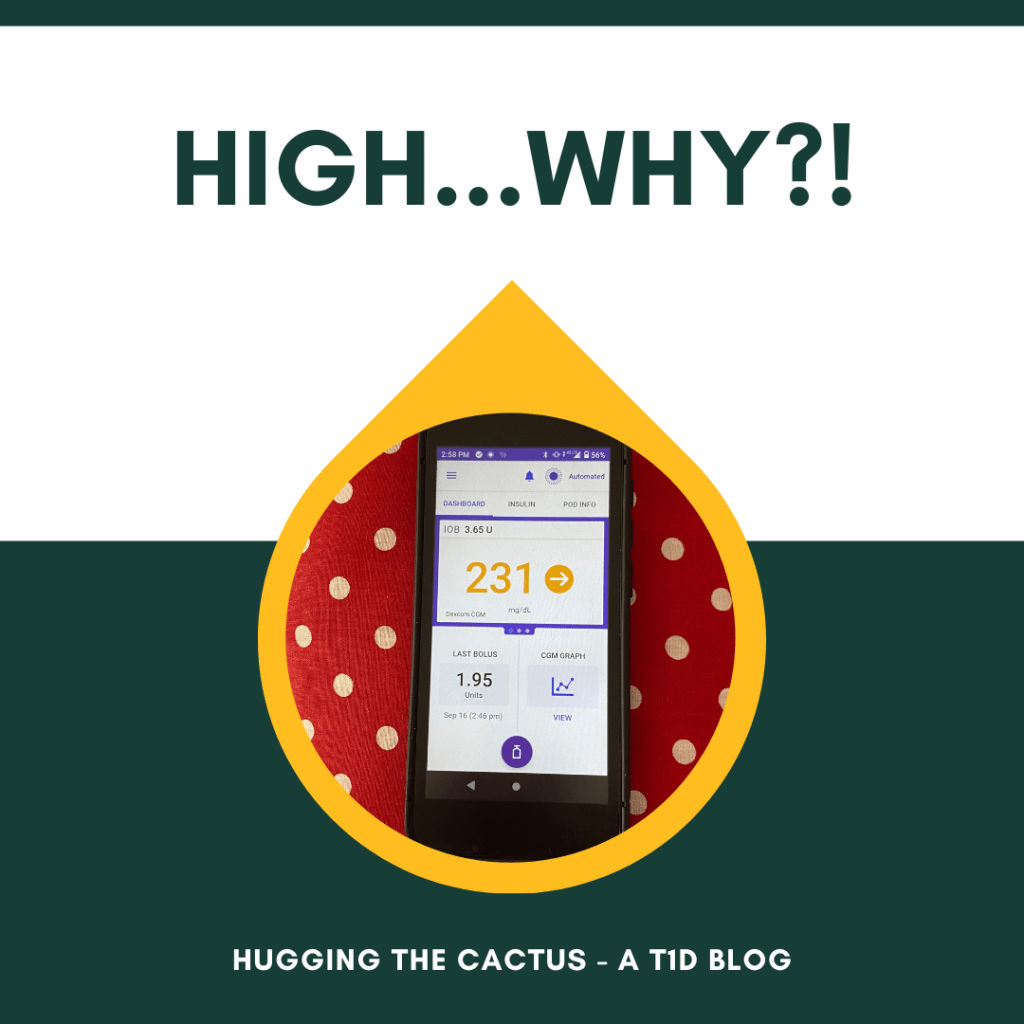
High…Why?!

Ugh, high again? Why does this keep happening?!

I mused to myself as my Dexcom vibrated incessantly, alerting me to the state of my blood sugar.

I’ve actually been wondering that very thought (and cursing out loud about it) more often than I’d like in recent weeks.

High blood sugar = the diabetes version of kryptonite, at least for me.

It’s been about 3 weeks since I started the Omnipod 5, and I guess my high hopes for the system to revolutionize my blood sugars came to be a little too literally. The 5 has been a godsend in terms of 1) helping me sleep through the night as I’ve only woken up once this month to correct a low OR high blood sugar and 2) catching lows before they happen or before I have to eat something in order to bring my BG back up.

But what the 5 and I are struggling with is the exact opposite of the latter, and that is catching highs before they happen – and then reacting accordingly. I’ve found that I’m dealing with more rapid and prolonged spikes than I thought I’d be. I’m doing what I can to proactively treat them myself by bolusing when they occur, but for some reason, it seems to take a solid 2-3 hours for my blood sugar to come back down nearly every time.

After consulting with some of my diabetes pals about this, and giving it some further contemplation, I’ve got a 3-step action plan to combat these highs:

  1. Give my Omnipod 5 more time to learn my body’s patterns – I’ve heard across the community that it can take several weeks for this to happen most effectively, so I need to try to be patient and wait for the results to occur.
  2. Continue to correct for highs when they occur, and do so swiftly. One of my colleagues said this helped a lot in the beginning, so I will continue to monitor for highs diligently and not be shy about bolusing for them (as long as I’m not stacking insulin too much).
  3. Pre-bolus, pre-bolus, and pre-bolus some more. I’ve always been a believer in the power of the pre-bolus, especially since I know that Humalog typically takes 60-75 minutes to start working in my body. I’m going to build pre-bolusing into my schedule and try to do it at least 30 minutes before I actually eat each of my meals, and we’ll see where that takes me.

Hopefully, this plan of mine coupled with my automated insulin delivery system will nip these high episodes in the bud before long. I can’t wait for “why, high” to become “smooth sailing” and translate into beautiful, level Dexcom graphs!

5 Ways Hot Weather Affects Diabetes

I’ve posted this on Hugging the Cactus a couple of times now – once in 2018 and again last year. I’m sharing it a third time today because we are in the throes of summertime now that July has arrived, and I needed a little reminder as to why it’s important to take certain precautions when it’s hot outside to take the best possible care of myself and my diabetes…

The summer heat seems to be here to stay in Massachusetts. We’ve experienced several weeks of soupy, high-heat weather that *almost* makes me long for cooler, autumnal days…but not quite, because that just means winter (and snow – blech) is right around the corner.

Truly, I do enjoy the summertime. To me, summer is about trips to the beach, ice cream consumption (and lots of it), barbecues with family and friends, long walks in the neighborhood, and endless outdoor adventures. Aside from all of those lovely things, summer also means that it’s time to be a little more diligent when it comes to my diabetes. That’s because hot weather can play some cruel tricks on a T1D’s body. What do I mean by that? Here’s five ways diabetes can be affected by hot weather.

Another thing to know about hot weather and diabetes? It will most definitely trigger ice cream cravings. Bolus accordingly.
  1. Dehydration can lead to high blood sugar. Everyone knows that it’s important to stay hydrated when it’s hot out, but it might be less common knowledge that dehydration can directly affect blood sugar. There’s a scientific explanation for this: If not properly hydrated, the body sees an increase in blood glucose concentration because blood won’t flow as easily to the kidneys, making it difficult for the kidneys to get rid of excess glucose in urine. The best way to prevent this, naturally, is to drink plenty of water and monitor blood sugars.
  2. Sunburn can drive up blood sugars. I’m very familiar with how a sunburn can result in higher blood sugars; in fact, just last week I was dealing with a particularly gnarly sunburn on my thighs and belly that not only made my numbers higher, but also really hurt. My skin was literally damaged, so the stress from the injury lead to retaliation from my blood sugar. Luckily, it only lasted about 48 hours, but those couple of days were challenging as I dealt with sticky highs that were practically resistant to insulin. And for the record, I DID apply sunscreen – numerous times – when I was at the beach. Next time, I’ll seek shade under the umbrella.
  3. Sweat can make it difficult for devices to stick. I don’t know a single medical device that’s immune to prolonged exposure to moisture/water, but that doesn’t prevent me from spending as much time as I can outdoors/at the beach/by the pool in the summer. Thank goodness for Skin-Tac wipes and medical adhesive tapes that help preserve my precious pods and sensors!“
  4. Insulin can overheat. There’s a reason why insulin vials come packaged in cartons with directions that specify what temperature insulin should stay at in order for it to be safe to use. Insulin can spoil easily when it reaches a certain temperature, so it’s important to store it in a cool place when the weather’s warm. I alternate between a mini portable cooler (that can hold 3 vials of insulin) and a pouch from FRIO – both do an excellent job at keeping my insulin cool.
  5. Low blood sugars can occur more frequently. Summertime is prime time for outdoor activities that result in higher energy expenditure. So it’s no wonder that blood sugar tends to plummet in hot weather. Looking at it on the bright side, it’s an excuse to eat even more ice cream – but it also means that monitoring how I feel and checking blood sugars often is that much more important.

Regardless of the diabetes challenges it may cause, I love summer weather, and I know I’ll miss it the moment the first snowflake falls this year.

Stress: The Sneaky Blood Sugar Spiker

Carbohydrates. Insulin intake. Exercise. These are things that most obviously impact blood sugar levels. But things like sleep, time of day, medication interactions, environmental changes, and yes, stress, might be more surprising factors that can wreak havoc on blood sugar in much stealthier ways.

Stress, in particular, is the one that’s been driving me (and my blood sugars) up the wall lately.

Truth be told, I’ve invited most of this stress into my life by committing to one (or seven) too many things this month. My calendar is positively overflowing with meeting invitations, hangouts, classes, and appointments, making the one or two evenings a week that I have to myself feel incredibly precious. Honestly, I kinda knew what I was doing when I flooded my schedule with so much because a significant part of me thrives under pressure and needs to stay busy. This is the same part of me that misses working full-time in an office because it broke up my otherwise fairly mundane routine; ergo, I felt justified in amping up my recent social activity.

Yet, there is another (smaller but still powerful) part of me that wishes I knew when to say “enough is enough”.

This image sums up the month of March perfectly for me: a bit of a time warp.

And now, that smaller part of me is standing with her hands on her hips, looking at the busy bee part of me defiantly, and saying “well, what did you expect?” in regards to the stressed-out feeling I haven’t been able to shake lately, as well as the high blood sugar levels that have been a direct result of that.

I’ve been doing everything I can to combat them – increasing my temp basal rate, lowering my carb intake, staying hydrated, getting daily exercise, and taking (nearly) double mealtime insulin doses at times. Some of these things have worked better than others, but as I sit here and write this post, I’m wondering if taking time to actively destress, in addition to prioritizing sleep, are the missing pieces in the puzzle.

Between jetting off from one thing to the next, I’ve barely had enough time to breathe, let alone practice self-care such as meditation or just…sitting on the couch and just being. And I’ve definitely not been getting as much sleep as I should. My teenage tendency to stay up late has collided with my adult habit of getting up early, which is an unpleasant combination.

So I’m thinking that the best way to evade stress, the sneaky blood sugar spiker, is to tackle it head on by addressing my lack of sleep and self-care. I know that my diabetes, and the rest of my body, will thank me once I take the chance to slow down.

Highs Won’t Ruin My Happy

High blood sugar isn’t fun.

When I experience it for prolonged periods of time (say, 2+ hours), I’m far from a happy camper. I anxiously check my Dexcom every 5 minutes until I see my blood sugar start to come back down to range. I gulp down glass after glass of water. I stack insulin (only sometimes). And I will even march or dance around in place as a means of getting my number to come down faster.

Needless to say, my mood tends to be pretty foul when I have a high blood sugar…

…except on the occasions when I refuse to let it steal my happiness.

One such event recently occurred. I was away for the weekend to attend a wedding that I was so dang excited to go to. I couldn’t wait to get all dolled up and spend some quality time with my partner and his friends. It was the first large event that I was going to since the pandemic began, and I admit there were some nerves despite being fully vaccinated. However, I felt better knowing that 1) everything was taking place outdoors, 2) I was surrounded by other like-minded individuals, and 3) I would still be taking extra precautions (e.g., using copious amounts of hand sanitizer all weekend long) to make sure that I was protecting myself and others, too.

I just wanted to have fun without worrying about the what-ifs…delta or diabetes be damned.

High blood sugar was no match for me and my happiness bubble.

And I just wanted to live in what I’ve since dubbed my “happiness bubble”, otherwise known as my own personal la-la land, in which everything is lovely and safe and none of the world’s many issues can penetrate.

An ignorant and naive place? Yes, for sure, but one that allowed me to embrace everything about the weekend:

It allowed me to enjoy every bit of food and drink all weekend long, even though it caused crazy high blood sugars.

It allowed me to forget about my diabetes for awhile and just soak up the company of others and the (truly beautiful) environment that I was experiencing.

It allowed me to feel bliss that I hadn’t really felt since before the pandemic.

Sure, it’s not sustainable to live this way all the time, and it definitely is not an effective diabetes management tactic. However, it was beyond worth it, just for a weekend, to live in my happiness bubble that high blood sugars or diabetes couldn’t ruin, no matter how hard they tried.

How I Learned the Importance of Carb Counting

This blog post was originally published on Hugging the Cactus on April 6, 2018. I’m reposting it today because most people know that carb counting is important to a person with diabetes, but they might not understand exactly why. This post features an example that demonstrates all too well the negative implications associated with neglecting to carb count. Read on to learn how I figured out the importance of carb counting…the hard way…

One recent evening, I was rummaging through the kitchen pantry and noticed a bag of “veggie stix” stashed away, waiting to get opened. The sight of the bag instantly brought back memories of a time I was blatantly irresponsible with my carb counting and insulin dosing…

I learned the hard way that neglecting to count carbs can lead to scary high blood sugars…

…It was my junior year of college. I had plans to meet with a friend for dinner at seven o’clock. While that’s a standard suppertime for many people, it was kind of late for me. So that explains why I decided to treat myself to a snack a couple hours before it was time to go, just to hold me until I had my meal. My snack of choice? A bag of veggie stix just like these were sitting in the kitchen of my on-campus apartment. I thought I’d help myself to a few, believing (naively) that I had enough self control to know when to stop shoveling them down my gullet. That’s right, instead of doing the right thing and counting out a bunch before stowing the bag away, I was blindly consuming handful after handful without dosing for a single stick.

I can’t even use the defense that these veggie stix are strangely addicting – they really are, they taste a little like those potato sticks that used to come in cans – because I knew what I was doing wasn’t good for me. I just didn’t care. I had munched my way through half of the bag when it dawned on me that it would probably be smart to stop myself from eating more. I rolled up the bag, returned to my room, and did some homework until it was time to meet with my gal pal.

Little did I know that my blood sugar was rising to potentially dangerous levels.

I didn’t find out how high I was – over 400 mg/dL – until I reached the sandwich shop and had a plate full of chicken pesto carb-y goodness waiting to be consumed. My face must’ve shown my shock, because my friend asked me if I was alright. I quickly explained to her my mistake, and took an extra large bolus to cover my food and correct my blood sugar. Once that was done, I somehow managed to stop panicking long enough to enjoy the dinner with my friend, even though I couldn’t eat a bite of mine until an hour or so after injecting my insulin.

Although it sucked to go through this, I’m kind of glad that it happened because I learned a major lesson from it: ALWAYS count my carbs. It doesn’t matter if I WANT to be lazy or pretend that my diabetes doesn’t exist, I HAVE to hold myself accountable. It may be mentally draining and a bit of a nuisance, but it’s my own health here. It’s up to me, and me alone, to manage it.

And by the way, I did just help myself to the above bag of veggie stix. I had exactly 24 pieces, which equals exactly 5.4 grams of carbohydrates – a much smaller amount than what I ate that one night five years ago.

5 Ways Hot Weather Affects Diabetes

This blog post was originally published on Hugging the Cactus on August 6, 2018. Call it an “oldie but goodie” because the ways in which hot weather can affect diabetes haven’t changed in the last few years and they won’t be changing any time soon…and with summer just around the corner, it’s good to remind ourselves of the extra precautions we might want to take in order to combat the heat. Read on for more on the ways summer weather can affect people with diabetes…

The summer heat seems to be here to stay in Massachusetts. We’ve experienced several weeks of soupy, high-heat weather that *almost* makes me long for cooler, autumnal days…but not quite, because that just means winter (and snow – blech) is right around the corner.

Truly, I do enjoy the summertime. To me, summer is about trips to the beach, ice cream consumption (and lots of it), barbecues with family and friends, long walks in the neighborhood, and endless outdoor adventures. Aside from all of those lovely things, summer also means that it’s time to be a little more diligent when it comes to my diabetes. That’s because hot weather can play some cruel tricks on a T1D’s body. What do I mean by that? Here’s five ways diabetes can be affected by hot weather.

Mr. Sun, Sun, Mr. Golden Sun, please shine down on me (and don’t make me go low or high…)
  1. Dehydration can lead to high blood sugar. Everyone knows that it’s important to stay hydrated when it’s hot out, but it might be less common knowledge that dehydration can directly affect blood sugar. There’s a scientific explanation for this: If not properly hydrated, the body sees an increase in blood glucose concentration because blood won’t flow as easily to the kidneys, making it difficult for the kidneys to get rid of excess glucose in urine. The best way to prevent this, naturally, is to drink plenty of water and monitor blood sugars.
  2. Sunburn can drive up blood sugars. I’m very familiar with how a sunburn can result in higher blood sugars; in fact, just last week I was dealing with a particularly gnarly sunburn on my thighs and belly that not only made my numbers higher, but also really hurt. My skin was literally damaged, so the stress from the injury lead to retaliation from my blood sugar. Luckily, it only lasted about 48 hours, but those couple of days were challenging as I dealt with sticky highs that were practically resistant to insulin. And for the record, I DID apply sunscreen – numerous times – when I was at the beach. Next time, I’ll seek shade under the umbrella.
  3. Sweat can make it difficult for devices to stick. I don’t know a single medical device that’s immune to prolonged exposure to moisture/water, but that doesn’t prevent me from spending as much time as I can outdoors/at the beach/by the pool in the summer. Thank goodness for Skin-Tac wipes and medical adhesive tapes that help preserve my precious pods and sensors!“
  4. Insulin can overheat. There’s a reason why insulin vials come packaged in cartons with directions that specify what temperature insulin should stay at in order for it to be safe to use. Insulin can spoil easily when it reaches a certain temperature, so it’s important to store it in a cool place when the weather’s warm. I alternate between a mini portable cooler (that can hold 3 vials of insulin) and a pouch from FRIO – both do an excellent job at keeping my insulin cool.
  5. Low blood sugars can occur more frequently. Summertime is prime time for outdoor activities that result in higher energy expenditure. So it’s no wonder that blood sugar tends to plummet in hot weather. Looking at it on the bright side, it’s an excuse to eat even more ice cream – but it also means that monitoring how I feel and checking blood sugars often is that much more important.

Regardless of the diabetes challenges it may cause, I love summer weather, and I know I’ll miss it the moment the first snowflake falls this year.

Dodging DKA: What Happened and What I Learned From It

In 23ish years of life with type 1 diabetes, I’ve never really experienced DKA…and I feel wildly fortunate to have avoided it.

But the other day, I came extremely close to it, and it’s something I won’t soon forget.

Here’s what happened: It was the wee hours of a Sunday morning. I woke up because I had to use the bathroom. My pod was on my thigh. I was due to change it that Sunday evening. I noticed that the pod’s adhesive folded up in the exact wrong way (it was crinkled up by the cannula), causing the cannula to bend and dislodge itself from my body…

…except I didn’t make that super-important observation until around 11 A.M., after several hours of tossing and turning in bed, unable to sleep because I was battling both a headache and stomachache.

What’s more is that around 10 A.M., I noticed that my CGM had been reporting a high blood sugar since about 5 A.M., and I simply hadn’t heard it alarming. When I saw that I was high, I took a bolus, but I didn’t bother checking on my pod because to my knowledge at that point, there was nothing wrong with it. Fast-forward to one hour later to when I did discover the dislodged cannula and I was feeling downright terrible: My stomachache turned into full-blown nausea, my head was pounding, my throat was drier than the Sahara, I couldn’t unfold myself out of the fetal position, AND I was feeling incredibly stupid for 1) missing my CGM’s blood sugar alerts and 2) not checking my pod to make sure it was secure to my body.

What bothered me more during this whole ordeal: my headache, my stomachache, or my anger at myself for letting this happen? (If you guessed the latter, then you’d be right.)

Fortunately, I did have a back-up pod and insulin with me, so I went about activating the new pod as quickly as possible. I felt a fleeting sense of relief when it was on me, but that relief turned into panic when I felt a swooping sensation in my stomach that indicated I was about to be sick. I ran to the bathroom and retched once, grateful that nothing actually came up, then sank down on the floor in shame, wondering how I could let myself get to this point of obvious borderline DKA.

The next few hours passed in a blur as I crumbled back into bed. I drank as much water as I could stomach, gave myself bolus after bolus, increased my basal rate, and tried to settle into a comfy position. I was extremely lucky that I wasn’t alone during this whole ordeal: My significant other was very concerned and doing everything he possibly could to help me. I was and am still so grateful for his care and attention. I didn’t admit it to him, but I was a little freaked out by the whole experience, but I took consolation over the fact that it didn’t come down to him having to bring me to the hospital.

By 4 o’clock that afternoon, my blood sugar was finally below 180 again and I was able to eat a little food, though I wasn’t overly hungry. I spent the remainder of the day beating myself up for letting this happen, but I guess that if I learned anything from it, it’s that I need to remember to 1) keep the volume turned up on my CGM so I can hear the alarms going off overnight, 2) check my pod immediately after hearing a high alarm so I can rule out any obvious pod issues, and 3) bring a syringe with me wherever I go so I can inject myself with insulin/get it in my system faster than a pod would be able to.

The experience also taught me a couple of other things…DKA is very real, very dangerous, and should be taken very seriously. The fact that I just barely dodged it is a jarring reminder that I should never underestimate it. On a much lighter note, though, I also proved to myself that I’m able to take control of a situation like that the moment I become aware of what’s going on. Thank goodness I was at least prepared enough that I had an extra pod and insulin on hand. I hope there isn’t a next time, but if there is, I know exactly what to do in order to take care of it as quickly as possible, thanks to this icky experience.