4 Ways Diabetes Makes it Difficult to Sleep

I’ll never forget the first time I saw my mother’s bio in her high school yearbook: She’d listed “sleep” as one of her favorite past times. I though it was hysterically funny then, and I still do now, but I also think it makes her incredibly relatable. Who doesn’t love catching some z’s?

I may not be unique to others when I say that I love a good night of sleep, but only people with diabetes know the real struggles that we, without functioning pancreases, face virtually every night at bedtime.

Because that’s right, diabetes doesn’t just make life hard for us when we’re awake, it also disrupts our precious slumbers. How dare you, diabetes!

Here’s four ways in which diabetes can make it difficult to sleep:

1 – Beeping and buzzing devices. Nobody actually likes waking up to a blaring alarm clock. Imagine not only having to contend with that, but also the possibility of low and/or high alarms going off at any hour of the night. The shrill alarms built into my Dexcom are very rude awakenings and definitely serve as an extra incentive to do everything possible to try to stay in range overnight, but we all know that diabetes can be unpredictable, so this isn’t always possible.

2 – Rolling over on uncomfortable sites. I toss and turn throughout the night: Usually, I fall asleep on my back, then switch to my side, and roll over on my stomach…multiple times throughout the night. And I never seem to be able to do it without rubbing up on a site. It doesn’t matter where it is – my arms, legs, stomach, or back – any rockin’ and rollin’ I do in my sleep is almost always bound to push my CGM sensor or pod uncomfortably harder into my body, and it can be the reason why I wake up in the middle of the night to make yet another adjustment in how I’m sleeping.
4 Ways Diabetes Makes it Difficult to Sleep
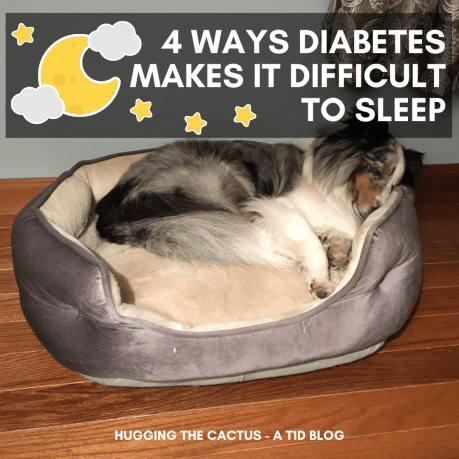
At least my diabetes has zero impact on Clarence’s ability to sleep. Was this another excuse to use my adorable dog as a good photo for this post? I shall neither confirm nor deny.

3 – Waiting for a high to come down. There have been a handful of occasions in the last year of life with diabetes ALONE in which I’ve been so, very tired but too afraid to go to sleep until my blood sugar has come down to a “safe” level. It doesn’t matter if the high was caused by incorrect carb calculations or a site that I’m not sure is working properly – I just want to avoid sleeping knowing that I have a hyperglycemic blood sugar because waking up to one in the morning is bound to start my day off on the wrong foot. And it even resulted in a trip to the ER one time, which I don’t want to experience again.

4 – Waking up to a low. Just like high blood sugar, low blood sugar can also delay and/or interrupt sleep. Whether the low happens just after brushing my teeth and I’m forced to ruin my fresh breath with something sugary (just thinking about the orange juice and mint flavor combination makes me wanna yak) or if it wakes me up from a sound slumber and I proceed down the stairs to eat the entire kitchen because I’ve run out of low supplies on the nightstand next to my bed…you get the picture. It’s downright annoying and honestly I bet that I’ve had at least a couple hundred nights of sleep in my 22+ years of diabetes disrupted to a low.

So you see, as much as a person with diabetes like me enjoys a full night of sleep, I’m always aware of the fact that my diabetes doesn’t sleep…and instead keeps me on toes.
 

From Anxiety to Adrenaline Rushes: How Extreme Emotions Affect My Blood Sugar

You know that feeling you get in the pit of your stomach when you receive bad news? It’s like your heart falls to the floor and your stomach starts swirling from the perceived sensation.

That’s unpleasant enough on its own, but for me, it can also cause blood sugar issues.

The same thing can be said for when I’m on a literal roller coaster (which doesn’t happen often, but when it does, involves extreme coercion from family or friends) – I get that awful swooping sensation on top of some sort of blood sugar impact.

Every leaf speaks bliss to me, fluttering from the autumn tree.
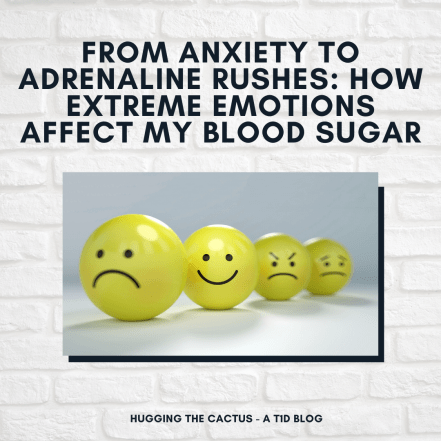
Do you know how difficult it is to find a picture depicting an adrenaline rush that isn’t a cliche shot of a roller coaster or skydiver? Hence…a slew of moody “smiley” faces.

Whether it’s anxiety, adrenaline, fear, or just a rush of unidentifiable feelings, there’s no doubt about it: Extreme emotions tend to make my blood sugar unhappy by causing it to spike.

I’ve always been somewhat aware of this phenomenon, but I started thinking about it more last week when I got some upsetting news. (I’m okay, please don’t start to speculate on what it was…just a personal matter that I don’t care to discuss in greater detail here. Love y’all for understanding and respecting that.)

Actually, it’s kind of interesting to think about how the sequence of events unfolded last Thursday. I received a message that caused me to instantly panic. I was going to learn the context behind the message about a half hour after I got it, so in the interim, I was pacing all around the house and trying to figure out what exactly was going on. My stomach was roiling, my palms were coated in a light sheen of sweat, and my already-unruly hair frizzed out even more….

…and my CGM trend started going up, up, up, ever so slowly but noticeably.

I didn’t do anything to correct my blood sugar – at least, not right away. I waited until after I heard the specific news that had gotten me so worked up to really pay attention to my rising levels. I probably could have made my high blood sugar less severe by running a temporary basal increase right after I initially freaked out, but obviously, I had other things on my mind than my diabetes at that moment in time.

The whole experience was a stark reminder that food and insulin are far from the only things that impact blood sugar levels. Raw human emotion did that to me, and it will do that to me again in the future.

It sucks, but isn’t it also fascinating to think about how diabetes is totally a physical and emotional chronic condition, in every possible way?

The Periodic Problem

I thought about how I was going to write this post many, many times. I so wanted to come up with a cute or clever euphemism for what I’m about to discuss, but really, that old “Ant Flo” cliche is all I could come up with, and that’s so overplayed.

If that didn’t give you a clue as to what this is all about, then look at the title again.

Still nothing?

Okay, this post is about my period.

Yep, the menstrual cycle, that time of the month, the curse…whatever name you want to call it, I’m talking about it today. And if you’re already cringing, chill. I promise there’s no need to, I’m not about to get graphic on you or anything.

Rather, I’m about to write about a reality that many women with diabetes face: The week leading up to a period, or the week that it starts, can be hell. And I’m not just referring to cramps or mood swings.

The Periodic Problem
This picture is actually a pretty accurate cartoon version of me…cacti plants, GameBoy, and pink included.

I’m talking about blood sugars, of course. I’ve thought about how my period and my diabetes interact more and more lately because of an “interesting” (that’s the nice way to put it) pattern that I’ve noticed each week leading up to my period for the last few months, and that’s how insulin essentially becomes as effective as water when I get it pumping through me: That is to say, my insulin intake has nearly doubled the week leading up to my period, and it’s something I never really noticed until recently.

I think I caught onto the trend in April. The week before my period started, I blamed my bad blood sugars and higher insulin intake on the fact that we were only a few weeks into quarantine, so it was natural that my body was having a tough time adjusting.

In May, I wondered whether I was dealing with faulty pods or bolusing incorrectly for my foods.

By the time June rolled around, though, I realized that there was something different at play here.

Last month, I dealt with the issue by raising my temp basal for most of the day – a 95% increase for 6-8 hours through the morning and afternoon – and giving myself 2-3 units more than I normally would at mealtimes. I still didn’t have great numbers, but they were better, and that was all that mattered to me.

But this month? I’m totally confused because this “periodic problem” did the opposite of what I expected it to do…the week before my period, it seemed like I need LESS insulin! It was simultaneously bemusing but exciting. I’ll never necessarily complain about having to take less insulin, or being able to eat an entire blueberry muffin without needing to bolus for it (yes, that really happened), but damn…some consistency here would be nice.

Who knows what my body will decide to do next month. At least I feel a little bit better knowing that there is some sort of pattern going on here that I need to pay attention to, so I’ll continue to monitor so I can try to anticipate what the week before my period will look like for my blood sugars.

Just one more reason why I kind of dread “that time of the month”, but also another justification to eat more chocolate in order to cope with it when it does come ’round.

Doctors Who Just “Get It”

Doctors who just “get” diabetes are the best.

And I’m not exclusively talking about endocrinologists here, because really, they’re the ones who specialize in diabetes…so, you know, they are supposed to just get it.

I’m talking about the other medical professionals that people with diabetes might see in addition to their endocrinologist.

Take me, for example…I see a primary care physician, a dentist, an allergist, an OB/GYN, and an ophthalmologist.

And only a couple of those specialists really understand what it means to have a T1D patient in their care.

Doctors Who Just _Get It_
It’s really nice when my doctors don’t question my authority on my own diabetes.

For example, I saw my allergist back in February (before all this COVID stuff) to see if she could switch me to a nasal spray that cost less than the $45 per month I was paying (because let’s be real, if I can save money on a prescription, I’m going to do it). The appointment was supposed to be quick and easy, but it turned into a two-hour affair (!) because she was concerned about my asthma.

I highlighted my issues with asthma in a post from January. The big takeaway from my most recent spells of wheeziness is that the inhaled steroid I was taking to deal with it at the time was making my blood sugar skyrocket, and I felt like I had to choose between breathing comfortably and maintaining healthy blood sugar levels…not an ideal this-or-that scenario by any standards.

So when my allergist detected some “squeakiness” (her words, not mine, and it makes me laugh because that’s a cute way to refer to the rasping gasping of asthma) in my lungs when she was listening to my breathing with a stethoscope, she asked me to catch her up on my history with asthma. When I did, she immediately understood my reluctance about taking the inhaled steroid, and prescribed me a new medication that will reduce my asthma symptoms as well as some of my allergy symptoms.

I’m never going to be thrilled, per se, about adding yet another medication into the mix: It’s just one more thing that I have to remember to do each day at a certain time. But what did excite me about this prescription is that I’ve noticed a real difference since I’ve started taking it. And more importantly, I felt heard by my allergist. She didn’t write off my concerns about the inhaled steroid, she took extra time during the appointment to run tests, and we had a back-and-forth dialogue in order to get to the bottom of things.

It was a stark contrast to the appointment I’d had with a nurse practitioner from my PCP’s office in which I was prescribed the inhaled steroid DESPITE having voiced my concerns, and the appointment was over within minutes.

It’s a bummer that not all medical professionals “get” diabetes, but it’s also a reminder that as patients, we can make a difference by continuing to advocate for ourselves until they do understand.

A Source of Toe-tal Stress

I don’t like horror stories.

I’m not big on scary things, in general (besides Halloween…I love dressing up)…but horror stories, in the form of tales told ’round the campfire or in media such as television or film, have never been my cup of tea. Probably because I’m a giant scaredy-cat, but I digress.

My disdain for horror doesn’t mean I’ve been able to successfully avoid it over the years. I’ve traipsed through my share of haunted houses, watched countless scary movies (with my hands over my eyes for a good portion of all films), and listened to spooky ghost stories.

The scariest story of all that I’ve heard over and over again has to do with…

Diabetes. And feet. Without going into more detail – because I’m shuddering at the mere thought – diabetes complications could lead to, um, amputations.

I’m not trying to make light of a very serious subject here: Let me be crystal clear when I say that diabetes complications are real and terrible, I wouldn’t wish them on anyone. They also frighten me so much that I tend to avoid blogging or even talking about them altogether. The slightest blur in my vision or tingling in my toes can send waves of panic through my brain that are so intense that I convince myself that I’m experiencing my first diabetes complications.

So when I discovered a cut on my toe several weeks ago, I couldn’t help but totally freak out, especially when I noticed blood around the site.

Need help_ (1)
As a person with diabetes, you’d never catch me barefoot and surrounded by all those rocks. OUCH.

For most people, a cut on the toe sounds like no big deal – you just put some antibiotic cream on it, wrap a Band-Aid around it, and let it heal. But for someone like me who has diabetes, a little cut triggers fears of serious issues like cellulitis or other infections that could lead to major problems.

It might sound ridiculous, but in the first couple days after I noticed my cut (it was a bit like a split in my skin), I had horrifying visions of my toe turning black and falling off. I became hyper-aware of every sensation I could and couldn’t feel in that area, and when I felt a slight stinging around the area a few times, I imagined that it meant that my days with all of my toes were numbered.

Was it silly for me to jump to such dramatic conclusions? Probably. Was I being paranoid? Definitely. But my overactive imagination was enough to convince me to at least consult my primary care physician about the matter.

I’m glad that I did. Over a two-week span, I had two virtual appointments with my doctor who took my concerns seriously. I described the issues and he gave me advice as to how to treat the cut (stop putting Neosporin and a Band-Aid around it each day, let it breathe, use a nail file to very gently proximate the wound, make sure I wear socks and shoes for all forms of exercise to better protect my feet). He agreed with my overarching concern: to heal it in order to prevent it from getting worse.

My toe is doing much better now, and after all that, I feel a bit (okay, a lot) sheepish that I made such a big deal about it in my head when I initially spotted the split in my skin. But in life with diabetes, everything related to my health has to be taken seriously, even if it means dealing with an added source of toe-tal stress.


My Thoughts on Returning to Work (and this “New Normal”)

We all know that 2020 hasn’t exactly gone to plan so far, largely thanks to COVID-19.

In a word, the last 8-10 weeks or so have been…weird. Collectively, the world experienced a lot of things: shock, rapid-fire adjustments, loss, and more than anything else, change.

It goes without saying that I’ve been very fortunate given the circumstances. I’ve had my job throughout this whole ordeal, and I’ve had experience working from home before which arguably made my transition to full-time remote work a little easier. While each week has come with its own unique set of challenges and emotions, there’s no denying that I’ve had it pretty good, overall, these last couple of months.

But now, along with everyone else, I’m about to enter a “new normal” (gosh I hate that term) as states begin to re-open. And with this “new normal” comes the possibility of returning to a physical office building each workweek.

I’ll admit that the sheer thought of it simultaneously excites and terrifies me.

My Thoughts on Returning to Work (and this _New Normal_)
My thoughts on re-entering the workplace are…complicated.

On the one hand, I’m yearning to go back to work in an office space. I miss my little cubicle, office camaraderie, and meetings that are held in-person, in conference rooms, as opposed to virtually.

On the other hand, I’ve never felt more anxious about returning to a space that is shared by people other than my family members.

There are a LOT of people that enter and exit my company’s building throughout the typical workday. There are at least a dozen other companies besides mine that occupy the other floors in the building. Tons of deliveries are made to these office suites each day. While there are custodial staff who do their best to keep the building clean, it can be…a challenge, as anyone who has seen our bathrooms can attest to.

Basically, I suppose that I’m feeling incredibly nervous about the exposure to germs that is bound to happen upon my return to the office.

Even if I didn’t have diabetes and wasn’t considered at a higher risk for COVID, I’m sure I’d still feel worried because it’s not just about me: It’s also about the people I live with. I’d never want to bring anything harmful into my family’s home, period, bottom line, end of story. And while the odds are pretty damn high that PPE (personal protective equipment) will become standard when re-entering the workplace, it does little to placate me because I’ve seen firsthand how sloppy people can be when it comes to wearing it or disposing of it properly.

And so, with much still unknown about COVID, it just seems like a giant gamble to resume working in an office environment when I can’t be sure that I won’t be exposed to anything.

As it stands right now, I don’t have a concrete “return to work” date. And I don’t know what exactly it will take in order for me to feel totally comfortable about returning to the office. But I do know that I’m cautiously optimistic for a smooth transition to a “new normal” that is safe for all.

3 Things I’ve Learned Since Switching to my Own Health Insurance Last Year

Just over 365 days ago, I made the switch from my parents’ health insurance plan to my own plan, provided by my employer.

In the last year, I’ve learned some important lessons about being responsible for my own healthcare coverage. Some lessons were easier to learn than others. I figured it might be helpful to others who just made the switch themselves (or who will be doing so in the near future) for me to sum up three big takeaways I’ve discovered along the way in the hopes that it makes the transition a little easier for those individuals, or at least saves them some time down the road.

AI Innovation Summit
Navigating the confusing world of health insurance has taught me quite a few lessons in the last year.
  1. Take advantage of a flexible spending account (FSA), if the option is available. I grew up knowing that FSAs exist – my parents would always bring their FSA account cards to all my doctor’s appointments and pay for all of my supplies using those cards – but I had no idea what the big deal was about them until I switched to my own health insurance plan. Basically, FSAs are a great employer-sponsored benefit because they allow account holders to pay for eligible medical expenses on a pre-tax basis. So those who have an FSA are able to pay for things they need tax-free, and the money is typically available to account holders on the first day of the health insurance plan year. My current health insurance plan allows a maximum contribution of $2,300, so I was able to put up to that amount on my account for 2020. It really comes in handy because my wallet doesn’t take as much of a beating from all of my necessary (and very expensive) diabetes supplies, and unlike the last half of 2019, I’m not paying as much out of pocket after my deductible is met.
  2. Keep records of everything. It might seem fussy to hold onto any and all receipts or transaction records, but there might come a day when one is needed. Case in point? At the end of 2019, my company announced during open enrollment that our FSA administrator was changing…which, at the time, I didn’t think was a big deal. I knew what the maximum contribution was, and I figured I’d only need to log into my FSA account sporadically to see how much money I had left for the year. Well…I was wrong about that. Back in February, I got a notification that I needed to submit verification of purchases of my regular OmniPod shipment, Dexcom sensors and transmitters, and my Humalog prescription. And you can bet your bottom dollar I didn’t have receipts for all three of those transactions because, well, my old FSA provider never once asked for receipts. As silly as it sounds now, I guess the thought never crossed my mind that my new FSA administrator would need purchase records. Long story short, I was able to submit an explanation of benefits in lieu of the receipts, but it would’ve been easier just to hold onto the original records (and I can assure you I’ve done that since this whole incident).
  3. Don’t be afraid to ask questions when things don’t add up. I had my annual physical in January and I had quite the shock when I was billed over $300 for all of the lab work that my primary care physician had me do. The moment I got that charge, I knew something wasn’t right – never before in my life have I been charged that much for a standard battery of tests that I take for my physical. So I wrote in to my PCP’s billing department and asked about the charges. That’s when I learned that I was mistakenly charged this amount and that I needed to reach out to my health insurance provider to re-run the charges. Although it was a little annoying to have to go back and forth between my health insurance provider and my PCP’s office, it was worth it because I saved myself $300 that I never actually owed in the first place. This taught me the importance of asking questions and following up with people until I understand, well, anything that’s confusing to me when it comes to my health insurance.


A Problematic Post

I am not the kind of person who scrolls through social media looking for posts that will make me angry. And I’m certainly not the kind of person who likes the idea of calling someone out on their perceived wrongs via social media (or any other medium) because I think that it’s usually not constructive.

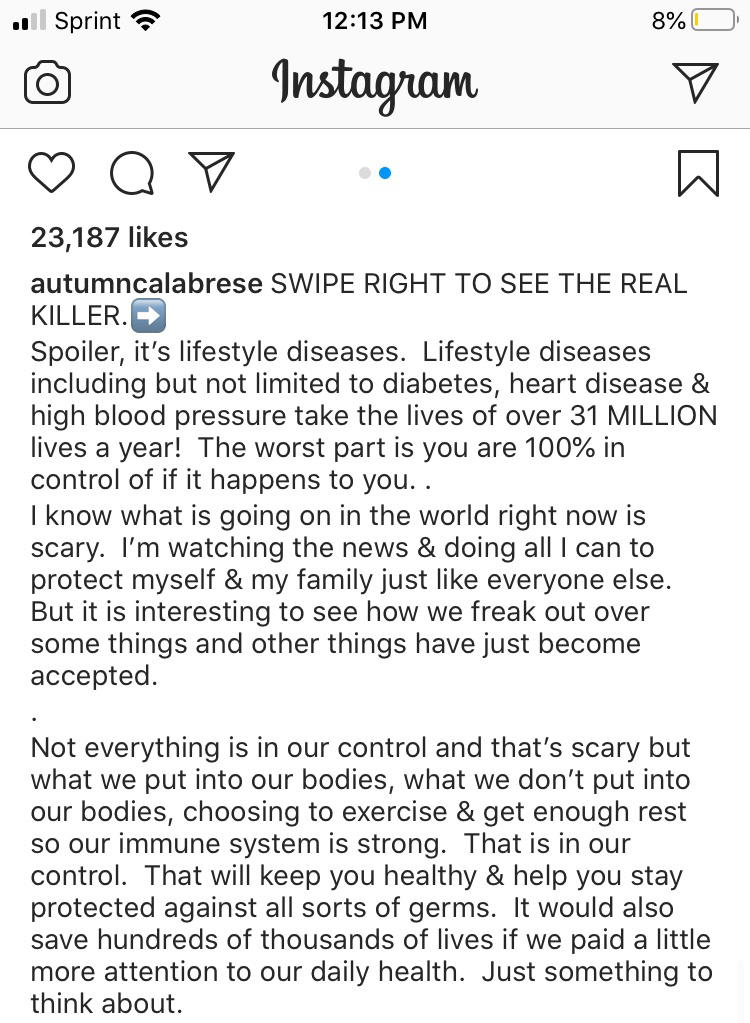
But I am the kind of person who thinks that word choice matters. So when I saw Autumn Calabrese, a celebrity fitness and nutrition expert, post the following text on Instagram, I got pretty upset. (Click photos to see them more clearly).

I’m not going to lie, I was pretty upset by this post. I’ve followed Autumn on Instagram for almost two and a half years now, ever since I subscribed to the popular Beachbody workout app. I really like her 21 Day Fix workout program because it kicks my butt every time in just 30 minutes. She comes across as a fun person who is really passionate about her job and enjoys the opportunity to help others, which is why I decided to follow her Instagram profile. Normally, I enjoy her posts because they’re filled with motivating fitness and eating tips that promote a healthier lifestyle. She definitely knows what she’s talking about when it comes to exercise and eating properly.

But after seeing this post, I think that Autumn – and people like her who are not educated in the minutiae chronic conditions like diabetes – needs to step off her soapbox.

She is using her post to say that diabetes – mind you, just generic “diabetes”, there’s no mention of any of the many types – is a lifestyle killer. She says that “the worst part about it is that you are 100% in control of if it happens to you.”

OMG. No, no, NO.

Forget that she was using the current coronavirus outbreak to promote her healthy eating plan (which in itself is a pretty weird way to advertise something) – she came after the diabetes community with this post. Now, I’ll never know what her true intent was, and I don’t care if Autumn was talking about a specific type of diabetes here. That doesn’t make a damn difference. The problem with this post is that she is perpetuating diabetes stigma and alluding to a myth that an individual has control over whether or not they get diabetes. Posts like this are the reason why there is so much confusion and misunderstanding when it comes to all types of diabetes, and I think she should be ashamed of herself for putting this on her profile.

It’s even more upsetting that she immediately got defensive when people started writing comments under her post, trying to inform and educate her. I was one of those people, and I think that I kindly and respectfully directed her to learn more by visiting beyondtype1.org so she could be better informed on all types of diabetes and maybe find out why what she wrote was harmful. Sadly, I never got a response, and her post remains on her profile, unchanged.

You can lead a horse to water, but you can’t make it drink. You can also unfollow a person on social media and write a blog post to get your feelings out there, so that’s just what I’ll do here.


COVID-19, Chronic Conditions, and…Telecommuting?

First, let me apologize for adding to what seems like a never-ending cycle of news and media about COVID-19, a.k.a. the coronavirus. But I wanted to write this post because a friend of mine works for a company that sent out a communication about it that I found…interesting, to say the least.

The email in question was about the company’s current coronavirus protocol. The following is an excerpt from the email, provided by my friend:

If you have or live with someone who has a medical condition that the WHO has highlighted as being at higher risk for complications from the virus (elderly, immunocompromised state, chronic conditions such as diabetes, chronic lung disease, and cardiovascular disease), you are strongly urged to work from home if possible with your job function. If you cannot work from home, please consult with your manager.

So…the wording of this email struck me as a little odd for a few reasons. If I worked for this company, I’d wonder: 1) Just because I have one of the named chronic conditions, does this mean I must seriously reconsider my present working environment even though nobody in my office travels internationally? 2) What exactly does “strongly urged” mean, anyways? and 3) What is a manager expected to do if someone cannot work from home, for whatever reason? Make up their own set of rules? Force someone to come in or not come in? And if the latter is the case…would a paycheck have to be forfeited?

hugging the cactus - a t1d blog
I’m absolutely amazed that I managed to find a stock image that wasn’t terrifying for this particular blog post and topic…

As I pondered the answers to these questions, I also started to think that there was a chance I was overreacting to the wording of the email. So I asked other friends how they felt about it and they reacted the same way I did. Everyone was generally confused by the message that this was saying (or not saying) about people living with chronic conditions and how they should handle a situation like this.

Plus, I can’t shake the feeling that emails like this just add to all the hype/panic that we’re already being inundated with, and if I were to receive something like this, it certainly wouldn’t do anything to ease my normally-anxious mind. It’s getting more and more challenging to tune it all out…

…but on the bright side, at least I know how to properly wash my hands and sneeze/cough into my elbow. So I’ll continue those common-sense practices every day, and when I’m doing my own work, I’ll be glad it’s from the comfort of my own cubicle.

“Real People” Sick

I’m sick. I’ve just got a cold, but my throat and head are aching so much that it’s knocked the wind out of me.

I spent the weekend confined to my bed, only getting up to blow my nose, use the bathroom, and eat something every now and then…not that I’ve had much of an appetite.

I think this is my body’s way of punishing me. It’s trying to force me to slow down, and I have no choice but to heed its commands.

I guess I shouldn’t be surprised…I’ve purposely kept myself as busy as possible in the last month. I’m always involved in something, whether it’s making plans with people, distracting myself with a new pet betta fish (his name is Tyrion and I love him), or crafting up a storm (I’m almost done knitting my first sweater and I’ve made two hats within the last two weeks). I’ve had a rough start to the year and unconsciously decided at some point or another that the best way to cope was to not cope at all. Hence, my body is rebelling against me, making it impossible for me to engage in any of the activities that would keep me busy.

And I’m annoyed.

1D453D78-461E-4A8C-9A66-1E7215334562
A sick PWD must have these essentials: a fully loaded test kit and a cup of tea made with honey and lemon. (Don’t forget to bolus.)

The silver lining is that my blood sugar/my diabetes don’t seem to be bothered by the cold. I’m sure my numbers would be better if I was exercising regularly, but that’s to be expected.

So I’m what we, people with diabetes, call “real people” sick: I’m definitely fighting something, but since it’s not affecting my blood sugars, it doesn’t have anything to do with my diabetes. And that’s a relief. Because handling sickness ON TOP OF out-of-control blood sugars/diabetes would be enough to drive me insane right now.

It’s almost nice that my blood sugar isn’t the first thing I’m worried about at the moment; instead, my priority is on relieving the pressure in my head and catching up on sleep. But I admit that it’s also frustrating because slowing down means that all of my other concerns, bothers, and feelings have time to catch up with me.

I guess all I can do now is practice being patient with myself (ha) so I can resume my routine of going from one thing to the next as soon as possible. And hey, I’ve had a genuine excuse to lay in bed and binge-watch Sex and the City for hours, so it can’t be all that bad, right?