Diabetes: Where’s the Off Button on This Thing?!

So many things in this world come with an “off” button or switch – just about all electronic devices, that obnoxious toy that your child loves playing with, and pretty much anything else that could be considered loud, disruptive, or downright annoying.

I wish diabetes was one of those things that came with an “off” button.

I suppose that technically would be a cure, but since we’re already talking about things that are purely imaginary at this point in time…
Think about it, though. Diabetes is 24/7/365. Even when I’m sleeping, it sure as hell is not, and despite my Omnipod 5 making it so that my overnight blood sugars are more stable than ever, it’s still disheartening to wake up to a low or high blood sugar alarm that I have to immediately do something about. So having an “off” button for my diabetes throughout the night, at the very least, would do so much for me.

But it’s also during times of interaction with others – in the workplace, at a bar/restaurant, in my pole classes, and so forth – that I find myself sometimes really longing for a diabetes “off” button. It’s not so much when my devices are alarming in those settings, because I’ve found that most people don’t even notice them. It’s more so when I’m having a low or a high that’s preventing me from being fully present in the moment.

Take, for example, the time that I was in my office and experiencing the symptoms of an oncoming low. This just so happened to coincide with lunchtime, but that was also when my coworkers decided to get up for an afternoon stretch/walk. They invited me to join them but I had to turn them down, as I knew that walking would only drive my blood sugar lower and potentially create a situation that I definitely didn’t want to subject my colleagues to. I hated having to say no on a particularly beautiful mid-September afternoon; alas, I don’t have an “off” button for my diabetes so I couldn’t just ignore what I needed to do at that moment in time.

Before I get too caught up in pessimism here, I’ve got to remind myself that it’s not like diabetes makes every social situation difficult or awkward for me. Far from it. There are even some occasions in which diabetes enhances the quality of interaction I have with others.

But this knowledge isn’t enough to make me stop wanting (yearning) for a diabetes “off” button, even if it only means that I get to utilize it for a short stint of time.
Diabetes Representation Matters

I’ve never really sat and thought about the power of seeing diabetes represented in media. Mostly, if diabetes is ever seen or mentioned in a TV show or podcast, it’s the butt of the joke, or portrayed with the slightest (or extreme, there’s no in-between) inaccuracies.

I guess the only time that I ever really considered it is when I weighed my experience filming a Dexcom G6 commercial (which you can read about here or watch here) against the knowledge that some other diabetes companies don’t have people who actually live with diabetes in their commercials; instead, they hire actors. I was – and still am – beyond grateful that Dexcom chose me and other people living with diabetes to be part of the G6 marketing campaign. It made me feel seen and heard, and perhaps inspired my mild irritation over the fact that other companies have chosen actors to appear in their ads. Actors can certainly pretend to know what it’s like to wear our devices or deal with diabetes 24/7, but the stark reality is that they have no clue – and let me tell you, it’s a lot more difficult than these commercials filled with smiling, happy people portray.

Anyways…the concept of diabetes representation mattering in a variety of contexts was driven home to me when I agreed to participate in a social media campaign for my pole fitness studio. All I knew was that the owner was going to film my very full level 1 class one night, and I had no idea if I’d actually appear in any of the footage selected for the Facebook/Instagram ads. Admittedly, I didn’t really care either way because I was just focused on learning the climbs, spins, and poses taught to us that evening, so I gave my permission to appear in the ads without a second thought. Imagine my surprise when, weeks later, I noticed a 3-second clip of myself climbing woven into one of the ads!

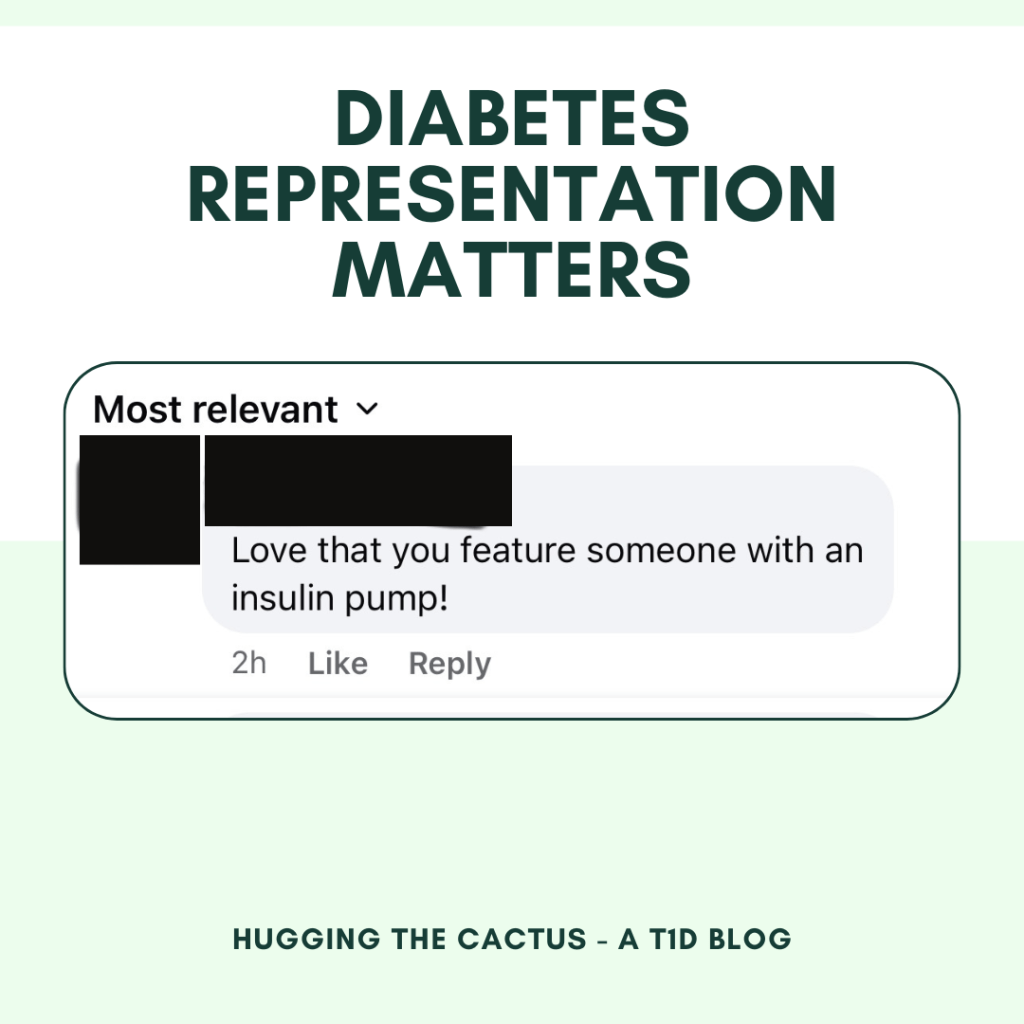
When I first saw it, I was a little embarrassed because I’m just naturally self-conscious and my form looked off in the video. But as days went by and it popped up every now and then on my social media feeds, I grew accustomed to it and let my inhibitions fade away. Any lingering anxieties over my appearance, though, turned into a burst of confidence and pride when this comment on the ad caught my eye one day:

Love that you feature someone with an insulin pump!

It’s funny how 9 words written by a total stranger on the Internet made me feel so good. It really serves as proof that representation does make a difference in defeating diabetes stigma and giving a normally invisible chronic illness greater visibility.

Thank you, random person who commented on this ad, for reinforcing that almost-forgotten notion for me.

Diabetes in the Wild Strikes Again

What if I told you that at the beginning of this year, I started training in a new type of exercise that has truly pushed me out of my comfort zone, empowered me, and made me begin to appreciate my body, as it is, more than I have in a long time?

I bet you’d be curious to know more about this form of fitness that has instilled such confidence in me.

It’s pole dancing.

Now, before you get all judgmental on me, let me encourage you to pause for a beat and realize that any stereotypes or preconceived notions you have about pole fitness are likely wildly incorrect, or at least unfair. Shove any thoughts about certain types of clubs out of your brain, here!

I’ve come to learn that pole dancing is less about sexy, slinky movement (unless you want it to be that way, which is also perfectly acceptable) and more about athleticism. The way that I have decided to approach pole is that I am testing my body’s ability to move with strength and grace, and I’m really proud of the progress that I’ve made in the 7 or so months since I attended my first class. I’ve learned that my body (and as a result, my mind) are capable of so much more than I ever thought, and I’ve also found out a few other important things about pole as a sport.

  1. It’s for everybody. Any person of any gender, size, and age can learn how to do it.
  2. There are many different styles of pole. You can learn a choreographed routine, you can wear heels, you can go barefoot, you can spin, you can be static, and so much more.
  3. The biggest obstacle in learning pole is your mind. I’m constantly talking myself into (and out of) certain poses and movements because I am scared of the unknown. It can be frightening to climb eight feet up into the air and put your trust fully in your muscles in order to hang on, much less contort into an elegant posture! But diabetes definitely hasn’t stopped me in any form or fashion from making the most out of a class, and I got proof that there’s other people with diabetes out there who pole not too long ago.

It’s common to have a pole buddy in most of my classes, due to the fact that there’s only a handful of poles available in the studio and twice as many available spots in a given class. So when a woman who was slight in stature and soft spoken asked me if I was okay with sharing a pole with her, I welcomed her over and was pleasantly surprised by what she said next.

“I saw your pump and figured it made sense to share a pole with another diabetic,” she said, motioning toward her own pump which was clipped to her shorts.

My face probably immediately lit up. I was excited to be partnered up with someone who shared something that we both innately understood. We started chatting about the fairly unique experience of pole-ing with diabetes; more specifically, whether or not our diabetes devices got in the way during classes. She shared that one time, her pump detached from her shorts, flung out as she maneuvered around the pole, and got its tubing wrapped around the pole as a result! She was totally fine, but embarrassed by the attention that the incident got her. I reassured her that I’ve had similarly mortifying experiences in fitness classes before, the most memorable being the time that my CGM kept going off in the middle of a yoga class and disturbing the quiet environment. We shared a laugh before refocusing our attentions on the instructor, and for the remainder of the class, our diabetes and our devices became afterthoughts as we transitioned from one pose to the next.

It was a short exchange, but one that bonded us and served as evidence to me that diabetes really can’t stop me (or anyone else living with) from pursuing what we want to do, even something less conventional like pole. This was one of my favorite “diabetes in the wild” encounters that I’ve had in quite some time, and now I know that any time we take a class together, I’ve got someone close by who gets me. And that’s a nice feeling.

Another Day, Another Annoying Diabetes Reference

I have controversial taste in entertainment.

While I’m a huge fan of trending shows like The Last of Us and Wednesday (I recently finished both first seasons and fell in love with the characters on both shows/mourn the fact that they likely won’t produce second seasons until 2025), I’m also really into what my mother calls “trash TV”.

This is synonymous with reality television – think along the lines of anything that the Bravo network plays. Most of those shows symbolize pure escapism and innocently mindless entertainment for me, and I’m addicted, so much so that my trash taste in TV translates to my podcast listening.

I listen to a handful of podcasts hosted by personalities that either appear on the Bravo network or talk often about Bravo-lebrity drama, and while I usually find them wildly entertaining, I’ve noticed an emerging trend on these podcasts in recent months that makes me incredibly irritated. And that’s how often diabetes comes up as a topic on these podcasts.

Nine times out of ten, it’s about Ozempic (the type 2 diabetes drug that famous and non-famous folks alike have started using in order to lose weight). Usually, the podcast hosts are poking fun at it or spending way too much time speculating who is and isn’t using it, and it drives me up the wall. NOBODY is talking about the morality of taking a type 2 diabetes drug when they do not have that condition themselves, or the fact that since it’s become so popular it’s made it scarce and potentially unavailable to the people that really need it. Now, I’ll take a step off the soapbox for a second because obviously I 1) don’t have type 2 diabetes and 2) don’t use or need to use Ozempic; therefore, I don’t have a true stake in the game other than that I could imagine myself being even more worked up if it were a matter of people taking Humalog for similar reasons (goodness knows the rage that I would feel if Humalog was becoming virtually fetishized because taking it resulted in some desirable outcome).

I also shouldn’t sit here and judge people who go on Ozempic who have maybe tried multiple other weight loss methods that have failed them, and they’re genuinely using the drug to try and get healthier – I can empathize with that more. No, what really bothers me is the resulting dialogue that seems to happen every time Ozempic is brought up, and that is pure ignorant bliss regarding what diabetes actually is and how significant of a role it plays in the daily lives of people living with it. Multiple podcasts that I listen to have covered the Ozempic “fad”, explaining to their seemingly naive audiences that it’s a drug for diabetes, followed by a punch line about how they don’t even know the difference between type 1 and type 2, and saying things along the lines of how they hope they get diabetes just so they have an excuse to take Ozempic.

It’s gross. And quite frankly, embarrassing for these podcast hosts to admit that they know so little about a condition (and I’m speaking broadly here about both T1D and T2D) but then claim they want to be diagnosed with it so they can maybe indulge in their vanity and lose weight. There’s much better ways to make clever little jokes about diabetes and I’m getting tired of people being lazy in their comedy by continuing to be misinformed.

Maybe all of this is a signal to me that it’s time to take the trashy podcasts out of my rotation…

3 Tips for Going Back to an Office with Diabetes

As anyone who lives with diabetes knows, it’s a condition that dislikes disruptions to a daily routine.

This was one of my main concerns when it came to starting my new job last week. The position is hybrid, meaning that I can work from home and in an office as it suits my needs. The prospect of returning to an office again after more than three years of working remotely positively excited me, but I’d be lying if I said that it also terrified me. I was anxious about my first day back in an office environment (in addition to all the jitters associated with starting a new job), and more than anything, I was worried about how my diabetes would be affected by this change.

This is because I’d settled into a fairly standard routine after all this time working from home. I have a workout regimen, eating schedule, and built-in breaks throughout my day that have greatly benefited my day-to-day blood sugar levels, and I knew that returning to an office setting would prevent me from maintaining these habits.

So that’s why I entered what I’m calling “diabetes hyper-prepare mode” the night before my first day in the office so I could try and think about all the ways my day would differ working in this setting versus my own home. And thus, I came up with these three tips that resulted in a very successful diabetes (and work) day:

Tip #1: Get ready as much as possible the night before. The week that I started my new job, I did my best to recall the routines that had worked well for me when I was regularly working in an office. The first thing that came to mind was the amount of preparation I typically did each weeknight so that I could get out the door as soon as possible in the morning. This included laying out my outfit, making breakfast ahead of time, putting together a lunch, and packing my bag. This extra work the night before really paid off the following morning and meant that I hit the road at exactly the time I had planned to; plus, the food prep worked wonders as I didn’t have to waste brain power in the morning trying to think about what I might eat throughout the day. The food was all set and ready to go, and I knew its carbohydrate contents, which resulted in phenomenal blood sugar levels all morning leading up to lunchtime.

Tip #2: Maintain movement. As it turns out, a 40-minute commute combined with lots of sitting in meetings means that my movement patterns in the office are minimal. I did my best to combat this by getting up a few times throughout the day to explore my new building in 10- or 15-minute intervals. Not only did this give my eyes a break from my dual monitors, but it allowed me to stretch and get familiar with the environment. It also helped to curb my post-lunch upward sloping blood sugar, so it was definitely beneficial to my body and mind to make sure I maintained semi-regular movement during the workday.

Tip #3: Have back-up supplies on hand. When I was packing my bag the night before, I made sure to slip a meter, test strips, and fingerstick device, as well as some fruit snacks, into one of the compartments as I didn’t want to run the risk of something going awry with my CGM or needing a low snack and not having it. Of course, I didn’t experience either scenario in the office that first day, but knowing that I had these items close by went a long way in reassuring me that I was prepared to handle any diabetes scenario that might crop up during the workday. And it turned out to be fodder for reminding me that I should also have an extra pod and insulin in my bag at all times, too – next time, I’ll make sure to bring those items with me so I can have even more diabetes bases covered.

These tips might seem pretty obvious, but I was kind of awestruck by just how weird it felt to be back in an office space after a long hiatus away from one. So I think that following these tips truly did help to ground me so I could stay focused on learning my new job and meeting my colleagues, rather than letting my diabetes take center stage for the day.

A Serendipitous T1D Encounter

Sometimes, when you’re in the most random of places, surrounded by a couple of people you know but mostly strangers, but the vibe is juuuuuust right and you feel perfectly at home?

That kinda describes how I felt at…an arcade bar, of all places, on a Saturday night outing earlier this month.

I was at the local arcade bar with my boyfriend and a bunch of our friends. I always have a blast when we go there, and this particular evening was no exception. But what made it extra special was what happened when I was playing pinball.

I don’t have a picture from this particular evening, and YES I know that Galaga isn’t pinball…but it IS my favorite arcade game, and this picture also features a sunburn around an old Dexcom site…so it works well enough for this post.

I was using arguably the best pinball machine on the property (the Lord of the Rings themed one), and my favorite band from my teenage years (okay, and admittedly probably my favorite band of all time…My Chemical Romance) was blaring on the speakers. I was on cloud 9 from that alone, but then this happened: The person playing Pirates of the Caribbean pinball next to me (another excellent choice), nonchalantly said to me, “I miss my Omnipod…my insurance won’t cover it for me anymore.”

I glanced sideways at him, not wanting to lose track of my silver pinball but also wanting to show my interest in the conversation. I nodded empathetically, and said something about how insurance matters can make things so difficult. He agreed, before quickly showing me his “ancient Medtronic pump”, deftly maneuvering it from his pocket so the tubing wouldn’t get tangled around anything. I smiled and we both returned our attention back to our respective games, which we went on to play in a companionable silence.

It was totally random, not at all expected, but a sweet and subtle reminder that I’m not alone, even in places where it seems like diabetes is the last thing on anyone’s mind except mine. I hope this guy felt the same way…a little positive reassurance that we’re all in this together and doing a really great job of living well with diabetes.

The Best Kind of Diabetes Conversation

In my humble opinion (and experience), the best kind of diabetes conversation happens when it’s least expected among a group of people who are willing to listen and learn about it.

I was fortunate enough to have this exact type of conversation with my newly formed volleyball team after our first match of the season. (Side note that until then, I’d never played volleyball in my entire life. I was a ball of nerves the whole time, but I think that joining the league will have a positive impact on my mental health, social life, and diabetes, so I’m excited to see where the season takes me.) We were gathered around the table in a bar, enjoying a pitcher of beer and learning more about one another, when diabetes entered the conversation – as it almost always does, eventually, when I meet new people.

It’s not always easy to have a conversation with new people about diabetes.

We probably spent less than 10 minutes on the subject of diabetes, but the whole time we did talk about, I felt extremely thankful to be surrounded by people who asked thoughtful questions, demonstrated curiosity to learn more, and made a pointed effort to ensure my comfort throughout the whole conversation. The energy that the group was emitting made me feel good as I shared my experiences and showed them my Dexcom and Omnipod devices, the latter of which isn’t always easy to do around new people because I can be a little self-conscious of how they appear on my body. But it felt natural to be open and upfront about all things diabetes, as I’ve experienced it, because everyone genuinely cared to learn more.

That’s what made it such a lovely conversation; in turn, it will also serve as a great reminder to me that telling new people about diabetes doesn’t always have to be an intimidating or stressful ordeal.

Tricky Timing and the Power of the Pre-Bolus

Pre-bolusing: It’s the term that describes taking insulin before eating food. The “before” part in the definition is key, because the amount of time that “before” is can and will vary among people with diabetes. It depends on a few factors, including the amount and type of insulin being used, the amount and type of food to be consumed, current blood sugar levels, and so forth.

It’s one of those things that’s tricky to nail the timing of, but boy, when it works it’s so worth it.

Pre-bolusing works well, but only when the timing of it is perfect.

I have two examples to complement that belief, one in which pre-bolusing almost lead to a disastrous outcome and the other in which everything turned out ideally. I’ll start with the more chaotic scenario first.

In this situation, my boyfriend and I spent the night in New Hampshire to attend a friends’ wedding and had a pretty late night, which meant we slept in a little later than we had intended the next day…actually, a lot later. We only had about 20 minutes to race around our room, pack up our belongings, and get ourselves looking presentable before we had to check out of the hotel. Luckily, our scrambling paid off and we made it out in time, but sleeping in cost us the opportunity to enjoy a complimentary hotel breakfast. We decided that it made sense to stop for brunch on our drive back home to Massachusetts, so we Googled a diner that was on our route home and stopped there for a meal.

When we got there, the restaurant was pretty crowded, but we were seated and able to place our brunch orders almost immediately – a good sign. I assumed this meant we wouldn’t have to wait more than 20 minutes or so (that feels like a restaurant standard) for our food to be ready, so I went ahead and pre-bolused my mealtime insulin. After all, I’d ordered a hearty omelet that would come with breakfast potatoes and toast, so I wanted to be proactive about avoiding high blood sugar and get my insulin in system sooner rather than later.

Unfortunately for me, our food ended up coming out later rather than sooner. In fact, we waited nearly 45 minutes for our dishes to finally come out. In that period of waiting, I was getting more and more anxious about my decision to pre-bolus with each minute that passed without food in front of me. By the 30-minute mark, I was close to full-on panic. Even though my Dexcom wasn’t indicating that my blood sugar was low (it held out steady the whole time), I was worried that the system delay in reporting my blood sugars would fail to catch a serious low in a timely manner. I told my boyfriend what was going on, and without hesitating he went to his car to grab some packs of honey that he’d stored in his glove compartment in case of emergency. We talked it over, and decided that it was probably best for me to consume at least one pack of honey because we couldn’t possibly know when our food was going to come out, and at this rate, we wanted to play it safe rather than be sorry. That didn’t exactly lessen the sorrow and stupidity that I felt for taking a pre-bolus (even though I couldn’t have possibly known that our food would be so delayed, I still felt badly about the whole thing), but it was what it was. And ultimately, I felt like I paid the price several hours later, when I was dealing with the very same high blood sugars that I’d hoped my pre-bolus would prevent. So much for making the pre-bolus grade that time…

But that doesn’t mean pre-bolusing always fails! This brings me to my other example. My mom and I had a nice lunch together last week. Before we left to go to the restaurant, I noticed my blood sugar was a little high. I decided to give myself a correction dose, plus one extra unit of insulin, because I knew we’d be eating foods that aren’t typical for me to consume at lunchtime that could result in highs later in the day. So again, I was aiming to be proactive and prevent prolonged high blood sugar.

And this time, the strategy worked great! At the restaurant, I stacked that pre-bolus with my actual meal bolus (not always a recommended tactic, but it was useful here) and rounded out my afternoon with a blood sugar in the 120s – a win in my book. Thanks to my pre-bolus, I didn’t experience any pesky blood sugar spikes and still landed in range, which in turn showcases the power of the pre-bolus perfectly.

So just like anything in life with diabetes, when pre-bolusing works, it’s wonderful…but it definitely requires a little finesse to learn exactly when/how/where to use it.

Diabetes in the Wild: Self-Defense Class Edition

“I have diabetes, too.”

A woman enrolled in the self-defense class that I took this month approached me, remarking on our shared condition, with a knowing look on her face. She glanced down at my pod, which I had marked with red duct tape to signal to others that this area of my body couldn’t engage in some of the movements that we’d be asked to do.

Diabetes in the wild moments happen when they’re least expect – I certainly didn’t anticipate this interaction when decked out in protective gear!

I smiled widely at her and we launched into a brief, but friendly and supportive conversation about diabetes in which we covered everything from devices to years lived with diabetes. We spoke for a few minutes before we wished one another well and parted ways.

Diabetes in the wild encounters are always interesting because they either spark instant camaraderie or, on the complete flipside, a flurry of ignorant questions/comments that prove to me just how much diabetes stigma is still alive.

Encounters like this one, fortunately, fall in the former category.

It’s just nice to know sometimes that I’m not alone, even in the most random of circumstances. That I don’t have to explain myself, or the nature of my fragile pod, to a person who actually understands why it needed to be protected. That I have someone who totally gets why I was in a panic the week before when I didn’t have a functioning CGM or my meter as a back-up when my blood sugar went low.

It’s a form of support that might not last more than 5 minutes or so, but still has a meaningful impact on me and my diabetes.

That “Thing” on my Arm

This blog post was originally published on June 12, 2019 on Hugging the Cactus. I’m sharing it again today because when you live with T1D, it’s inevitable that you’ll attract stares – and sometimes questions you’d rather not answer – from people who are befuddled by your diabetes gadgets and gizmos. This one encounter in particular is a great reminder that not all oglers have ill intent…read on for more.

“Yo, I don’t mean to be rude, but what’s that thing on your arm? Looks pretty cool.”

I turned around to face the stranger who was looking at me and asking me this question. It was well after midnight and we were on the rooftop of a fairly crowded bar. It was a balmy, summery night and I was enjoying the atmosphere with my boyfriend and my best friend. I’d had a few drinks over the course of the night, but judging by the state of everyone else on the rooftop, I was probably more sober than most of them.

That “thing” on my arm is basically my pancreas – please don’t stare at it, bro.

I could’ve answered his question in a scolding manner; it wasn’t a “thing”, it was a device that keeps me alive.

I could’ve totally dismissed him and told him to mind his own beeswax, because really, it is sort of rude to point out something on another person’s body.

I could’ve lied and told him it was something that it’s not to get him to stop bothering me.

I could’ve launched into an educational breakdown of what an insulin pump is and why my OmniPod looks the way it does.

I could’ve done any number of things, but instead I decided to say, “Oh, this is my insulin pump. I’ve got it decorated right now with a picture of a lighthouse because I like adding some style to it.” I smiled at him as a way of reassuring him that I really didn’t care that he was asking me, because I didn’t.

My straightforward answer seemed to please this random man. He told me again that he thought it was cool, and then we chatted a bit about where the lighthouse is and discovered we both have a connection to Massachusetts. Within a few brief moments, the conversation was over as we went our separate ways.

It was a perfectly harmless interaction that could’ve went a number of different ways, but to me, it’s all about context. This guy was just asking out of curiosity, and I truly don’t think he was trying to be rude about it. So I answered his question succinctly but good-naturedly, because I felt that was the only way to go about it in this busy party environment. Plus, let’s be real here…had I delved into a discussion about diabetes and devices, this drunk man probably wouldn’t have digested a single detail of my description. (Ahh, I love alliteration.) And another important point? He was damn right, my pump did look cool because of the lighthouse sticker!

But man, how much simpler it’d’ve been if I’d just been wearing my “THIS IS MY INSULIN PUMP” sticker on my pod that night.