You Should Feel Empowered to Advocate for Yourself and Your Diabetes

This was the message conveyed to me after one of the best endocrinology appointments I’ve ever had, at least in my adulthood.

I’ll confess that I was nervous going to my first endo appointment of the new year. I didn’t know what to expect as I wasn’t bringing any specific concerns with me – besides the fact that I was upset about a conversation I’d had with a different doctor regarding a separate issue.

After the nurse practitioner and I exchanged pleasantries, she sat down at the computer screen that was displaying my record and asked me what I wanted to discuss during our appointment.

That’s when it all came flooding out.

I babbled about how I didn’t have anything in particular I wanted to talk to her about besides the fact that I got a very discouraging message from a doctor who told me I needed to have better control over my diabetes, and that this was infuriating to me because 1) not all of my health concerns can be blamed on my diabetes and 2) it was disheartening to be told by one subset of my health care team that I’m doing great with an A1c of around 7, but to hear from another subset that I’m not doing great and need to work harder. Once I finished my train of thought, I braced myself for a less-than-favorable reaction.

But that’s not what I got.
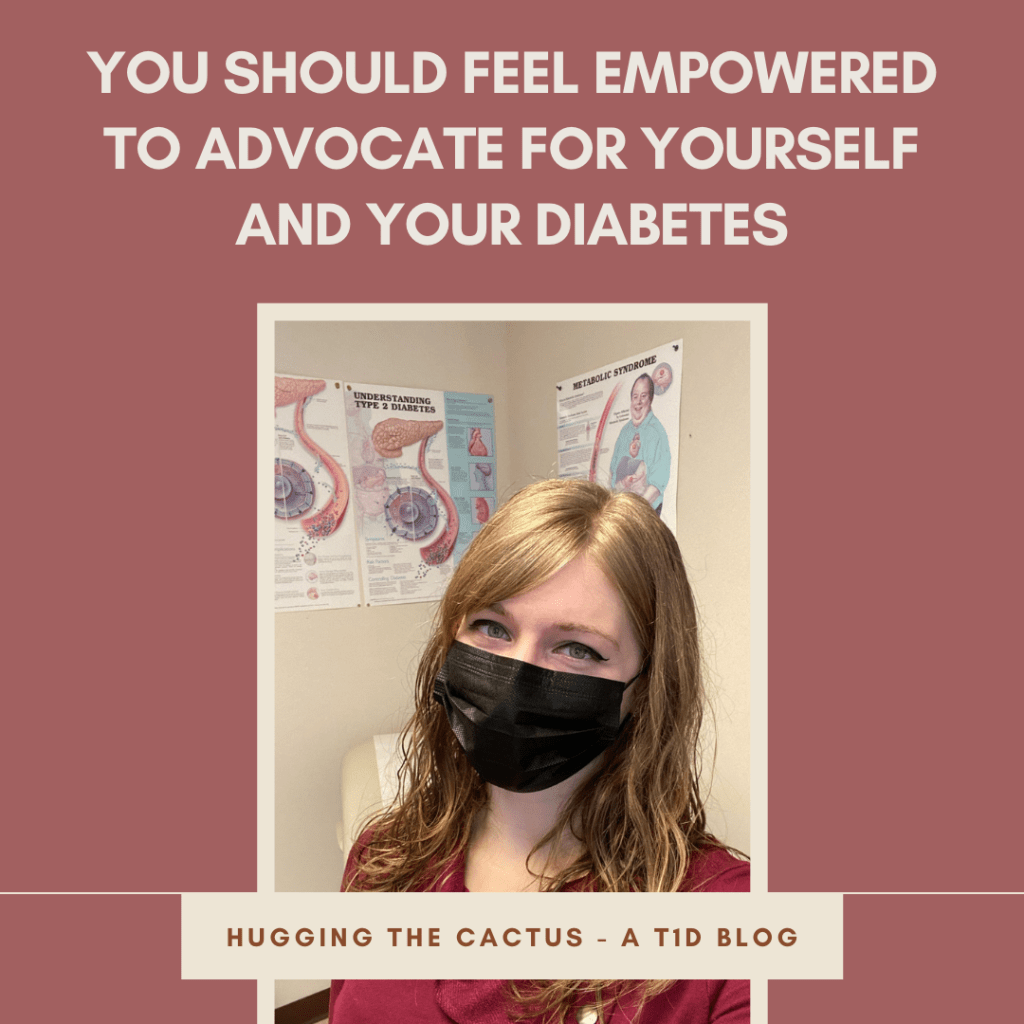
I’m really glad that nobody walked into the exam room as I was taking goofy selfies like this.

Rather, my NP asked me to explain my concerns in greater detail. She sat, listened, and told me that she disagreed with the comments from my other doctor’s office. It was validating to hear someone who actually does work in diabetes reassure me that, for starters, my diabetes might not necessarily be to blame for any other health issues I was experiencing. She also made me feel better about my A1c and that my track record proves how hard I’ve worked over the years to maintain a 7 (or below) and that it’s not indicative at all of a lack of control over anything.

Best of all, when I sheepishly admitted to her that I’d been embarrassed to write in about the health concern in question, she reminded me that I should always feel empowered to advocate for myself and my overall wellness. It was an incredibly powerful message for her to convey to me, seeing as my self-doubt had manifested itself in full-force over this whole interaction with the doctor’s office. And it’s a message that I plan to carry with me to future doctor’s appointments to help ensure that I do stay on top of my health to the fullest extent possible, while also making my voice heard.

At the end of the appointment, my NP turned and said to me that I’m an inspiration. While I don’t exactly agree with her words, I can’t remember the last time I left an appointment feeling truly understood as a patient living with type 1 diabetes. That’s what’s inspiring to me…the fact that a physician took the time to recognize the hard work it takes to live everyday life with T1D. And the discovery that my A1c has dropped by .3 to a level that I’m very proud to have reached – well, that’s the cherry on top of my first endocrinology visit of 2022.

“You Need to Have Better Control”

I read those six words, all strung together in a terse message from my doctor’s office.

Not exactly the response I was anticipating when I reached out to them to express concerns over a minor health issue I was experiencing…

Let me back up a bit. In early January, I decided to message one of my doctor’s to discuss said minor health issue. A week went by and I didn’t hear anything from them, so I sent them another message, reminding them gently that I was hoping for a reply sooner rather than later. Several more days pass by and I start to get annoyed, but I still keep everything in perspective: Maybe they’re understaffed at the moment. Perhaps a computer error prevented them from getting my messages. Or they might be just crazy busy with beginning-of-the-year appointments and responsibilities. Whatever the case may be, I decided to message one more time, drawing attention to the fact that my first message had been sent two weeks prior and that if I didn’t hear back by the end of the week, then I’d just call the office to hopefully connect with a nurse.

Luckily, it didn’t come down to that because within 48 hours of me sending that third message, I finally heard back from someone. And this someone said something that left me a bit gobsmacked:

“…with an A1c of 7 – you need to be better with your control.”

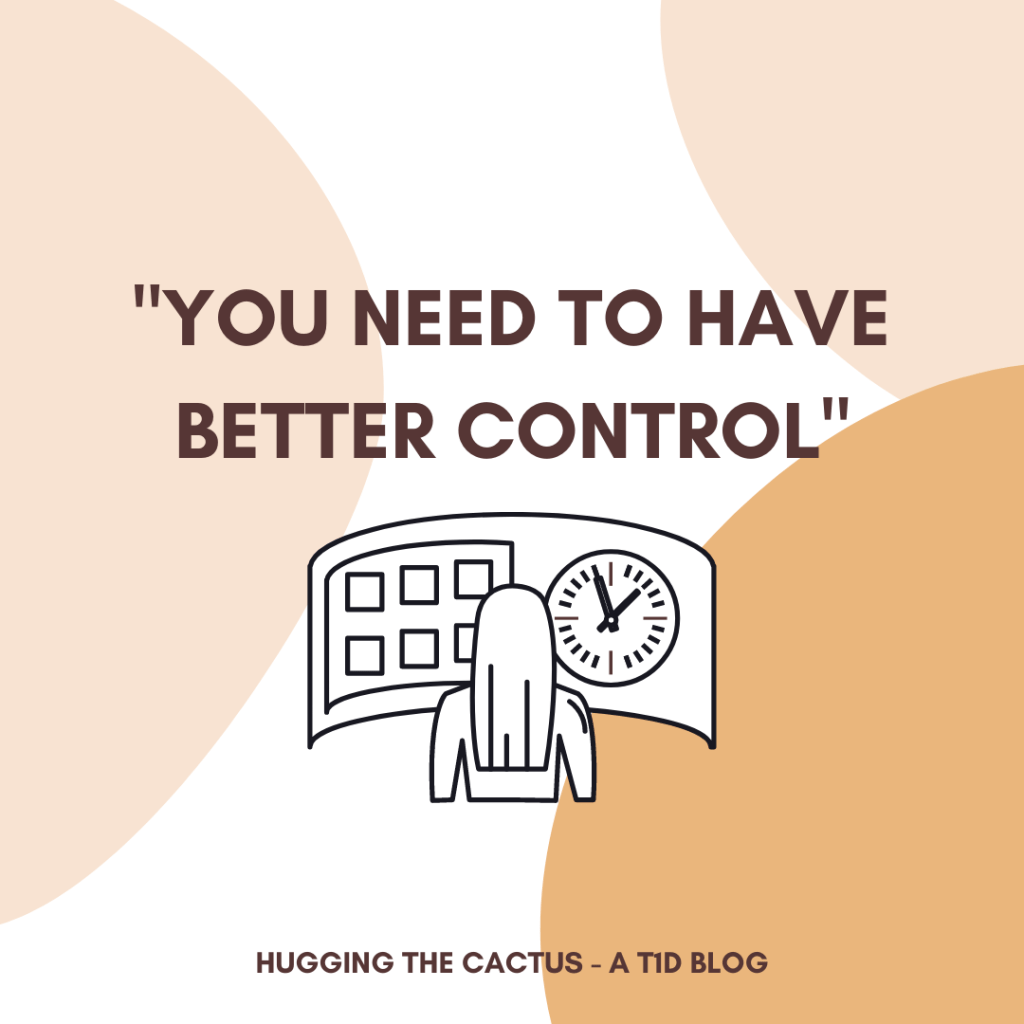
Life with diabetes often feels like this image – like you’re the only one in the control room of a command center that dictates whether or not you live. And yep, it’s exhausting.

I couldn’t believe what I’d just read, for multiple reasons. For starters, I’d mentioned in my first message that I *think* my A1c was right around 7, but I couldn’t be sure because it’s been a bit since I last had my A1c checked. So clearly, by reading the response from my doctor, nobody had gone in to check my records or look up my historical A1c – which may or may not have provided them with better context so they could answer my question better, but that’s besides the point. What had me most irate was the fact that I’ve been told – time and time again – that I’m doing a great job with an A1c around 7. I’ve had endos and nurse practitioners alike tell me that I don’t need to make any major changes and that I’m too hard on myself when I express a desire to get a lower A1c. So to have a completely different medical professional make a snap judgment right then and there that implies I do not have control over my A1c is obviously in direct conflict with what I’ve heard from others. How maddening is that?

Furthermore…I’m sorry, but A1c does not paint a complete picture of my “control”. I believe, along with many other people in the diabetes community (including medical professionals) that time in range is where it’s at. The amount of time I spend in range is leaps and bounds better than where I was in college – and honestly, so is my A1c.

This is why it’s incredibly frustrating to me that this person handled my health issue as though it was directly related to my diabetes and their perception of my lack of control. The three-sentence, curt reply to my initial message didn’t exactly help matters either, though I’m trying to not read too much into that…after all, you can’t gauge tone via written message.

I’ve decided the best way to handle this whole exchange is to bring my issue up again when I see this doctor later in the year. I’m not going to reply in the message thread, because I don’t see how that would cause any good, but I will bring this up when I go to see the nurse practitioner at my endocrinologist’s office at the end of this month. While she likely can’t fully help me address my health concern, she’s bound to provide me with some insight and some actual helpful advice that won’t involve her jumping to conclusions about my control. We’ll see how it goes.

For now, I will just have to try to keep my head held up high by taking control of the situation, if not my diabetes.

Adding Yet Another Doctor to my Diabetes Care Team…

As a person with diabetes, I see (what feels like) a ton of doctors. It’s probably not that many more compared to most people, but in addition to seeing doctors like a primary care physician and a dentist, I also see an ophthalmologist (eye care specialist), an endocrinologist (my diabetes doctor), an allergist, and a mental health professional.

But recently, one more doctor got added to that list: a podiatrist.

A podiatrist has become the newest member of my diabetes care team.

I wrote about how the nurse practitioner at my endocrinologist’s office promised to hook me up with a referral to a podiatrist in this blog post. Long story short, I voiced my concerns to her over the calluses on my feet, and she suggested I see a podiatrist so I could get an expert’s opinion on whether or not they were something to be worried about.

Fortunately, my first meeting with the podiatrist went well as I was assured that my calluses aren’t anything to stress over…but that initial appointment turned into a series of follow-ups (I’ll be seeing him every six months) as I learned that the podiatrist wanted me to start wearing orthotics to support pronation in my feet that I never realized I had. The doctor advised me to come back every six months so the degenerative changes in my feet can continue to be monitored, even though he was very pleased to see in my X-rays that the overall health of the bones in both feet is good.

Naturally, I had mixed feelings regarding the outcome of my first two appointments with the podiatrist.

On the one hand, I was happy to hear that my diabetes wasn’t creating any complications (beyond poor circulation – my feet are always cold and according to the podiatrist, this is due to Raynaud’s). Nerve damage is always something that I fear and I was genuinely frightened that the doctor was going to tell me that I was beginning to show signs of diabetic neuropathy in my feet. Obviously, I’m so relieved that this isn’t the case.

On the other hand, I was bummed to hear that his recommendation was to wear orthotics. Orthotics? Before I’m 30?! I guess it’s just the connotation of the word (it conjures up images of elderly folks hobbling around on canes and wearing special-made sneakers to support unsteady gaits) that’s got me rattled. I never realized that my tendency to walk around on my tippy-toes was due to the way my foot is shaped…but honestly, if wearing orthotics in my shoes now will help prevent or delay hip and knee pain later on in life, then I’ll quit complaining and just get on with it, even though it means I’ve got another doctor to see semi-regularly now.

I Finally Had an Endo Appointment, and…

…and it went well. Much better than I anticipated, both to my surprise and delight.

I’ve written here and here about my long overdue endocrinology appointment and my struggles deciding whether or not to pursue a new doctor. I eventually settled on taking an appointment with a nurse practitioner at my current endo’s office (mostly because I wanted advice from a professional sooner rather than later).

But my expectations for the appointment were low. I was doubtful that the NP would take the time to listen to, let alone address, my concerns. Fortunately, she proved me wrong.

My appointment – and the NP herself – really exceeded my expectations.

After we introduced ourselves to one another, I opened up to her that my previous appointment with the endocrinologist had been disappointing. I’d like to think I was gentle but brutally honest in my approach: Using kinder words than this, I explained to her that I felt like my last appointment was a waste of time and that I disagreed with the doctor’s assessment that I was doing just fine with my diabetes management. My sentiments were met with sympathy as the NP let me vent to her about where I felt I was lacking in terms of my diabetes care in the last several months.

The appointment lasted roughly 20 minutes or so, and by the end of it, several things happened: 1) I was given a new test kit and test strip prescription (I told the NP that I distrust my Livongo meter and want a reliable back-up for when I’m not wearing my CGM), 2) I had a referral to see a podiatrist due to concerns I expressed about my feet, 3) We agreed on a minor tweak to my correction factor that will hopefully help eliminate some mid-morning highs I’ve been experiencing, and 4) We set up a follow-up appointment with one another to take place in 3 months in addition to an appointment 6 months from now with the endocrinologist to make sure all of my bases are covered and I don’t have to go so long without seeing a doctor for my diabetes again.

I can’t remember the last time that I felt so heard by a diabetes clinician (or even any kind of clinician).

As the appointment concluded, I told the NP that I’m the type of person who relies on accountability in order to stay on top of my diabetes, and this appointment was the exact sort of accountability wake-up call that I needed to hold me over for the next few months until my next one.

And I daresay…thanks to the affability and receptiveness of this NP, I’m actually looking forward to our next visit in early 2022.

An Endo Update

So I’ve got an update on my whole I-haven’t-seen-my-endocrinologist-in-8-months situation.

It’s not exactly the update I was hoping for, but it’s one that I believe just might push me into making some positive change around my diabetes care.

As it turns out, my endocrinologist is on leave and not taking appointments until February 2022, at the earliest.

What’s even crazier than that February 2022 wait time? The fact that I haven’t been at an in-person endo appointment since 2019.

I found this out after contacting her office and receiving a message back that I could either wait until that time to see her, or I could schedule an appointment with a doctor at a different location that the office would suggest to me.

At first, I wasn’t sure what the right move was. I was almost certain that I couldn’t (and shouldn’t) wait another 4 months to see someone about my diabetes; after all, I’ve been unhappy with my management for most of this year. But even though I have been similarly unhappy about my relationship with my current endo (it’s practically nonexistent), I admit that I felt fear over the prospect of seeing someone new because any other provider would only know me based on the information available to them in my records. In other words, they would only know me based on numbers, not based on who I am and my personal diabetes management style/beliefs.

So I sat on this news for a few days as I pondered whether or not to take this as a sign that it’s time for me to find a new permanent endo, despite the mere thought being incredibly daunting to me.

During my pondering period, I happened to get a call from my endo’s office that wound up making my mind up for me.

They called to let me know about an available appointment with the nurse practitioner who works closely with my endo – an appointment that I could get this week.

I hesitated for a moment (I really hadn’t anticipated getting an appointment before the end of the month) before agreeing to take the open slot. And I’m glad that’s what I decided to do, because 1) at least I can talk to someone about what I think I’m lacking in terms of my current diabetes management; 2) I might end up getting some quality advice that will redeem my endo’s office in my eyes; and 3) even if I don’t see eye to eye with this person, it will be the push I need to start actively pursuing a new endo that will more closely match my diabetes care style.

We’ll see what happens.

Way Overdue for An Endo Appointment

By chance, I was looking through some old lab results on my endocrinologist’s online patient portal when I noticed something.

I was (and still am, as of this writing) way overdue for an endo appointment.

The last time I saw my doctor was at a virtual appointment back in February – more than 8 months ago. This gap in time between appointments feel especially significant because most of my life with diabetes, I’ve gone to the endocrinologist 4 times per year. It was only when I started seeing this new endocrinologist (who I’m not a particularly big fan of, BTW) a couple of years ago, and it was at her suggestion that I dropped down to twice yearly appointments.

From the beginning, I haven’t loved that recommendation.

I’ve realized that I am the type of person who kind of relies on regular visits with my endocrinologist in order to keep my diabetes (and myself) in check. This doesn’t mean I actually enjoying going to see my endo – because who honestly likes to go see any doctor – but it does mean that I feel like there’s been a missing component to my diabetes care lately.

I guess I’ve just been too busy (traveling, working, trying to maintain a semblance of a social life) to slow down and really notice the absence in my diabetes care and management.

But what bothers me more is that my endo’s office hasn’t even tried to contact me to schedule an appointment. What gives?! The moment I knew that I was way past due for an appointment, I messaged their office, and I still haven’t received a response back.

So in addition to it being time for my endocrinology appointment, it may also be time for a new endocrinologist, period.

Nothing to Complain About

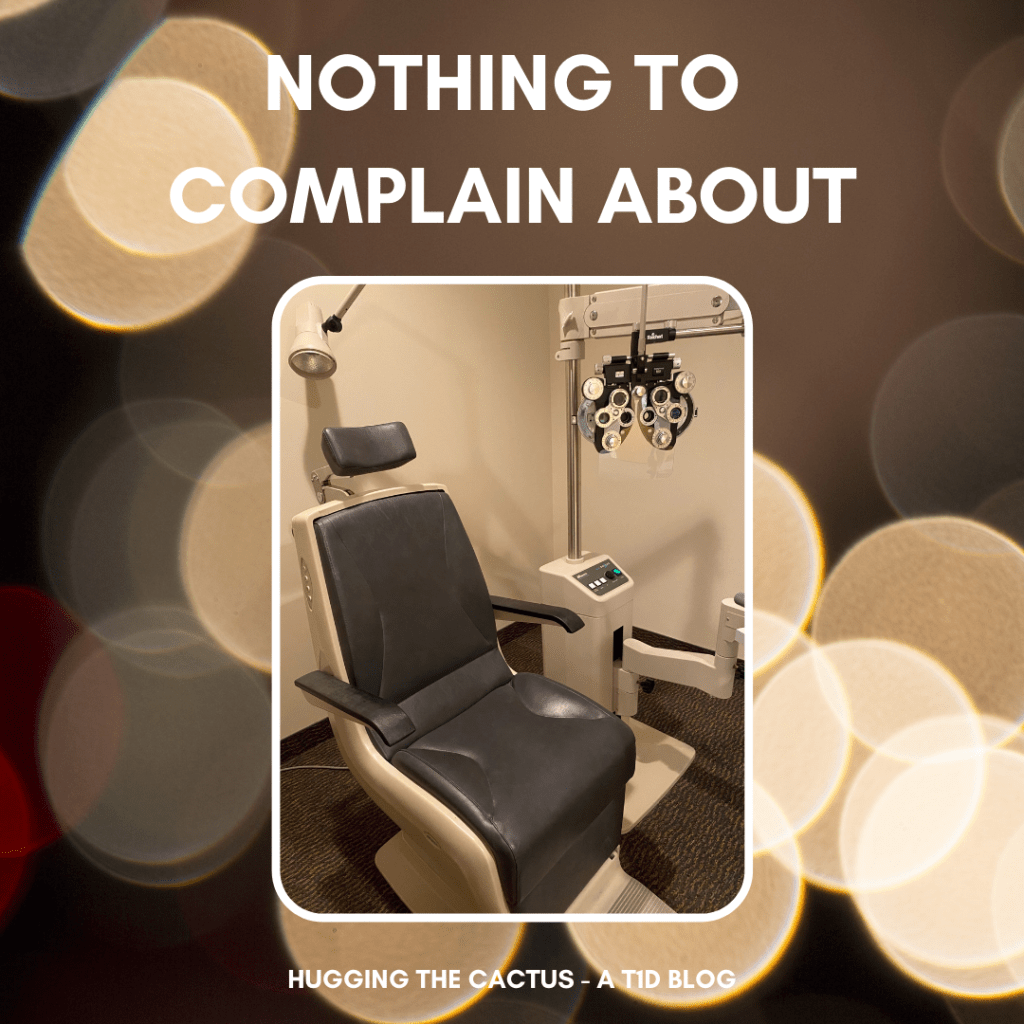
I’m writing this blog post from my ophthalmologist’s office – I’m sitting in a chair in an exam room, waiting for my eyes to dilate so my doctor can complete the exam.

Just before my eyes were dilated, I checked in for the appointment and went over my information with a nurse who works here. During the check-in, she asked me how my eyes fared in the last year.

The chair from which I wrote most of this blog post – on my phone, to boot! (It takes time for eyes to dilate, okay?!)

“I have nothing to complain about, all is well!” I said to her.

“That’s great to hear. After all, after a year like we’ve had, it’s nice when there’s no complaints about something.” She replied.

I sat here in this chair and smiled under my mask. Too true. It’s refreshing when there aren’t any complaints about any aspect of my health and well-being, considering diabetes can be such a pill.

And I’m happy to report (now from the comfort of my own desk chair) that I have “gorgeous retinas”, according to my ophthalmologist.

Nothing to complain about, indeed.

My A1c Results are in and…

Before I left for my vacation, I had my (long overdue) annual physical with my primary care doctor. Like he does every year, he ordered bloodwork for me which meant that I had a whole host of health data to review on my online patient portal, including my current A1c.

When I saw that value up more than half a point from my last reading, my heart sank.

Now, I’m not going to say specifically what the reading was, because I’m a strong believer in keeping that sort of information to myself (and if you’re the type of person who shares their A1c, that’s okay, too – it’s just not for me). But I will say that it definitely isn’t the worst A1c reading that I’ve ever had, though it upset me because I think it’s the highest I’ve been since my college years.

Once it fully sunk in that this was my current A1c reading, like it or not, I started thinking about the why. Why have I gone up? I could think of a few factors…

  • I haven’t been eating super healthy; rather, I probably eat too many sweets that cause my blood sugar to fluctuate more than it ideally should.
  • The pandemic has changed a few things about my daily lifestyle – I don’t get out of the house as much I used to because I work from home, which means I’m in very close proximity to my kitchen and that gives me too many opportunities throughout the day to snack.
  • I get lazy and don’t bolus for “small” snacks (i.e., snacks with 10 carbs or less).
  • On the subject of laziness, I’ve been really bad about “eyeballing” my plates and portions lately when it would obviously behoove me to measure out my food and study my nutrition labels.

So those are the things I could think of that are the likely culprits behind my dissatisfactory A1c. As I sat and stewed over them and chided myself for my carelessness, though, I also tried to gently remind myself that A1c is only one measure of blood sugar “control”: I told myself that I need to bear in mind that my overall time in range is something that I should study and try to learn from, rather than dwell on this narrow snapshot of my 90-day blood sugar averages.

This is as close as I’ll get to sharing my personal A1c/time in range metrics… 😉

Using my Dexcom Clarity app, I learned that my time in range was suffering. I prefer to spend 80% of my time in range, and lately, I’ve fallen short of that goal. So after studying the amount of time that I spend “high” or “very high” (high blood sugars are always more troublesome for me than lows), I started to get a clearer picture of what was going wrong for me and what I might need to do to fix it.

This whole exercise, as bummed as I was to have to go through it, is going to serve as a great reminder to me that whenever I get disappointing news about my diabetes management, the best way to cope with it is to study the facts that I quite literally have available to me at the tips of my fingers. I know why my A1c is where it is, and I also know now the areas in which I need to improve. And that’s something to be grateful about and use as a motivator so that I can improve both my A1c and my time in range.

I know I can do it – I’ve done it before and can’t wait to feel that triumph over my diabetes.

From Patient to Medical Student: My Journey with Diabetes Treatment – A Post by Konstantina Taki

This post was written by Konstantina Taki and it was originally published on the T1International blog on June 8, 2021. I’m sharing it here today because the journey from patient to medical student as person with diabetes has always personally fascinated me. Despite my interest in medicine, I’ve never actively pursued it as a career (and probably never will), but I appreciated learning about Konstantina’s experience. Thank you, Konstantina, for sharing your perspective!

Having lived with type 1 diabetes for more than 12 years, I have experienced different aspects of the condition. First of all, as a patient, I approach diabetes from a personal view. I can also understand how the condition affects parents of children with diabetes. It’s something new, demanding and difficult to handle. The last five years, as a medical student in Greece, I have seen diabetes from yet another more practical and scientific perspective.

The world of medicine is a marvellous, enormous one. It is a multifaceted science. When I started studying medicine back in 2016, I had a completely romantic approach. I was convinced that the core of medicine is the purpose of making people’s lives better. I believed that healthcare systems were patient-centered and every decision or strategy was made in order to ensure that people’s lives were safe and to improve their health. It was a challenge for me to realise that even in such a human-centered domain, there are motives and decisions which aren’t really altruistic. Instead they are often led by powerful companies.

“Inequality in treatment of people with diabetes should come to an end.” – Konstantina Taki

Over the course of time, I had to face the fact that pharmaceutical companies influence healthcare systems in such a way that healthcare professionals almost have no control. For example, a lot of medical research is funded by the pharmaceutical industry, or ‘Big Pharma’. So how can we ensure that the outcome of research is unbiased? The vast majority of medical seminars and conferences are also sponsored by Big Pharma. This means that organisations who want to support medicine without pharmaceutical industry support struggle in terms of fundraising. Healthcare systems, and the people leading them, tend to lose their purpose of saving people’s lives and improving the health of patients. Instead, they take advantage of people’s health to make profits.

Type 1 diabetes is a non-preventable chronic illness, and its successful management depends on insulin. Without insulin, a person with diabetes is in danger. Insulin belongs to the category of essential medications. I believe pharmaceutical companies take advantage and exploit this situation. Unfortunately, many patients, including those with diabetes, deal with the effects of Big Pharma’s politics and strategies. Having read articles, and later discovering T1International, I saw the process of how the profits of pharmaceuticals cause the loss of human lives. In 2021, people with diabetes still die of their inability to access the only drug that keeps them alive: insulin.

Your money or your life. This is a dilemma that seems to have deep roots in medical society. I am lucky, and I feel safe due to the fact that in Greece this phenomenon doesn’t occur as much as abroad. However, I did experience this dilemma personally in my Endocrinology appointment. In the examination room, there was my doctor, a nurse and a sales manager from a pharmaceutical company with diabetes products. The whole appointment was led by the sales manager. She was focusing on the weak points of my blood sugar throughout the session. Her aim was to convince me to start using a continuous glucose monitor (CGM), which at the time wasn’t distributed for free in Greece. Once I understood that she was trying to get me to use and pay for the product, I tried to focus on my diabetes management without discussing the CGM. The doctor was indifferent. She didn’t seem to be bothered by the sales manager. I ended up arguing with them and then I left the room.

Access to healthcare is an unquestioned human right for every person, which includes the need for medication and technology. Given the fact that the production and distribution of medication diabetes technology can provide extreme amounts of profits to companies, people with low or even no income are therefore excluded from healthcare systems. So who is being served by healthcare systems? Patients or profits? And how could all those profit-maximizing strategies come to an end or at least decrease?

Being able to approach diabetes as a patient but also as a medical student, and hopefully as a medical doctor in a few years, I have mixed feelings. I undoubtedly want to see a change. From a humanitarian view, I strongly believe that no human life is inferior when it comes to health and medicine. People should be treated equally, without discrimination or undue pressure. If there is one thing that medicine has taught me is how vulnerable we are when our health is at risk. In addition, I acknowledge that my awareness for this phenomenon is a result of the realisation of the catastrophic effects my life would have if I had no access to insulin. Companies should not hold patients hostage – but it happens every day.

The reason I appreciate T1International so deeply is its scope to change this condition through raising awareness and advocacy. Inequality in treatment of people with diabetes should come to an end. Health care systems globally must turn into patient centered systems. It is a difficult and slow process but nothing is unachievable. #insulin4all isn’t just a trend. It is a need, a vision, and hopefully one day it will become a reality.

Reflecting on my Experience with Metformin

A couple of years ago, I wrote a blog post series about my experience with Metformin. As I was paging through my blog, looking for either an old post to republish or inspiration for a new post to write, I came across that series and got to thinking about how I felt on Metformin.

If you aren’t familiar with what Metformin is, it’s an oral medication that’s typically used to help stabilize blood sugar levels for people with type 2 diabetes. This is where you might be thinking…I (Molly) have type 1 diabetes, so why was I prescribed this medication?

Well, my endocrinologist at the time wanted me to try taking Metformin in tandem with doses of insulin in an attempt to reduce my overall insulin needs. She expressed concerns that my daily insulin intake was high (something I disagree with now, as I think about it a couple of years later), and that she had some general awareness of studies that indicated it might not be good for my future health if I continued using so much insulin each day. (Note: I don’t know what study or studies she was referring to, and this is where I should’ve done more research before just taking her word for it and going on the pill. This is an example of poor patient advocacy on my part.)

I did not enjoy my time on Metformin.

Even though I met her sentiments with skepticism, I trusted this endocrinologist, so I decided to give Metformin the old college try. And I hated it. Hated it! I tried taking it per my doctor’s instructions for two separate spans of time (each lasting a month or so) and made the decision to stop using it because I simply didn’t see that it was making any sort of difference. Actually, it was affecting something, just not my blood sugar levels or insulin intake – it was affecting my anxiety levels. I was afraid that Metformin, coupled with my insulin, would cause me to have low blood sugars all the time. While in reality, I didn’t experience many lows, I was still always paranoid about them and it was an unpleasant thing to have to deal with.

So now, about two years later as I think about these ineffective encounters with Metformin, I realize that I should have done a lot more before even considering taking it. I should’ve asked more questions. I should’ve done more research. I should’ve asked around the diabetes online community to see if anyone had advice for me. I should’ve pushed back more with my doctor to get to the bottom of the reason(s) why she wanted me to take Metformin. Going back to my point above…this was a big lesson in patient advocacy. It’s important to ask questions and gather all the facts, especially in situations like this where there was so much uncertainty, in order to receive the best care possible. And it’s important to remember that even the most trusted and well-liked doctors aren’t always right when it comes to the medical guidance they suggest or give. At the end of the day, I’ve got to keep in mind that nobody knows my body and brain better than I do, so it’s okay to challenge the authority of the experts (in a respectful, kind way of course).