I’ve never really sat and thought about the power of seeing diabetes represented in media. Mostly, if diabetes is ever seen or mentioned in a TV show or podcast, it’s the butt of the joke, or portrayed with the slightest (or extreme, there’s no in-between) inaccuracies.
I guess the only time that I ever really considered it is when I weighed my experience filming a Dexcom G6 commercial (which you can read about here or watch here) against the knowledge that some other diabetes companies don’t have people who actually live with diabetes in their commercials; instead, they hire actors. I was – and still am – beyond grateful that Dexcom chose me and other people living with diabetes to be part of the G6 marketing campaign. It made me feel seen and heard, and perhaps inspired my mild irritation over the fact that other companies have chosen actors to appear in their ads. Actors can certainly pretend to know what it’s like to wear our devices or deal with diabetes 24/7, but the stark reality is that they have no clue – and let me tell you, it’s a lot more difficult than these commercials filled with smiling, happy people portray.
Anyways…the concept of diabetes representation mattering in a variety of contexts was driven home to me when I agreed to participate in a social media campaign for my pole fitness studio. All I knew was that the owner was going to film my very full level 1 class one night, and I had no idea if I’d actually appear in any of the footage selected for the Facebook/Instagram ads. Admittedly, I didn’t really care either way because I was just focused on learning the climbs, spins, and poses taught to us that evening, so I gave my permission to appear in the ads without a second thought. Imagine my surprise when, weeks later, I noticed a 3-second clip of myself climbing woven into one of the ads!
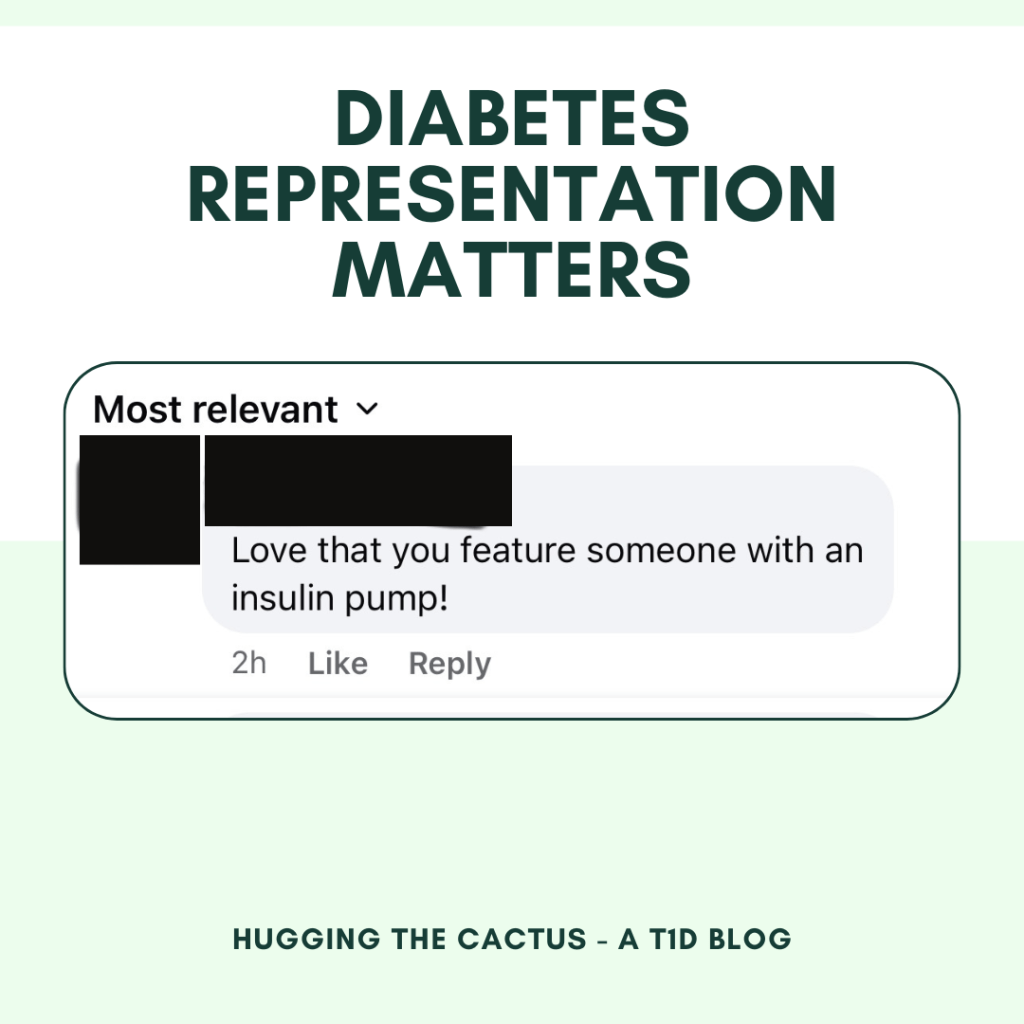
When I first saw it, I was a little embarrassed because I’m just naturally self-conscious and my form looked off in the video. But as days went by and it popped up every now and then on my social media feeds, I grew accustomed to it and let my inhibitions fade away. Any lingering anxieties over my appearance, though, turned into a burst of confidence and pride when this comment on the ad caught my eye one day:
Love that you feature someone with an insulin pump!
It’s funny how 9 words written by a total stranger on the Internet made me feel so good. It really serves as proof that representation does make a difference in defeating diabetes stigma and giving a normally invisible chronic illness greater visibility.
Thank you, random person who commented on this ad, for reinforcing that almost-forgotten notion for me.
Without a doubt, insulin injections are primarily responsible for keeping my blood sugar levels in range.
But I’d be remiss if I didn’t also consider how movement factors into the equation.
Yup, gettin’ steppin’ is key in helping me maintain tighter control over my blood sugars. If my levels start spiking after a meal or a snack – and I didn’t pre-bolus my insulin – then I start walking for as little as 15 minutes as a surefire means of getting my number back down. If I need to get up during my workday for a quick stretch and blood sugar level-set, I start stepping. If my blood sugar is higher than I’d like it to be before I go to sleep at night, then you guessed it: I get those steps in, whether it’s just marching in place or literally doing laps around my tiny condo.
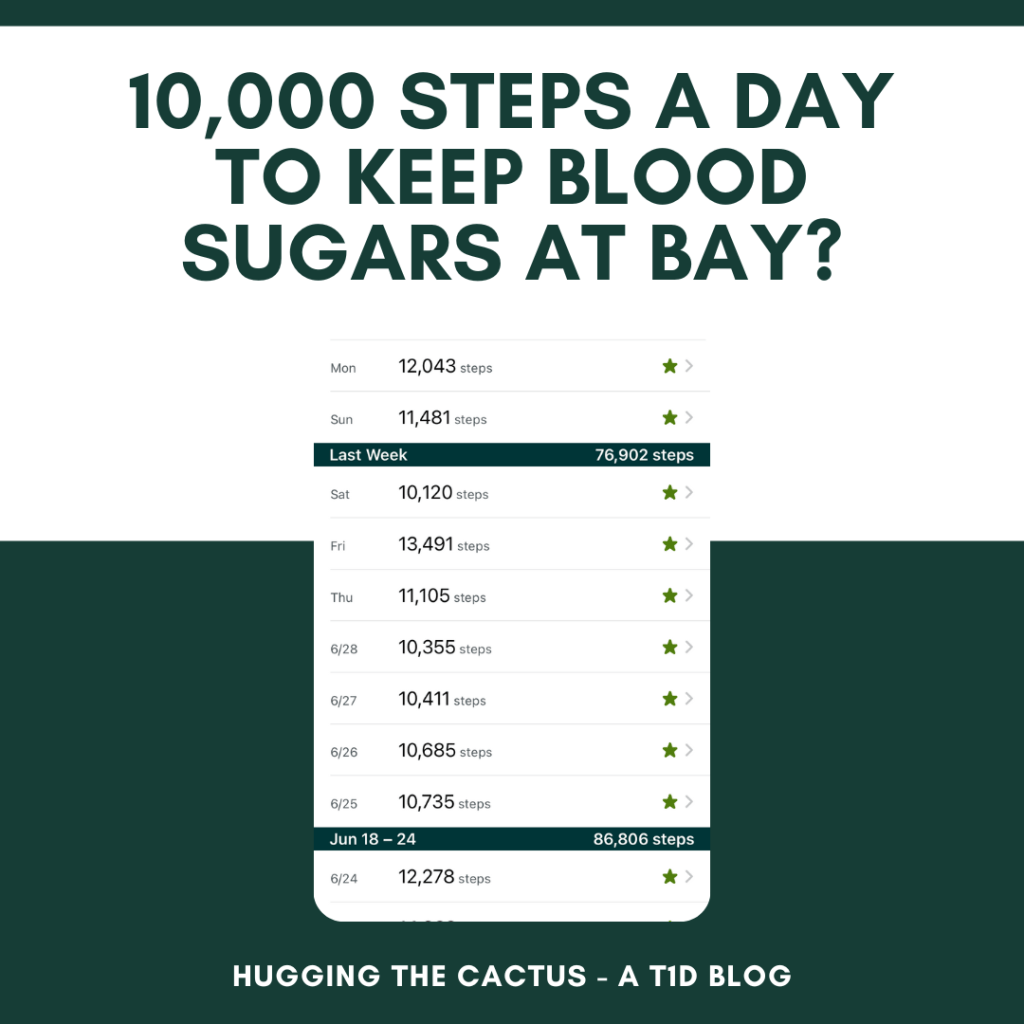
I don’t always get 80,000+ steps per week, but when I do, it’s a terrific feeling!
All this movement not only means that I hit my daily step goal of 10,000 steps, but it has also obviously proven successful in helping me deal with high blood sugars (the kinda, sorta high ones and the really, super-duper high ones). In the case of the latter, I’ve found that coupling a dose of insulin with 10-20 minutes of movement is really effective in bringing me back within range in about 45 minutes, whereas I might have to wait an hour or more if I rely on the insulin alone. That shows how powerful – and so stinkin’ simple – it is to get those 10,000 steps in on a given day.
The added bonus? It feels good to get all that movement in a day, especially considering I spend 40+ hours a week sitting at a desk for my job. My body, my mind, and my diabetes benefit so greatly from it, and it’s been part of my routine for so long that I know that I can consider my 10,000 steps a day a permanent part of my diabetes management toolkit.
Spring cleaning is more than a practice of tidying one’s home. It’s also a great way to keep blood sugar levels down, as I was reminded when I decided to take on the long overdue task of cleaning out my closet.
Ever since I moved into my home (nearly 3 years ago), the clothing and random other junk taking up space in my decently sized walk-in closet has largely remained untouched. Not in the sense that I don’t take things in and out of my closet every day, because I do. Rather, I haven’t sorted through anything in my closet since I decided what would go in there and what order it would stay in. Forget clearing out clothing with seasonal changes or refolding items as they got jostled out of place, no way! It’s really no wonder that over time, my closet grew more and more cluttered until finally I couldn’t take it anymore and devoted a few hours to cleaning it out.
It was an exhausting exercise – and yes, the word exercise really applies here because I was sweaty, huffing, and puffing in no time. I had to take everything out, lay it in heaps on my floor, go through each pile individually to see what I wanted to keep and toss, and either refold or rehang garments as I filed stuff back into place to my liking. I’m not sure how many pounds worth of clothing I actually sorted through, but it was definitely a sizeable amount as my arms ached from pulling clothes down from shelves and my hanger bar. And it definitely made sense that I was getting overheated, as I kept walking back and forth between my closet and my bedroom floor with my arms weighted down and in a space that was overly warm due to insufficient air conditioning.
So when my blood sugar levels started tanking 30 minutes into my organizing process, I shouldn’t have been particularly surprised. But in hindsight, it makes perfect sense as the cleaning was basically an extended moderate-intensity cardio AND strength session. What I should’ve been was more prepared for the possibility of going low by enabling activity mode on my Omnipod so that my blood sugar target could be increased from 100 to 150 for the duration of my cleaning, but instead I was crashing and cursing that I had to interrupt my workflow with a fruit snack break.
Maybe next time I’ll do better and coincide my spring cleaning with a high blood sugar so I could reap the benefits of the extra exercise, thereby turning the unexpected blood sugar buster into a welcome one.
The latter half of July in New England has been hot, hot, hot this year. It’s almost pleasant compared to last year’s rainy summer months, but let’s emphasize “almost” in that sentiment.
Fortunately, something that makes the heat a bit more bearable is the fact that the condo complex that I live at has a pool! And what’s even better is that it’s pretty easy to find slots of time on the weekends to hang out by it and enjoy it undisturbed by other community members. Case in point? My boyfriend and I found an hour on a scorching Sunday evening to take a dip before grilling some chicken and veggies for dinner.
We had only just entered the pool up to our waists when a familiar screeching sound blared in our ears. Yup…my pod had just failed.
My community pool! Not pictured? My wailing pod!
Rather than get cranky about it, though, I just shrugged and figured it was no big deal, I had to change it in the next few hours, anyways. I was about to rip it off my abdomen when my boyfriend pointed out that the moment I submerged myself more fully in the water, then I wouldn’t hear the screaming pod anymore. Sure enough, he was right – I could only hear the shrill sound when I was underwater, making for an interesting soundtrack whenever I swam under the water’s surface.
We swam and chatted for about an hour before deciding that I probably shouldn’t procrastinate any longer when it came to putting on a new pod. So we dried off and headed inside, and discovered that my blood sugar had lingered in the low 100s the entire time. That was a welcome sight to see – my assumption is that I’d had enough insulin on board from earlier in the day that coupled with the exercise I got from swimming to prevent any sort of blood sugar bump.
So even though I literally swam right into a pod failure, it worked out in a funny way. It’s nice to know that pod failures don’t always have to be a total nuisance.
I’m in an interesting phase of my life right now where I don’t like to say no to most things.
I think this has a lot to do with the fact that I’ve let fear and anxiety hold me back in many different areas. But if there’s anything I’ve learned as I’ve gotten older, it’s that life is too short to not jump at opportunities when they’re presented to me and to do my best to abandon my assumptions before deciding how I feel about something.
So when my boyfriend asked me if I wanted to go snowboarding with him last month, I enthusiastically said yes. I’ve never been a winter sports person, per se, but I’ve definitely spent too many weekends in the last couple of months cooped up indoors – so spending an afternoon outside at a nearby ski resort trying something completely new sounded like an awesome way to beat winter blues.
I should’ve expected it would also be a literal crash course in snowboarding with diabetes! Literal in more ways than one, because I fell…a LOT. Like, so many times that I lost count. But I was also learning how to navigate a brand-new physical activity with diabetes, which can be daunting. I handled it by preparing as best as I could, and practiced these tips and tricks that worked wonderfully for me when I hit the slopes:
#1: Set a temp basal. In the days leading up to snowboarding, I did a little research online to see what kind of tips other people with diabetes had to share about what to expect when snowboarding with diabetes. The most interesting piece of advice that I found and wound up taking was setting a temp basal with my pump. The physical activity of snowboarding, combined with the mountain’s higher altitude, meant that my insulin could be absorbed in my system at a more rapid pace. So I reduced the amount of basal insulin by about a third for a few hours, which worked out great because I didn’t have to worry about impending low blood sugars and could instead focus on trying to glide effortlessly across the snow like all the other skiers and snowboarders (I had little success in that, but that’s besides the point).
#2: Wear ALL the layers. The night before the snowboarding trip, I laid out all of the clothes that I would layer on the next day. I had thermal pants and a thermal undershirt that I wore for layer 1. I wore jeans and a sweatshirt for layer 2, followed by a fleece zip-up for layer 3. Before heading out onto the slopes, I put on my snow pants, winter jacket, waterproof gloves, snowboard boots, scarf, hat, helmet, and goggles…and yes, even though I resembled the Michelin man with all that clothing on, it was worth it because I didn’t feel the sting of the cold not even once. Plus, my diabetes devices, snacks, and other personal items were extra protected under all those layers, which gave me a sense of security throughout the day.
#3: Protect diabetes technology. This was my main concern for the day. I’ve heard horror stories about PDMs falling victim to particularly nasty skiing and snowboarding collisions. I refused to run the risk of smashing my screen by protecting it as best as I could. So I brought an extra sock with me that I used as a pouch for both my PDM and my cell phone. Once they were safely nestled in the sock, I placed it into a plastic baggie, which served as an extra layer of protection that was waterproof. I then put the plastic baggie into the pocket of the fleece I was wearing under my snow pants and zipped up the aforementioned pocket so there were zero chances of anything falling out of it. It was probably a little extreme in terms of protection, but my devices stayed completely dry and intact (despite the many, many falls I experienced over the course of the afternoon), and that was what mattered most to me!
If Shaun White (the pro snowboarder) is known as the Flying Tomato on the slopes, I want to be known as the Rainbow Wonder – I loved rocking my bright snowboarding accessories on the mountain!
#4: Be smart about packing snacks. I knew I would be limited in terms of what I could carry up and down the mountain – it’s not like I could safely snowboard with my purse or backpack strapped onto me (that would’ve added extra weight that would’ve made me even more wobbly on my board) – so my many pockets definitely came in handy and helped ensure that I had plenty of snacks stashed on me at all times. In addition, I chose to pack things like glucose tablets and granola bars because they were more likely to hold up in the cold weather/not freeze like a packet of honey or a juice box might.
#5: Stay hydrated. I think what surprised me more than anything else was how thirsty I felt after only about an hour of attempting to snowboard. In hindsight, though, it made sense – I was outside in the dry wintry air and trying to partake in fairly strenuous exercise, so of course I would be thirsty. Since I couldn’t carry around a water bottle with me, I made sure that any bathroom breaks that I took at the lodge also included trips to the water fountain – a strategy that kept me well hydrated out on the bunny slope.
#6: Monitor, monitor, monitor. I must’ve pulled out my phone to check my Dexcom graph a dozen different times over the course of the 4-5 hours we were snowboarding. That might sound like a bit much, but I had no idea what to expect in terms of the impact of snowboarding on my blood sugar. Watching my levels like a hawk helped me determine how much to eat at lunchtime, what kind of temp basal I should set, and how long I could stay committed to the activity before having to stop to treat a high or a low blood sugar. I felt extra grateful for my Dexcom on this day, because it would’ve been a pain and very inconvenient to check my blood sugar with a finger prick that many times.
Even though I wasn’t quite as badass as I wanted to be on the slopes (more like bruised-ass), I’m still really happy that I gave it a try and proved to myself that this is yet another thing that diabetes can’t stop me from enjoying. I look forward to my next attempt, which will hopefully include similar diabetes-related success as well as a lesson or two from an experienced instructor – because goodness knows I could benefit from that!
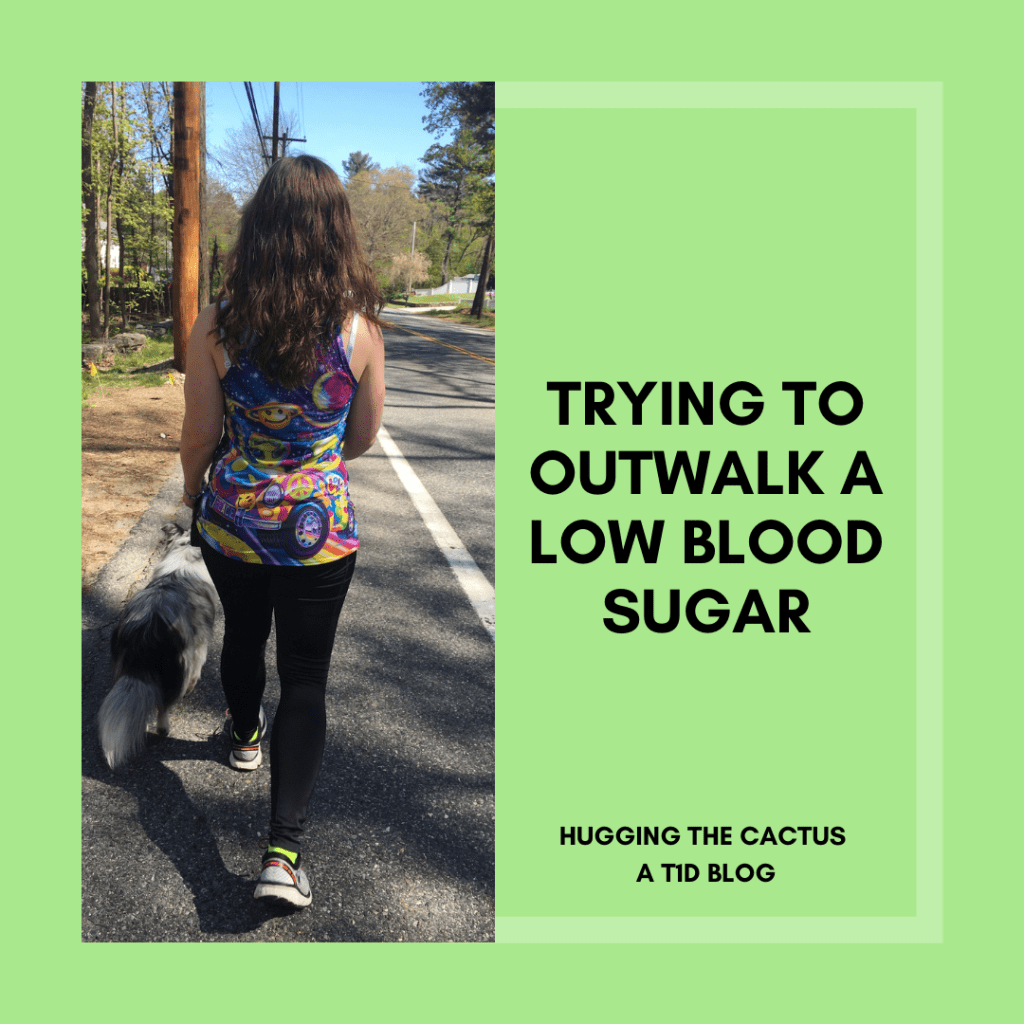
I was a mile into my regular morning walk when the beeps started.
Dammit.
The beeps were coming from my Dexcom app on my phone and they were alerting me to a low blood sugar. Rather than correcting the low, though, or even opening up the app to dismiss the alarm, I just kept walking.
Outwalk the low blood sugar, Molly.
Outwalking a low blood sugar is easier said than done.
I really couldn’t understand why my blood sugar was low in the first place considering that I had no food in my system or insulin on board (other than my standard basal rate). Fasting workouts tend to virtually guarantee stable blood sugars for me, which is wonderful because otherwise exercise tends to make me crash. But what was different about this morning? I was utterly befuddled. My Dexcom alarm chimed a second time.
Outwalk the low blood sugar, Molly.
Even more confusing was my complete and utter determination to not treat the low blood sugar until I got home. I had glucose tablets on me, so it’s not like it was a matter of lacking a treatment. Rather, I think I was more focused on maintaining my fasted state for as long as possible, since I almost always do an exercise circuit (weight lifting, cardio training, HIIT intervals, etc.) when I return home from my morning walks. My low alarm rang a third time, just as loudly as it had before.
Outwalk the low blood sugar. You’re only 15 minutes from home.
I was deaf to my Dexcom’s persistent alarms for the next 15 minutes as I somewhat floundered down the road home, letting my impatient puppy tug me along. It’s almost like she knew that I was low and was trying to hurry me home, and I was 100% okay with that because my brain was starting to get fuzzy.
Outwalk the low blood sugar…
At long last, nearly half an hour after my first low alarm sounded, I was crossing the threshold of my front door and fishing my phone from my bag. I tapped through my notifications and cleared the low alert, noting that I was 66 mg/dL and definitely needed to eat something before continuing on with my morning routine. I sighed, set my sight on the kitchen (where a low blood sugar food stash awaited me), and resigned myself to the fact that I couldn’t outwalk the low blood sugar this time.
By that I mean that I pretend that I like getting up early in the mornings, but truth be told…I hate it. Oh how I long for the days that I could sleep in as late as I wanted and shun my very few responsibilities…
Even though I clearly don’t love waking up early, there is one benefit to it that truly lasts all day long. And that is getting my workouts done within the first hour or so of my day.
Listen, I’m not a fitness freak. I don’t have a ripped bod. More often than not, I’m working out so I can eat and drink the things that I like without feeling as terrible about it (only light sarcasm used in that previous sentence). But I do like exercising and try to do so every single day because, well, it’s good for me and definitely helps me to produce better blood sugars.
Exercising is a thousand times harder than it needs to be, though, when my blood sugar crashes halfway through a routine – which happened a lot more than I wanted it to when I was working out in the afternoons or evenings.
Fed up with the lows, I changed up my routine and that’s when I discovered the beauty of fasting morning workouts.
I am definitely not as flexible as this cartoon lady.
I learned that if I work out soon after I wake up in the morning and wait until after I’m done to eat breakfast, then lows almost never happen. It’s like magic. I’m able to get through my exercise routine (which is usually a half hour circuit of some sort) without having to modify my basal rates whatsoever. Since I don’t have any insulin on board (because I haven’t eaten any food yet), I’m only working out with my basal rate running in the background, so there’s a much lower chance that my blood sugar will really fluctuate when I’m exercising. Of course, mornings that I wake up with a low or a high blood sugar are a little more challenging, seeing as I either have to bring it back up to a good level for working out or get some insulin pumping in my system, but I wake up most mornings with my blood sugar in a range that makes me feel comfortable working out in.
All the diabetes business aside, I gotta say…my other favorite part of working out first thing is that it’s over with and done for the day. Ba-da bing, ba-da boom. It’s not looming over my head for the remainder of the day, and that’s a really nice feeling.
It seems like a new fitness trend is “going viral” every week: between aerial silks, SoulCycle, and at-home fitness mirrors (in which a real trainer appears in your mirror and you get to watch yourself while they talk you through the workout – whoa FUTURISTIC right?), there is a plethora of ways to get physical that don’t involve standard, boring weights or treadmills.
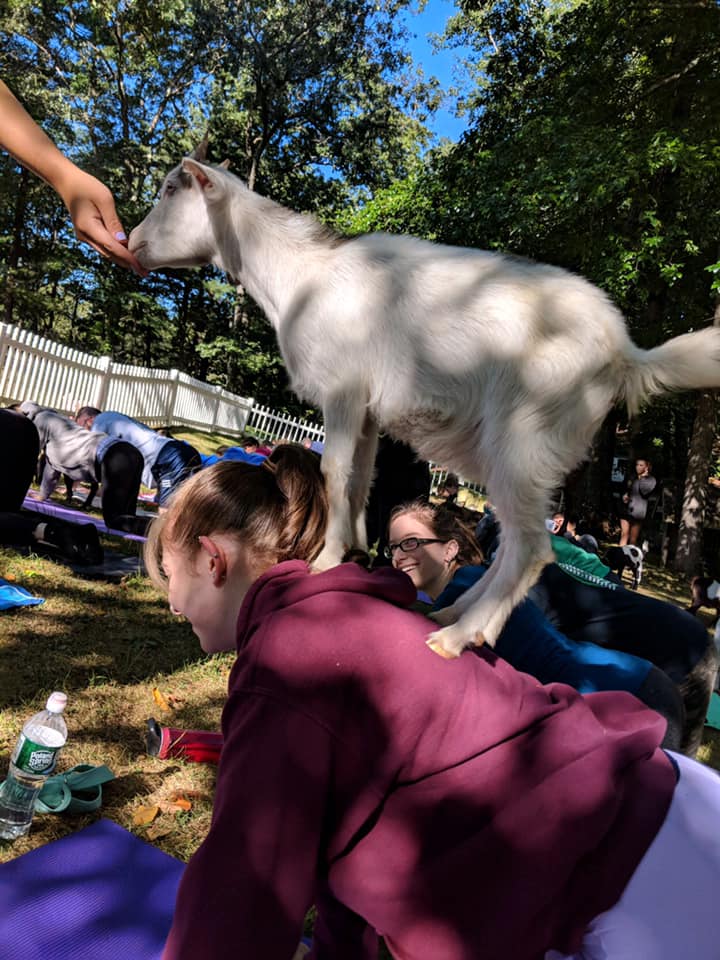
I recently had the opportunity to try one of the most random, and possibly cutest, fitness craze…goat yoga. Yep. Yoga, but with goats.
All downward dogs should be called downward goats when doing a goat yoga class.
It’s exactly what it sounds like. You move through a series of yoga poses, but there just happens to be adorable baby goats roaming around the class. They aren’t shy about making their presence known, either. When they aren’t bleating or searching for goat treats under your yoga mat, they’re actually JUMPING ON TOP OF YOU. It doesn’t matter if you’re in a tabletop pose (see my photo, above), downward dog, child’s pose…they’ll find a way to climb on you and turn you into their personal jungle gym.
It was a little disconcerting at first, and it was damn difficult to focus on flowing through yoga poses because you didn’t know if or when a goat would hop on your back or accidentally brush up against you with its horns.
And it was virtually IMPOSSIBLE when my blood sugar went low halfway through the class.
I knew that I was starting to feel off after I completed a short series of bird-dog crunches. I felt oddly exhausted after doing five on each side, so I went to go check my CGM data on my phone when I realized I didn’t have access to any, because I’d just inserted a new sensor that morning and the warm-up period wouldn’t be complete until the end of the goat yoga class.
Great timing on that one, Molly.
I decided to give it a few minutes before I took any corrective measures. So I just sat there, watching people struggle to get bendy with goats running amok. It was really pretty funny, but my sense of humor was shot, thanks to my low blood sugar.
I’m a little embarrassed to admit that the goat factor also prevented me from correcting my low right away, but…well, those things were germy. They’re farm animals, of course they will be messy and smelly. But they were literally peeing and pooping on our yoga mats, and precariously closely to our clothes/bodies. Forget feeling like I needed to sanitize my mat when the class was over – I felt like I needed to power wash MYSELF, at max intensity, just so I could feel totally clean again. So the prospect of checking my blood sugar in the middle of everything seemed absolutely unsanitary and virtually impossible.
But…like, I had to suck it up. After all, I didn’t want to do that thing that goats do, which is faint. Except they do it in a semi-cute way, and because they’re born with a condition that causes muscles to seize up when they’re startled. And there was no way I was about to faint due to a stinkin’ low blood sugar in front of a bunch of strangers and goats.
So I forced myself to navigate to the clean, protected patch of land that my backpack was perched on, dodging poop balls on the way over, and immediately grabbed my hand sanitizer so I could cleanse myself before reaching into my backpack and consuming a small box of yogurt-covered raisins. I still felt gross about it, but I did the right thing and took care of myself.
And I’m happy to report that by the end of the class, my blood sugar was on an upswing and not one goat had peed or pooed directly on me. Sweet success!
“How are you today, ma’am?” The man behind the Dunkin’ Donuts counter smiled and looked at me expectantly, as I started back at him blankly.
I wasn’t sure how to answer. My mental state wasn’t great, that was for sure. I’d just come from a visit to a walk-in clinic, where I’d had X-rays of my foot taken to see whether or not it was fractured.
The previous 24 hours had been a bit of a whirlwind. I’d worked and gone to my first-ever kickboxing class, which was an awesome experience. I’d had dinner with my partner and started playing video games soon after as a way to unwind after the long day. That’s when pain in my foot flared up, suddenly and significantly.
Could I have injured it in the kickboxing class, without even knowing it? Was I overdoing it on exercising, in general? How and why did the pain just start up like that? Almost immediately, I plopped myself down onto the couch with an ice pack and extra cushions, hoping that I could stop the pain as quickly as it started.
No such luck. I went to bed early that night, but the pain was so severe that sleep was virtually impossible. I tossed and turned for hours, wondering what the hell was going on and coming up with a plan to get it checked out A.S.A.P.
That’s how I found myself at a walk-in clinic, a little over 12 hours after I first felt the pain. I was evaluated by a nurse practitioner who told me that “the likelihood of a fracture was low” (thank goodness) and that it was “probably tendinitis.” I was given instructions to rest, ice, and elevate my foot for the weekend, and take non-steroidal anti-inflammatory drugs (otherwise known as NSAIDs, like Ibuprofen or Aspirin) as needed.
I’m trying to put my best foot forward as I deal with this injury.
That meant hours and hours of being sedentary.
That meant no exercise of any kind – I even had to keep walking at a minimum.
That meant my spirits were crushed.
I was glad that it wasn’t worse, and proud of myself for not waiting to seek medical treatment. But that didn’t mean I was thrilled with the outcome. Basically, I had to take the wait-and-see approach. Time will tell how long the pain lasts, and I can’t stand not knowing. I also can’t stand not being able to be active. Daily exercise is a key element to maintaining good blood sugars. Sitting around idle doesn’t do my diabetes any favors, but it’s not like I had any other choice.
I left the clinic, trying to process this information. This certainly wasn’t the way I wanted to kick off the long Memorial Day weekend. It definitely could have gotten off on a better foot. (Okay, okay, I’ll stop with the puns.) I found myself at a nearby Dunkin’ Donuts minutes later. I hobbled in, hoping that an iced coffee might lift my spirits somewhat.
I blinked, bringing myself back into the moment, and smiled wryly at the Dunkin’ cashier. “I’m okay,” I said to him. It wasn’t just a response to his question, it was also a reassurance to myself. I’m okay and I will be okay. I won’t let this get me down.
Normally, if you asked me if I would willingly go into a 105 degrees Fahrenheit room for 90 minutes for a workout, I’d say ohh HELL nawwww before you had the chance to finish asking your question.
I’m not someone who has a passion for exercising. I tolerate it. I try to do it daily for two very important reasons: 1) It keeps me in shape and 2) it helps me manage my blood sugars better. Otherwise, there’s very little about exercise that I actually enjoy. I’m not a fan of feeling out-of-breath for long periods of time. I have a love-hate relationship with the post-workout soreness that floods my body after a particularly intense session. And I definitely cannot stand sweating – on just about any given day, I’d rather be freezing cold and wearing layers of clothing than dripping in sweat.
All that said, though, I willingly participated in a fitness class called Bikram yoga…which is also known as hot yoga because you’re in a temperature-controlled room heated exactly to 105 degrees for the duration of the workout. For 90 minutes, you slowly move through 26 poses, and that’s that.
I wasn’t worried about the latter; it was the former that had me sweating (both literally and figuratively). I wondered whether I’d be able to tolerate the heat for a full hour and a half. I also had concerns about my diabetes devices – would I be sweating so much that they would fall off? Would they be able to stay safely in the room with me, or would the heat be too extreme for them? And how would my body and blood sugars respond to the hot yoga, anyways?
I knew the only way to get answers to my questions was to show up for class and find out for myself.
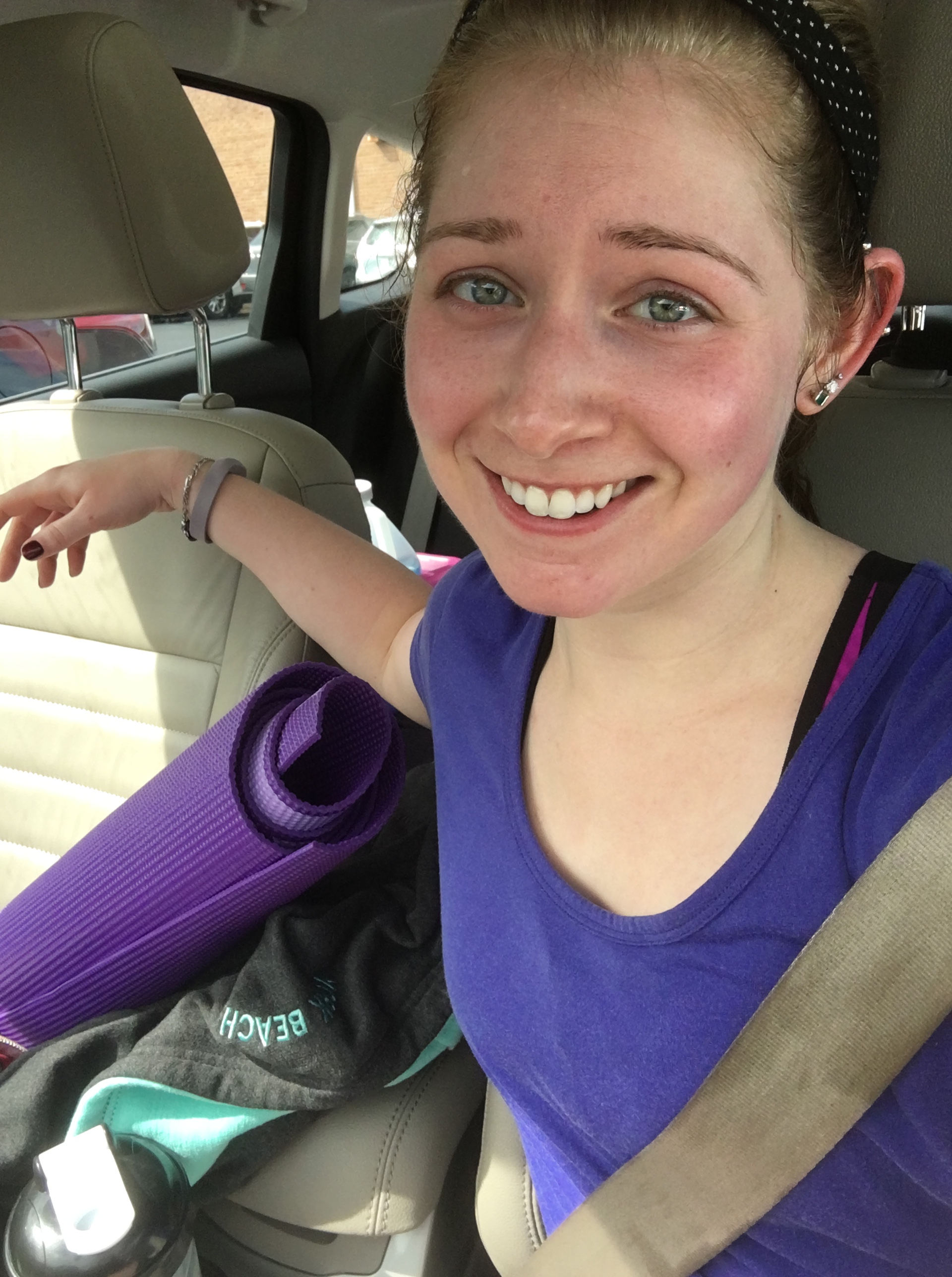
Me, post-class, dripping in sweat in my car. Next time, I’m bringing a change of clothes.
And that’s exactly what I did. I went to a morning class with my stomach empty and my backpack full of diabetes supplies. My blood sugars tend to respond better to exercise when I don’t have any food in my system or insulin on board, so I made it a point to wait to eat my breakfast after yoga instead of before. But I still wasn’t entirely sure if or how my blood sugar might react to a brand new kind of workout, so I wanted to be armed with several different low snacks. I felt fairly confident about its stability, though, as I headed into the class sitting pretty at 110 mg/dL.
In addition to extra diabetes supplies, I also thought to bring with me some water that I’d filled and frozen the night before the class so I could stay hydrated throughout it with water that was sure to be extra refreshing in the heat.
Even though I had all this stuff with me, I chose to leave most of it in a cubby outside the studio, save for my CGM receiver, a tube of glucose tablets, and my water bottle. I didn’t want to take any chances with my cell phone, PDM, or glucometer and expose them to the heat – I have firsthand experience with an overheated cell phone, and while it does eventually cool back down its own, overheating my devices is not something I’d actively seek to do. I was taking a bit of a risk with the CGM receiver, but since I have the Dexcom app on my cell phone, it’s not like I’d be at a huge disadvantage if something were to happen to my receiver.
So with my gear in hand, I stepped foot into the yoga studio…and immediately started sweating. Yes, that quickly! It was a heavy, stifling, and moist heat – the exact kind that I hate the most. I started to question whether I had the endurance to even sit in this heat for 90 minutes, let alone move seamlessly through yoga poses in it. In the minutes before the class began, I sipped water slowly and told myself that above everything else, I needed to listen to my body throughout the class. I started to feel better as I reassured myself that it would be perfectly acceptable to walk out should I start to feel light-headed, low, queasy, or anything else abnormal.
Fortunately, though, an exit plan wasn’t needed as I made it through the full class! That’s not to say it wasn’t challenging or extremely sweaty – seriously, my body was so covered in sweat that it looked like I’d just come out of a swimming pool – but I proved to myself that I could do it. And the best part was that my blood sugar behaved beautifully: As a reminder, it was 110 mg/dL at 8:30 A.M. Class started at 9 and lasted until 10:30 A.M. I was home by 11 and when I checked my blood sugar there, I was at 118 mg/dL. I couldn’t have asked for better pre-, mid-, and post-workout blood sugar levels.
Was it scary to try this new, moderately intense exercise? Yes. Was I concerned about my diabetes before, during, and after the class? Yes. But was it all worth it? I’d say yes. I overcame my fears and was met by blood sugar success, making hot yoga a diabetes win in my book.




 Hugging the Cactus