St. Patrick’s Day is a favorite holiday of mine because I enjoy celebrating my Irish heritage. Almost every year, I eat a traditional boiled dinner, listen to Irish music, and wear an excessive amount of green.
This year, though, was a little different. In addition to all of the above, I attended the TypeOneNation summit in Boston. The event was organized by JDRF and just about 900 people with diabetes attended, along with their families and caregivers.
There’s nothing like being in Boston on St. Paddy’s day, even if it is for an event that has nothing to do with the holiday’s shenanigans. The spirit of the day made it slightly less painful to wake up at the crack of dawn in order to catch an early morning commuter rail into the city. As I sipped an Irish cream iced coffee from Honey Dew (absolutely delicious) on the ride, I got myself pumped up for what would surely be a fun day.
Once we arrived at the Back Bay station, I was one frigid (and mercifully short) walk away from the event space: the Boston Marriott Copley hotel. I went straight to the registration table so I could receive a name tag and itinerary, then made a beeline for the vendor hall. You can never have too much free diabetes swag, am I right?
Within the hall, I recognized many familiar faces and happily made the rounds to chat with some of my T1D friends in attendance. I couldn’t help but feel like I was at a family reunion of sorts as I reconnected with people who I don’t get to see often enough.
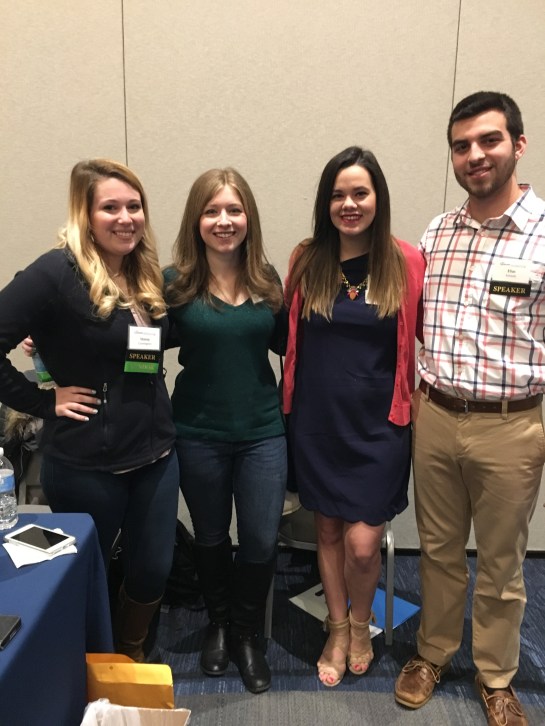
I was pumped to see some friends I’ve made through the CDN at the summit!
Before long, the events of the day got into full swing as the keynote speaker, Nicole Johnson, addressed the crowd. Nicole won the Miss America pageant in 1999 soon after she received her diabetes diagnosis. She’s done many incredible things since earning that accolade, and she delivered an inspiring speech about living life with diabetes to the fullest. As she spoke, I looked around the room and noticed all the little kids who were there. It warmed my heart to see how they received Nicole’s words. Many of them looked at her in absolute awe. It was obvious that they thought she was pretty great, and I bet that having diabetes in common with her helped them to feel just as cool. Nicole is definitely a wonderful role model!
The rest of the day went by much too quickly as I went to two different talks offered at the summit. One was about going to college with diabetes, and the other was about sex and drugs – the “taboo” diabetes topics. Even though I’ve already experienced what it’s like to go off to college with diabetes, I wanted to go to this talk because it was given by my friends from the CDN. I also wanted to meet the parents and children at the session because I was curious to learn about their concerns. As someone who went to a very similar talk seven (?!) years ago, I felt that I could potentially offer reassurance to these families, especially since the whole college experience was so recent for me. And it turned out that the woman seated next to me was an anxious mom who seemed receptive to the words of encouragement I spoke to her at the end of the panel. While I believe that the session could’ve lasted many more hours (everyone was so engaged in the conversation), I think that the session acted as a good launching point into future discussions for many families who are going to make this transition soon.
I wolfed down a quick lunch – I loved seeing the food labeled with carb counts – before heading to the next session. I chose it because, c’mon, a title like “Sex, Drugs, and Rock n’ Roll” can get anyone’s attention. Plus, I feel very strongly that the touchier diabetes topics SHOULD be talked about more often. They can be scary to approach, but it’s important to know what to expect in certain situations in which diabetes can play a major role. I had to duck out of this one a bit early to catch the commuter rail back home, but they were delving into some pretty juicy stuff when I got up to leave. I give major credit to all of the panelists in that one – it can’t be easy to talk about highly personal intimate matters in a room filled with strangers!
Although my time at the summit was truncated, I’m so glad that I took the time to go to it. It’s no secret that I enjoy talking with other people with diabetes. Hearing their stories and sharing experiences makes diabetes feel less isolating. And I’m thrilled that I finally got to meet a few people I knew from the DOC but had yet to see in person!
Diabetes conferences, meet-ups, summits…they’re the types of family reunions you actually get excited about and want to attend.
Happy Valentine’s Day, readers. Whether you celebrate the holiday or not, I’d like to make you think about a dozen roses today.
A dozen roses is a classic Valentine’s gift, right? But what if you received 11 roses in your bouquet, instead of 12? What if you knew that a rose was spared because the value of that flower helped support a child living with diabetes in a less-resourced country?
I bet you wouldn’t mind getting one less rose in that case.
This Valentine’s Day, please consider sparing a rose. Life for a Child is a nonprofit charity that created the Spare a Rose campaign. They’re able to support nearly 20,000 young people living with diabetes by using donations to buy them insulin, syringes, clinical care, diabetes education, and more. Anyone who’s familiar with diabetes realizes that access to care, education, and resources is critical to living a healthy and normal life. No one would want to deny another, especially a child, from having to forgo these resources because of the financial burden associated with them.
Diabetes in the wild refers to a random encounter with another T1D when out and about. My favorite recent occurrence of this happened when I was in Disney World with my mom (also a T1D). We had just entered Animal Kingdom. I was sporting my pod on the back of my upper arm.
I don’t think Timon noticed my pod, but another T1D in the park sure did!
“Hey, Podder!” I heard someone yell. For a split second, I thought someone was saying, “hey, Potter,” you know, like the Harry Potter kind of Potter.
I looked around and saw a girl a few years younger than me waving her arms in my direction. When we made eye contact, she smiled and pointed at her pod. I gave her a thumbs up and the moment was over as quickly as it happened.
But it puts a smile on my face when I think about it, because it goes to show how awesome these chance meetings are – they serve as little reminders that even when I may feel like the odd duck in a crowd due to my pod, I’m not as alone as I think I am when it comes to diabetes.
Diabetes evokes curiosity for those who are not familiar with it. I’ve been asked many questions over the years – can you eat sweets, does it hurt when you give yourself shots, do you have to protect your pump from water, just to name a few – all relatively easy-to-answer, yes-or-no questions. But every now and then, someone will ask harder questions. And one that I’ve struggled to answer in a succinct manner is: What does it feel like to have low blood sugar?
There isn’t really a simple answer. I guess my textbook response is to rattle off a list of common hypoglycemic symptoms: shakiness, dizziness, sweating, slurred speech, weakness. But I know that other PWD experience slightly different symptoms, such as feeling cold instead of sweaty, or drastic changes in personality. And there are even some PWD who don’t experience any symptoms due to hypoglycemia unawareness.
So how exactly do I response to a question like that, one that’s more loaded than it appears?
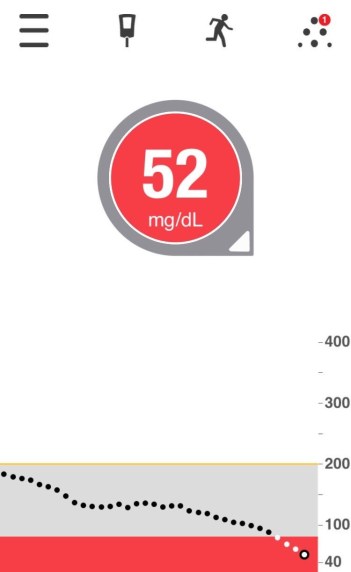
A graphical representation of a sudden low – I guarantee I was not feeling great when this one hit.
I could tell the asker to imagine feeling simultaneously ravenous and disoriented. I could tell them to picture walking into the kitchen and feeling like inhaling the entire contents of the pantry – that’s how intensely your body craves sugar.
I could tell them to think about what it’s like to wake up in the middle of the night drenched in sweat. It might seem like a reaction to a nightmare, but it’s the body trying to convey a message that is, by some miracle, supposed to be grasped by someone who was just trying to get a solid night’s sleep.
I could tell them to envision feeling like energy is sapped out of every pore in the body abruptly, with little warning.
I could tell them that sometimes, it results in pure panic, particularly when no fast-acting carbohydrates are on hand or when no one is around to help you.
I could tell them that low blood sugar is one of the biggest sources of anxiety for many PWD, that it causes a deeply rooted fear. That it can sometimes lead to a PWD making unhealthy choices just to avoid a low from happening in the first place.
I could say all of this to anyone who asked me this question – and I still don’t think it would completely convey what it’s like to have low blood sugar.
How would you describe it to someone asking you about it? Would you use the terse medical explanation, or would you try to talk about how it really feels?
Leave your responses in the comments – I’d like to know how you handle this. And if you thought this was an interesting post, let me know. I’m thinking of doing a series about how I answer the more complicated diabetes-related questions I’m asked.
Merry Christmas Eve, to all those who celebrate it! Christmas is one of my absolute favorite holidays. I love spending time with my family and friends, attending mass, baking (and eating) Christmas cookies, and decorating the tree. This time of year is pure magic; a time when I feel most joyful.
This Christmas Eve also marks my 20th year of living with type one diabetes. I don’t remember much from that night in 1997, seeing as I was only four years old. I recall tons of family members visiting me in the hospital and bringing gifts for me. One of the gifts I received was a honey-colored teddy bear that I particularly liked and hugged often throughout my hospital stay.
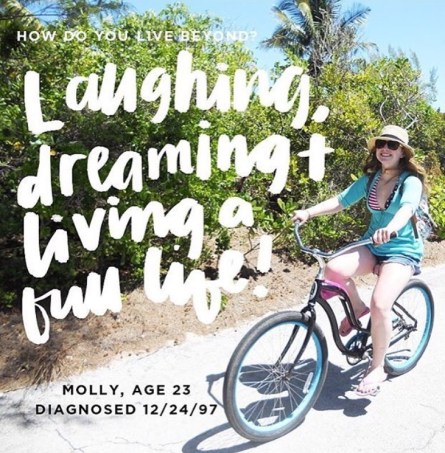
Beyond Type 1 featured me on their Instagram Wall of Warriors last year. This is how I #LiveBeyond.
Twenty years with diabetes is a long time. Too long, especially since every couple of years since my diagnosis I’ve been told that a cure would be found “soon”. I’ve come to accept the fact that “soon” just might not be within this lifetime, and rather than dwell on that, I choose to focus on the joy of life itself. How lucky am I to live a full life, surrounded by loved ones, employed full-time, with a roof over my head and food on my plate? How lucky am I to be able to have access to the insulin I need and to have a choice when it comes to the pump and meter I use? How lucky am I to have the knowledge and willpower it takes to manage a chronic illness every second of every day?
I’m extraordinarily lucky. I’m blessed.
That’s what I’m focusing on joy on this significant diaversary. I’m embracing the spirit of the season and recognizing the good in this life. Diabetes takes things away from me sometimes – a full night’s sleep, an occasional dessert, a missed trip to the gym – but I refuse to let it take my joy.
I often tell others that I feel lucky to have received my diabetes diagnosis at a young age. Why? One major reason is that it didn’t really interrupt my life – I was so little that I barely remember it, so it wasn’t necessarily a traumatic event (at least, not for me – my parents probably strongly disagree with that).
But I’ve heard many different diagnosis stories from fellow T1Ds over the years, and not everyone was as fortunate as me. In fact, I met a few students at the last couple of CDN annual retreats who received diagnoses just as they were starting their college careers. Diabetes was still pretty new to some of them, which made me realize that growing up with diabetes is probably a bit easier than developing it during one of the most formative and chaotic periods in life: young adulthood. Add college and the “real world” into the mix and you’ve got a recipe for a mass quantity of stress.
This is why I think it’s wonderful that the College Diabetes Network recently created a specialized guide for newly diagnosed young adults: You’ve Got This: A Guide for Young Adults Diagnosed with Type 1 Diabetes. The guide offers tips and tricks on how to adapt to life with diabetes, and covers areas like relating to peers and navigating school and work.
Two students who helped bring this guide to life, Andy and Deja, were kind enough to take time out of their busy schedules to answer some questions I had about the guide.
AndyDeja
Tell me about yourself. Where are you from and what do you do for a living? What are you studying in school?
Andy: Thank you for this opportunity to talk about CDN’s new guide and my T1D experience! My name is Andy Zeiger and I’m from Danville, California near Oakland. I recently graduated from the University of Washington (UW) with a degree in molecular biology and I’m currently part of the Asthma Collaboratory at UC San Francisco researching population genetics. I love reading history and biographies. After graduation I went on a two-month cross country drive (on my own!) to learn more about our country’s cities and big thinkers. I also enjoy taking my dog Rose on walks and talking to her about my problems.
Deja: My name is Deja Gipson; I am from Atlanta, GA. I am currently in my sophomore year, studying Electrical Engineering at the University of Alabama. I am 20 years old.
You were diagnosed with diabetes as a young adult. What was your diagnosis like and how did you react?
A: My diagnosis happened during winter break of my junior year of college because my dad observed that I went to the bathroom three times during the new Star Wars movie. Within 48 hours of hearing I had type 1 diabetes, I had picked the brain of an endocrinologist, learned how to count carbs with a diabetes educator, and discussed dietary strategies with a nutritionist. These resources primed how I viewed my diabetes in those early days: I was given the tools and resources to do this. So that’s how I reacted, I just jumped headfirst into living with diabetes. Apart from crying in a restaurant bathroom my first day with diabetes because I didn’t know if I could eat a Philly cheesesteak (I can and do), I worked hard early on to not let myself get too negative about the diabetes. In the almost two years since my diagnosis I have learned that the WAY in which I was diagnosed – by being provided with lots of positive support and great resources – is a key reason why I have achieved tight diabetes management and a positive outlook. This is the reason why I believe strongly in CDN and their guide for newly diagnosed young adults. When individuals with T1D have access to the strong social support networks of CDN, and the insightful and useful information in this guide, they will be better equipped to thrive with diabetes.
D: My diagnosis went a lot smoother than most, compared to the diagnosis stories I’ve heard from others in the diabetes community. I was diagnosed at 17, which was my senior year in high school. I was actually admitted into the hospital the week of my senior prom. If I would have stayed in the hospital any longer than I did, I would’ve missed it! So as a senior in high school, that was a big deal for me. Fortunately, I was able to attend, my dress just fit a little bigger than it did when I first tried it on due to the weight I had lost.
When and how did you become involved with the College Diabetes Network?
A: I returned to school after winter break newly minted with T1D and ready to take on a heavy course-load as well as my research position on campus. For the subsequent few months, I put my head down and worked hard, figuring that successfully incorporating T1D into my life meant shouldering the burden on my own. I would soon find that the best way to successfully integrate T1D into my life was actually to allow people to help me and, in letting them help me, I could find ways to in return, help them. I began volunteering with the Pacific Northwest Chapter of JDRF where I was lucky to meet Kassidey Short, a UW student who had been living with T1D almost her entire life. We founded a CDN Chapter on our campus and began working with the Seattle University CDN chapter to build a support system for T1D students in Seattle. We anchored our CDN Chapter to the local JDRF infrastructure and built connections with various organizations at UW including the disability services office, residential life and local clinics. We utilized CDN’s many resources to put on two educational panel events for high school seniors and college freshmen. During my senior year we were recognized for our work in building a support system for T1D students when I was awarded a Mary Gates scholarship and our group was featured in the UW student newspaper. CDN sent out applications to attend a workshop in Boston to create this guide, and I could not pass up the opportunity to learn about the diabetes experiences of my peers and become a better advocate for T1D in the broader community.
D: I became involved with CDN once I got to college. I was informed by my endocrinologist that my school most likely had a Chapter and that I would feel comfortable knowing and interacting with other students my age with Type 1. He was very correct! I have made bonds through CDN that will last a lifetime!
CDN is launching a guide for newly diagnosed young adults on November 13th. What kind of information does this guide contain?
D: The guide that we’ve created for newly diagnosed young adults contains the “real” things you need to know about having diabetes at this age. The information in the guide was collected from a group of young adults, so I believe that the contents are truly authentic and will help anyone become more aware of the things you really need to know about “dia-beet-us”!
How did you contribute to the guide?
A: In the spring of 2017, CDN hosted newly diagnosed adults from CDN Chapters across the nation at a workshop in Boston. We received a packet of information to review which would serve as the framework for this guide and were asked to come prepared with comments about the guide and reflections on our experiences with T1D. As with every member of the workshop, I deconstructed my own diagnosis experience for the most valuable insights and shared them with the group. We had sessions moderated by the founder and CEO of CDN, Christina Roth, and we had guest researchers prime us with questions based on their own experiences with diabetes from a clinical and biomedical research perspective. Personally, I sought to contribute to the guide by relaying positive reflections on a living with type one. My experience with diabetes has forced me to become more efficient and deliberate with my daily activities. It has taught me incredible insights about my body and I have seen massive benefits in taking care of my mental and physical heath every day. While T1D is a chronic illness with its unique challenges, individuals with T1D can relate to the daily struggles and adversities felt by anybody living with a chronic illness. Empathy and compassion are born out of a concerted effort to appreciate the struggles and pressures befalling our neighbors, and T1D has created a platform for me to do that. Furthermore, Insulin was first used in human clinical trials in 1922! If I had been diagnosed with T1D as a 20-year old prior to 1922, the standard of care would have been a miserable starvation regiment and I would have lived for approximately two to four years. We are living at a time when the gap in life expectancy between people living with type 1 and the general population is closing and we can live a relatively normal life with the disease. That is the miracle of science that I wished to convey!
Is there a part of the guide that you think is particularly helpful to newly diagnosed young adults? Which part, and why?
A: The first section of the mental health chapter of the guide discusses positive approaches to “diabetes control”. I wish I had been able to read this chapter the day I was diagnosed. My care team and family prepared me with great resources and support, but all too often I felt like I was riding in the passenger seat, living at the whim of my disease. This part of the guide reminds us that our diabetes is our own, we will make adjustments throughout our life and will never perfectly have it under control, but that’s okay. It’s better to strive for the tightest control possible than to feel guilty or defeated in pursuit of unattainable perfection.
D: I believe that the Family portion of the guide is the most important. Your family are the ones who care about you the most, and sometimes their “caring” can come off as rude, which can get to be annoying and overbearing. I believe that it is important to let them know how they can help you so that way they can still feel a part of your life and can help you the correct way.
What advice would you give to a young adult newly diagnosed with diabetes?
A: Every day I check my blood around five or six times and give myself five shots of insulin. Nobody does this for me, which means I am completely reliant on myself to count carbs and dose my insulin and make sure that I have tight control of my diabetes. However, it is nearsighted to think that I alone affect my health; in fact, we are all stakeholders of each other’s health. As Benjamin Franklin related in his Appeal for the Hospital, “We are in this world mutual Hosts to each other… the Good, particular Men may do separately, in relieving the Sick, is small, compared with what they may do collectively.” Essentially, if you were just diagnosed with diabetes, you should know that you gain strength from the help of others. You may not yet know anybody who has diabetes and you may think that people without it can’t understand what you are going through, but carrying the burden of the struggle by yourself is painstakingly difficult. I know because I have tried. Type 1 diabetes is a silent struggle but depression, chronic pain and obesity are silent struggles too. These struggles may not involve blood gymnastics, but more people than you can imagine do understand what it is like to grapple with their health every day, and they want to help. My advice would be that you are promoting your health and the health of those around you when you acknowledge the gravity of your community’s struggles and actively seek ways to help. Being supportive to others is a great way to turn your diabetes into a positive.
D: Know that you’re not alone in this! You can live a prosperous life and show diabetes that you’re the boss!!!
Thank you for answering my questions, Andy and Deja! “You’ve Got This: A Guide for Young Adults Diagnosed with Type 1 Diabetes” is available digitally on the CDN website on November 13th, along with videos featuring CDN students talking about their experiences and what they have learned. Here’s a sneak peek!
To celebrate, I’ll be posting a variety of content that’ll give non-T1Ds a bit more insight into life with diabetes. I’m going to *attempt* to respond to the many wonderful prompts provided by Beyond Type 1 and the College Diabetes Network, starting today!
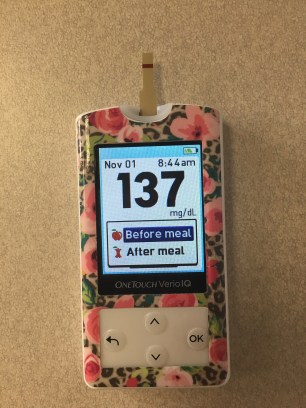
Beyond Type 1’s first prompt is easy enough: Post a photo of your #bgnow! (This is a hashtag commonly used on Twitter to share current blood sugar readings.)
So here it is:
Hey, not bad! Especially for a post-breakfast blood sugar! I’m hoping for some tighter numbers this month, seeing as I just saw my endocrinologist a few days ago. I had a good A1c reading, but not my best, so I was a little disappointed. But she reminded me that my A1c is just an average, and that I should be proud of the progress I’ve made in the last few years. Her faith in my ability to take the best care of my diabetes that I can is super reassuring. That, combined with my excitement to advocate all month long, is exactly what I need to meet my personal goals.
Looking forward to an awesome month of diabetes advocacy!




 Hugging the Cactus