And the Nominee is…Me?!

Friends, I am pleased to share that I have been nominated for a WEGO Health Award. My blogging for Hugging the Cactus has qualified me to be a Patient Leader nominee for the “Best Kept Secret” award, which is very exciting to me! What’s more, if I advance to the finals round, I may be able to win a trip to Las Vegas for the HLTH conference in October. This would provide me the opportunity to be around other Patient Leaders who, I’m confident, I could learn so much from, as well as the rare chance to attend a health-focused conference based on merit rather than cost.

What exactly are the WEGO Health Awards? They were created to recognize and honor those who strive to make a difference in the online health community. In the past few days, I’ve scrolled through the growing list of nominees who are advocates for all sorts of conditions, from anemia to ulcerative colitis. It’s quite eye-opening to see just how many health topics inspire individuals to spread awareness via social media, blogs, podcasts, YouTube channels, and more. And it truly is an honor to be listed among these incredibly inspiring nominees.

70AA0C50-FF9F-4BCC-A8DE-20A76C79A2A5
Well, this is just plain cool.

If you feel that I deserve to move on to the semi-finalist round, please follow this link to endorse my nomination. By clicking the link, you can view the other nominees and their profiles, which I strongly encourage so you can find out for yourself the sheer volume of skilled storytellers out there. Plus, you never know, you might just discover someone who you can relate to or who inspires you. After all, in a world of chronic conditions that can feel so isolating, isn’t it always a comfort to find out that you’re not alone?


Supporting T1D Students with my #SensorSelfie

I’m taking a departure from a “traditional” blog post today to tell you, my dear readers, that you should consider celebrating a special holiday with me today: National Selfie Day! Before you roll your eyes at the mere idea of that, please keep reading to learn how participating will help support students with diabetes.

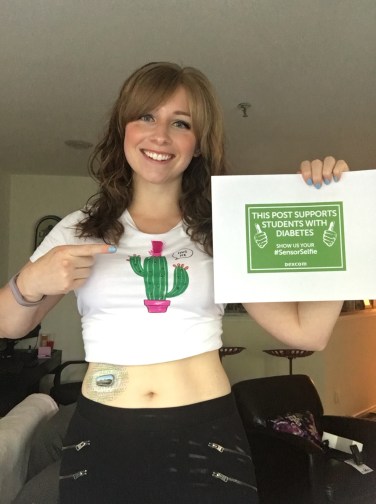
Dexcom has partnered with a nonprofit that is very important to me – The College Diabetes Network (CDN) – to help put some focus on the diabetes community and raise money. They’ve created the #SensorSelfie social media campaign to encourage people with diabetes to take photos of themselves proudly donning their Dexcom sensors.

947D37E4-B661-4EC5-8E02-C58D07A66110
Here’s my #SensorSelfie, which wouldn’t be complete without my cactus shirt.

But what exactly do you need to do in order to take part in the campaign? There’s four simple steps to follow today, June 21st:

  1. Take a picture showing off your Dexcom sensor
  2. Post the photo to your Facebook and Instagram pages
  3. Use the hashtag #SensorSelfie and tag @Dexcom
  4. Tell ALLLLLL your diabuddies to do the same

For every post that uses #SensorSelfie today, Dexcom will donate $1 to CDN. Can you imagine how much money could be raised if you got all the T1Ds you know to participate?

If you’re looking for some more information on this social media campaign, click this link. Otherwise, what are you waiting for? Get to snapping, posting, and tagging!

Bret Michaels Appreciation Post

There’s a bunch of famous T1Ds who would be really cool to meet: Victor Garber, Sonia Sotomayor, Derek Theler, to name a few. And obviously, there’s Nick Jonas, who is probably the most popular of them all. But there’s a different musician with diabetes who I’d be even more eager to meet than Nick – nothing against the guy, of course.

Who do I have in mind? Why, the one and only Bret Michaels, the lead singer of the rock band Poison.

This might surprise some of you – I don’t exactly seem like the type who’s into that sort of music. But I totally am. Nothin’ But a Good Time, Unskinny Bop, and Talk Dirty to Me are among my favorite Poison songs. They’re simply excellent to dance and sing along to, and to play on Guitar Hero (which I did often in the game’s heyday, and absolutely pretended to be a rock and roll guitar QUEEN every time I played it).

And I somewhat ashamedly admit to indulging in Rock of Love when it regularly aired on Vh1. It was Bret’s dating show, and it was like The Bachelor on steroids. Total reality TV trash, but I was hooked on it and never missed a season.

Okay, so you get the idea that Bret Michaels might be a stereotypical rock star who revels in big hair, eyeliner, and female company…but he’s different from most because like me, he has type 1 diabetes.

BRET MICHAELS APPRECIATION POST
It would be friggen’ sweet if Bret Michaels saw this post.

From what I’ve read and understand, he was only a couple years older than me when he was diagnosed. Growing up, he was the only kid with diabetes in school, which presented its challenges. Arguably, the stigma surrounding diabetes in those days was much stronger, and Bret struggled when his classmates and their parents misunderstood his condition and how it came about. But that didn’t stop Bret from developing into a self-motivated individual. Along with his parents, he started the first youth camp for T1Ds, which still exists today in Pennsylvania. As he grew into adulthood, his passion for music and creativity flourished, and he became a founding member of the band known as Poison today. It took time for Poison to achieve success, but through hardship Bret persevered and took comfort in music as a therapeutic outlet.

It must’ve been difficult for Bret to admit to the world that he had diabetes, but after collapsing onstage at the Madison Square Garden in 1987, he had little choice but to share his story. Instead of dwelling on possible repercussions, though, he chose to work harder rather than give up. Poison’s popularity grew over the years as they found widespread commercial success, but Bret never forgot about supporting diabetes charities like JDRF and the American Diabetes Association. He even founded his own charity that supports youths with diabetes and helps them afford diabetes camps.

I can’t help but appreciate the fact that he’s devoted much of his life to being a performer as well as a philanthropist – neither are easy, and to do both and still manage to take care of his diabetes is something that I think is amazing. That’s why I say move over, Nick Jonas (though he has also done so much for diabetes organizations) – I’d like to meet who I consider the OG T1D philanthropist/celeb, Mr. Bret Michaels.


7 Questions People Always Ask Me About Type 1 Diabetes

Human beings are naturally curious creatures. So it’s never really surprised me when, upon discovering my T1D, people tend to ask me boatloads of questions about what it’s like. And it’s definitely not at all shocking that many of these questions are recurring.

I've missed you terribly!

Here’s a list of seven questions that I’m almost always asked when I encounter someone who’s just learning about my diabetes. You’ll notice a trend as you read, because even though there’s “no such thing” as a stupid question, this list kinda gets dumber as it goes on. There, you’ve been warned…

7. What does it mean when your blood sugar is high/low?
This is definitely a fair question. I never expect someone who is unfamiliar with diabetes to know the meaning of hypoglycemia or hyperglycemia. I actually kind of appreciate being asked this question, because it helps me spread awareness. The more people that know how to react in severe high or low blood sugar cases, the better, IMHO.

6. Why do you wear all of those devices?
Another decent question – I never mind explaining how my CGM and my pump work, but I do mind when people say ignorant things, like “Oh, are those patches to help you quit smoking?” *Eye roll*

5. Can you eat/drink [fill-in-the-blank]?
Ugh…I get why people ask me this, but it’s a little more tiring to explain. My answer is usually along the lines of: “I can eat or drink whatever I like, but I need to take insulin to account for it. So I try to eat a limited amount of carbs at a time, because that means I have to take less insulin, and there’s less room for error.” But even after that easy-to-understand explanation, the typical follow-up questions are “BUT CAN YOU EAT CAKE/COOKIES/ICE CREAM/ANY SUGARY FOOD?!” And that’s when I lose a bit of my patience, TBH.

4. Does it hurt when you check your blood sugar/give yourself a shot?
I mean, no? I’m not trying to be facetious or anything, but really, after 21+ years of checking blood sugar and giving myself insulin multiple times per day…there’d be a real issue if it hurt every single time. I concede that there are the occasional sites that sting, but it’s not nearly as bad as many people seem to assume.

3. What’s that beeping sound/ARE YOU GOING TO EXPLODE?!
Honestly…use common sense. What’s the likelier scenario here: That my devices have built-in alarms, or that I’m going to spontaneously combust?

2. How did you get diabetes/WHAT DID YOU DO WRONG?
This. is. such. an. ignorant. question. Nobody, myself included, did anything “wrong” that resulted in my diabetes diagnosis. I didn’t catch it and no number of lifestyle changes could have prevented me from developing diabetes. My immune system merely decided to attack and destroy the insulin-producing beta cells that lived in my pancreas. There’s no real answer as to how diabetes is caused, though genetics likely play a role in it. Don’t worry, you won’t “catch” the ‘betes by being in my presence.

1. Do you have the…bad kind of diabetes?
This question is THE WORST of them all because there is no good kind of diabetes! Gestational, type 2, LADA…none of them are favorable. They all suck. They all require constant care, regulatory medications, and endocrinology expertise. So please for the love of all that is sacred and holy, next time you hear someone ask this question, gently inform them that there’s no such thing as good/bad diabetes.


 

Spare a Rose this Valentine’s Day

So Valentine’s Day is tomorrow. Perhaps you loathe the holiday of love and celebrate it solo, or choose to use the day to express your gratitude for your close friends, in the style of Parks and Recreation’s invented holiday, Galentine’s Day.

If you’re in a relationship, you might have an extravagant, candle-lit, five-course dinner planned with your loved one. Or maybe you’ll keep it a bit more simple and say “I love you” to your sweetheart, with a thoughtful card, box of chocolates, and a dozen roses in hand.

Whether or not your scenario includes a dozen roses, though, consider this:

What if you received 11 roses in your bouquet, instead of 12? What if you knew that a rose was spared because the value of that flower helped support a child living with diabetes in a less-resourced country?

I bet you wouldn’t mind getting one less rose in that case.

SquareTag

This Valentine’s Day, please consider sparing a rose as part of your celebrations. Life for a Child is a nonprofit charity that created the Spare a Rose campaign. They’re able to support nearly 20,000 young people living with diabetes by using donations to buy them insulin, syringes, clinical care, diabetes education, and more. Anyone who’s familiar with diabetes realizes that access to care, education, and resources is critical to living a healthy and normal life. No one would want to deny another, especially a child, from having to forgo these resources because of the financial burden associated with them.

Spare a rose and save child this Valentine’s Day.

Why I’m Afraid to Turn 26

I’ve never been afraid of my birthday. In fact, I’ve looked forward to it every single year because of all the fun things that distinguish the occasion. I’m lucky to be able to say that each third of May of my life has been filled with celebration, gratitude, and cake – what’s not to like about that?

But this year is different for me. I’m turning 26, which means I’ll no longer be eligible for dependent coverage under my parents’ health plan. I’ll need to enroll in my employer’s plan and figure things out from there.

to my best buddy,
I don’t want a cake or presents for my birthday this year. I’d rather affordable health insurance.

This is terrifying to me. Why?

I’ve heard the stories.

Alec Raeshawn Smith’s story sticks out to me the most. He researched his insurance options and when he realized that the out-of-pocket costs for insulin were exorbitantly high, he decided to forgo insurance because it seemed more manageable to him.

He passed away just one month after going off his mother’s health insurance plan.

His family believes he was rationing insulin in order to survive until he could afford to buy some more.

There’s nothing about Alec’s story that isn’t tragic. It’s especially sad and frightening to someone who is about to begin navigating the confusing, expensive, and ruthless world of health insurance.

I’m hoping that I never get to a point where I need to pursue the dangerous “solution” of rationing insulin. But I’m also hoping that the biggies of insulin manufacturing – Novo Nordisk, Eli Lilly, and Sanofi – wake up and realize that they’re doing more harm than good. In 1996, just one year before I was diagnosed with diabetes, one vial of Humalog insulin (which I’ve used and continue to use since diagnosis) cost $21. Fast-forward 20 years, and Humalog costs skyrocketed to twelve times the cost at $255 per vial. Why? What could possibly justify this? How could anyone say that it is right for someone with diabetes who needs insulin to survive, and who didn’t ask for diabetes or do something to cause it, to pay that much on a regular basis to stay alive?

One thing is for sure: Insulin prices CANNOT stay as high as they are. There’s simply no reason for it, other than shameless, disgraceful greed.

And that is the simple truth of why I’m afraid to turn 26 this year.

Diabetes Fake News: Make it Stop!

Wanna know something that blows my mind? It’s the fact that way, way too many people in this world truly believe that diabetes can be “cured” naturally with at-home remedies.

Let me say it LOUDLY so the people in the back can hear: THERE IS NO CURE FOR DIABETES.

(Yet, anyways.)

But remarkably, I still see plenty of memes and infographics shared all across social media that promote this false ideology. It needs to stop! It’s harmful when others share fake diabetes information, for a couple of reasons: 1) It promotes misinformation, making diabetes that much more confusing and misunderstood by those unfamiliar with it and 2) it gives false hope to someone who may be emotionally vulnerable when it comes to diabetes.

Happy New Year!

So, with that in mind, please stop sharing fake diabetes cures that suggest that PWD incorporate the following into their diets to “cure” diabetes:

  • Cinnamon
  • Okra
  • Avocado
  • Ginseng
  • Lemon water
  • Aloe vera
  • LITERALLY ANY FOODS OR HERBS
  • Any sort of snake oil miracle drug

Instead, consider the facts:

  • Diabetes does not have a cure. While it can be managed with insulin (injected) or oral medication, there is still no cure for it.
  • It requires daily monitoring.
  • There are foods that might be considered better choices compared to others for some people with diabetes, but there is NO food out there that will control or cure diabetes.
  • Diabetes is not a one-size-fits-all condition. Each person with diabetes is different and uses different methods to deal with diabetes. As a result, there’s no true “right” or “wrong” way to manage it, a PWD merely does what’s best for that individual, alone.

The end of the story, bottom line, crux-of-the-matter: Make fake diabetes news stop.

Don’t Feel Sorry About my Diabetes

Today’s blog post is going to be short and sweet, and about a subject that I think every person with diabetes deals with whenever they tell someone new about their diabetes.

It doesn’t matter how diabetes comes up in conversation. Whether it’s in a joking, serious, educational, happy, sad, or angry manner, the person I’m talking to almost always says…

“I’m sorry.”

Capture
I’m not sorry that I have diabetes, so you shouldn’t be, either.

Sometimes, I think it’s because society has instilled this weird reflex in people to apologize for something that they didn’t do. Other times, I think it’s because people just don’t know how else to respond to something that may be sobering or grounded in reality. But the simple fact of the matter is…

People need to stop apologizing to me, and other people with diabetes, for having it.

Here’s why:

  1. It doesn’t make sense.
  2. We weren’t given a choice – it’s a simple truth that we’ve learned to accept.
  3. It makes me feel strange, because it’s almost like the other person is taking accountability for my diabetes.
  4. I believe that human beings apologize too much, in general, and it diminishes apologies when they matter most or are most sincere.
  5. I’m not sorry that I have diabetes, so why should someone else be?

While I genuinely empathize with and appreciate people who apologize as a knee-jerk response, I’m just here to gently tell them that it isn’t necessary. Save “I’m sorry” for times that it’s warranted, and not for something like having diabetes, a matter in which no one has a choice.

Beyond Diabetes

This November, I participated in the #HappyDiabeticChallenge on Instagram. This challenge centered around daily prompts to respond to via an Instagram post or story. I’ve decided to spread the challenge to my blog for the last couple days of National Diabetes Awareness Month. As a result, today’s post topic is beyond diabetes.

I can’t believe that today is the final day of November, A.K.A. National Diabetes Awareness Month. In a way, I’m relieved. After all, diabetes advocacy can be exhausting. I’ve kept up daily Instagram posts, in one way or another, in response to the #HappyDiabeticChallenge. I’ve tried to keep all of my blog posts this month on theme. I even participated in a fundraising live stream on YouTube, which was an anxiety-provoking yet exhilarating event all on its own.

Needless to say, I’m looking forward to dialing it back down, temporarily, for the month of December. I won’t stop advocating, but I will take a small step back from it so I can recover and process everything from the month in my own time.

It’ll be a good way of reminding myself that I’m more. More than just this stupid chronic disease. There’s so much more to me than diabetes: I’m a daughter, a sister, a girlfriend, a best friend. I’m a dog lover (despite being allergic to most of them). I’m a young professional. I’m a millennial (who proudly owns the moniker). I’m a Disney fanatic and Harry Potter obsessive. I’m a creative and passionate person who cares about a lot of different people, things, and projects.

Capture
I am more than my diabetes.

I’m beyond my diabetes. I prove that to myself each day by living my life unencumbered by it. When it knocks me down, I always get back up to remind it that I’m the boss.

Beyond National Diabetes Awareness Month is a broader realization that I’m a bit burnt out by this hardcore advocacy. And that’s okay. I’ll take a breather and remember to enjoy life more, because I know that I’m beyond diabetes.

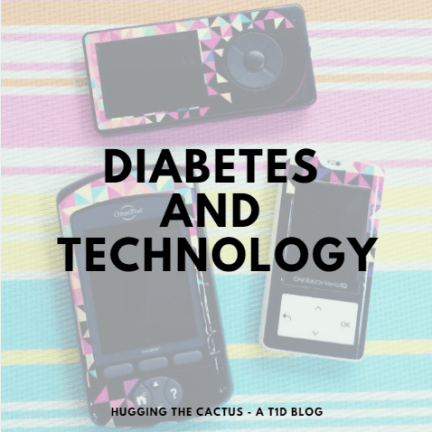
Diabetes and Technology

This November, I participated in the #HappyDiabeticChallenge on Instagram. This challenge centered around daily prompts to respond to via an Instagram post or story. I’ve decided to spread the challenge to my blog for the last couple days of National Diabetes Awareness Month. As a result, today’s post will be about diabetes and technology.

Diabetes and technology: a pair as iconic as peanut butter and jelly, Lucy and Desi, and Han Solo and Chewbacca. I can’t imagine managing my diabetes without all the technical tools and devices I have in my arsenal.

I’m grateful for all the tools we have at our disposal these days, because I know that this wasn’t always the case. I didn’t have to experience a time without a test kit. I didn’t have to deal with checking my blood sugar only once or twice daily using a complicated urinalysis system. Though I chose to take insulin via manual injections for many years, I had the option to try an insulin pump whenever I was ready. And when the CGM came around, approximately ten years after my diagnosis, I was able to start using this new technology.

Capture
Just a few of the key technological components in my diabetes toolkit.

So I guess that diabetes and technology makes me think of two, somewhat contradictory, concepts: privilege and freedom.

It’s a privilege that I have a wide array of technology available to me. I’m lucky that I’m able to use it, because I know that many people with diabetes in this world cannot afford it or do not have access to it. It makes me upset to think about how diabetes might be harder for these individuals due to a lack of treatment and care options, but in that way, it reinforces how freeing diabetes technology has been for me. I have the freedom to bolus quickly and easily as needed. I’m free from annoying tubing, thanks to my OmniPod pump. I’m free to live a life less interrupted by diabetes, because my technology helps me manage it with greater finesse than if I were doing it 100% on my own.

That being said, I won’t ever take my access to diabetes technology for granted.

I can only hope that, as technology innovations continue to improve the quality of life for people with diabetes, technology accessibility becomes more widespread, as well.