First Impressions: My New Livongo Blood Sugar Meter

I shared that my company is offering a sweet new benefit for its associates with diabetes: a free blood sugar meter with free refills on test strips and lancets as the need arises.

Great perk, right?!

Naturally, I took advantage of this offer as soon as I could, seeing as I was eager to start playing around with a new meter (I talk about the reasons why in this blog post).

While I waited for my new meter to come in the mail, I did some research on it. I was excited to learn that it would be a back-lit, full-color touchscreen. It looked sleek and modern, and I was impressed that it seemed to have a lot more features compared to my blood sugar meters of yore (I still remember having to use a giant droplet of blood and waiting an entire minute for my blood sugar results to appear on a very clunky screen…oh, the 90s). I couldn’t remember the last time I was so pumped about a new piece of diabetes equipment – my anticipation for this Livongo meter was hiiiiiiiigh.
First Impressions_ My New Livongo Blood Sugar Meter
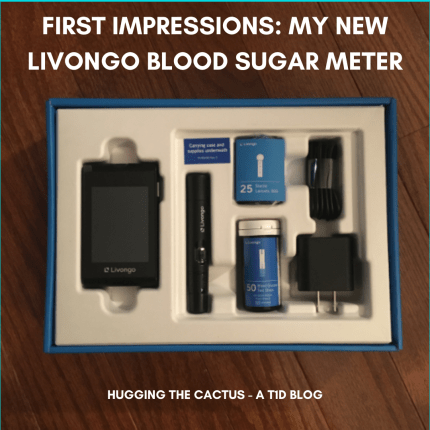
Here she is – my new Livongo meter which I’ve dubbed Livi. Because what else would you call it?!

So when it arrived, I eagerly checked out all of its features. It is, indeed, a well-designed meter – though a bit heftier than I was expecting. Maybe I’m too used to the lightweight nature of my Verio IQ, but this Livongo meter almost feels like a chunky smartphone. It’s not as big as my OmniPod PDM, but it’s in that neighborhood.

I was more so surprised by the test strips – they looked and felt huge compared to my Verio strips! They reminded me of the test strips I used in the first few years of my diabetes diagnosis.

I admit that I didn’t have the patience to read through the instruction manual, I just jumped right into my first blood sugar check. After all, once you’ve used any one type of meter, it’s pretty easy to figure out how the rest of ’em work: insert a test strip, prick a finger, swipe blood onto the strip, and wait for results.

That’s exactly how this meter works, with one caveat. Once I inserted the test strip into the machine, I got a message that notified me the machine was “checking” the test strip. Uhh…checking for what, exactly? I’m not really sure, but the “check” took about 3 seconds before a soft-pitched beep let me know that I could put my blood onto the test strip.

So I did, but I was mildly bemused by the actual amount of blood the strip needed – it felt like it needed more than my Verio strips. I have no idea if this is truly the case, but there is distinct design difference between the strips beyond the hardiness of the Livongo strips, which are not only at least double the size of Verio strips but also feature a vertical line for the blood sample rather than a horizontal. It’s slightly trickier to get just the right amount of blood onto the strip, and I admit that I’ve wasted 2-3 test strips at a time with the Livongo machine so far because I was unsuccessful in getting enough blood on the strips.

Anyways, once I applied blood to the strip, I noticed that the machine didn’t countdown to my results – it merely informed me it was processing them. My very first check with the Livongo was high, in the 250s, and I was yet again surprised when I received an actual message along with my results.

“Your blood sugar is high. Did you know that exercising after meals can help lower blood sugar?”

(I should note that the meter knew I’d just eaten dinner because once it makes the blood sugar result available, you notify the machine whether or not this result was before/after a meal/snack, and then you let it know how you feel – you can select from a handful of pre-loaded options.)

I was taken aback by the message because, well, of course I knew that my number wasn’t great, and I’ve always known that exercising after meals can help bring blood sugar down. This meter is kind of funny, because as I continue to use it, it populates a bunch of different messages depending on my blood sugar in a given moment. Sometimes I get a “kudos”, other times I get random facts about nutrition like, “did you know that spinach is a great source of potassium?” Maybe if I was a newly diagnosed person with diabetes who didn’t know much about nutrition or ways to improve blood sugar levels, I’d find these tidbits of advice more helpful, but for someone as experienced as me they come across as both funny and judge-y.

Since receiving the meter, I’ve used it to check my blood sugar dozens of times and I’m still formulating my opinion on it in terms of its accuracy, usability, design, and overall appeal. I’ll say this for now: I’m intrigued enough by the meter and its ability to immediately send blood sugar data to a cell phone/computer via Bluetooth. It’s definitely one of the most high-tech blood sugar meters I’ve ever used and the touchscreen does make it kind of fun to play around with.

I plan on making a video to better showcase the actual experience of doing a blood sugar check with the Livongo, and I’ll have a full review available in the coming weeks. Stay tuned!

4 Ways Diabetes Makes it Difficult to Sleep

I’ll never forget the first time I saw my mother’s bio in her high school yearbook: She’d listed “sleep” as one of her favorite past times. I though it was hysterically funny then, and I still do now, but I also think it makes her incredibly relatable. Who doesn’t love catching some z’s?

I may not be unique to others when I say that I love a good night of sleep, but only people with diabetes know the real struggles that we, without functioning pancreases, face virtually every night at bedtime.

Because that’s right, diabetes doesn’t just make life hard for us when we’re awake, it also disrupts our precious slumbers. How dare you, diabetes!

Here’s four ways in which diabetes can make it difficult to sleep:

1 – Beeping and buzzing devices. Nobody actually likes waking up to a blaring alarm clock. Imagine not only having to contend with that, but also the possibility of low and/or high alarms going off at any hour of the night. The shrill alarms built into my Dexcom are very rude awakenings and definitely serve as an extra incentive to do everything possible to try to stay in range overnight, but we all know that diabetes can be unpredictable, so this isn’t always possible.

2 – Rolling over on uncomfortable sites. I toss and turn throughout the night: Usually, I fall asleep on my back, then switch to my side, and roll over on my stomach…multiple times throughout the night. And I never seem to be able to do it without rubbing up on a site. It doesn’t matter where it is – my arms, legs, stomach, or back – any rockin’ and rollin’ I do in my sleep is almost always bound to push my CGM sensor or pod uncomfortably harder into my body, and it can be the reason why I wake up in the middle of the night to make yet another adjustment in how I’m sleeping.

4 Ways Diabetes Makes it Difficult to Sleep
At least my diabetes has zero impact on Clarence’s ability to sleep. Was this another excuse to use my adorable dog as a good photo for this post? I shall neither confirm nor deny.

3 – Waiting for a high to come down. There have been a handful of occasions in the last year of life with diabetes ALONE in which I’ve been so, very tired but too afraid to go to sleep until my blood sugar has come down to a “safe” level. It doesn’t matter if the high was caused by incorrect carb calculations or a site that I’m not sure is working properly – I just want to avoid sleeping knowing that I have a hyperglycemic blood sugar because waking up to one in the morning is bound to start my day off on the wrong foot. And it even resulted in a trip to the ER one time, which I don’t want to experience again.

4 – Waking up to a low. Just like high blood sugar, low blood sugar can also delay and/or interrupt sleep. Whether the low happens just after brushing my teeth and I’m forced to ruin my fresh breath with something sugary (just thinking about the orange juice and mint flavor combination makes me wanna yak) or if it wakes me up from a sound slumber and I proceed down the stairs to eat the entire kitchen because I’ve run out of low supplies on the nightstand next to my bed…you get the picture. It’s downright annoying and honestly I bet that I’ve had at least a couple hundred nights of sleep in my 22+ years of diabetes disrupted to a low.

So you see, as much as a person with diabetes like me enjoys a full night of sleep, I’m always aware of the fact that my diabetes doesn’t sleep…and instead keeps me on toes.


From Anxiety to Adrenaline Rushes: How Extreme Emotions Affect My Blood Sugar

You know that feeling you get in the pit of your stomach when you receive bad news? It’s like your heart falls to the floor and your stomach starts swirling from the perceived sensation.

That’s unpleasant enough on its own, but for me, it can also cause blood sugar issues.

The same thing can be said for when I’m on a literal roller coaster (which doesn’t happen often, but when it does, involves extreme coercion from family or friends) – I get that awful swooping sensation on top of some sort of blood sugar impact.

Every leaf speaks bliss to me, fluttering from the autumn tree.
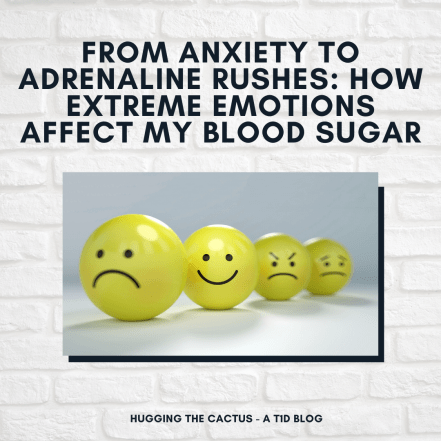
Do you know how difficult it is to find a picture depicting an adrenaline rush that isn’t a cliche shot of a roller coaster or skydiver? Hence…a slew of moody “smiley” faces.

Whether it’s anxiety, adrenaline, fear, or just a rush of unidentifiable feelings, there’s no doubt about it: Extreme emotions tend to make my blood sugar unhappy by causing it to spike.

I’ve always been somewhat aware of this phenomenon, but I started thinking about it more last week when I got some upsetting news. (I’m okay, please don’t start to speculate on what it was…just a personal matter that I don’t care to discuss in greater detail here. Love y’all for understanding and respecting that.)

Actually, it’s kind of interesting to think about how the sequence of events unfolded last Thursday. I received a message that caused me to instantly panic. I was going to learn the context behind the message about a half hour after I got it, so in the interim, I was pacing all around the house and trying to figure out what exactly was going on. My stomach was roiling, my palms were coated in a light sheen of sweat, and my already-unruly hair frizzed out even more….

…and my CGM trend started going up, up, up, ever so slowly but noticeably.

I didn’t do anything to correct my blood sugar – at least, not right away. I waited until after I heard the specific news that had gotten me so worked up to really pay attention to my rising levels. I probably could have made my high blood sugar less severe by running a temporary basal increase right after I initially freaked out, but obviously, I had other things on my mind than my diabetes at that moment in time.

The whole experience was a stark reminder that food and insulin are far from the only things that impact blood sugar levels. Raw human emotion did that to me, and it will do that to me again in the future.

It sucks, but isn’t it also fascinating to think about how diabetes is totally a physical and emotional chronic condition, in every possible way?

My Top 10 Low Blood Sugar Treatments

Anyone who has ever experienced low blood sugar knows that it’s an icky feeling.

The shakiness. The sweating. The desperate desire to eat the entire contents of your kitchen.

It’s an unpleasant experience, but the one thought that has always made low blood sugars slightly more bearable for me is that I have to consume fast-acting, sugary, yummy carbs that are medically necessary. I’ve had some fun with that medically necessary bit in situations over the years: “Hey, stay away from that cupcake, I need it for my blood sugar!”

In any case, I’ve come up with my 10 favorite low blood sugars treatments that I’ve discovered work best for me…and tend to also be pretty tasty (well, maybe not #3, but everything else is a winner for most people in the flavor department).

1. Marshmallows. Even though I feel like I’m playing chubby bunny (you know, that pointless game when you see how many marshmallows you can fit inside your mouth at once and your cheeks puff out like an adorably plump rabbit munching on carrots) any time I consume a marshmallow, I can’t deny that they work incredibly well for low blood sugars. While I don’t mind the flavor of marshmallows, I definitely don’t love it, so I can always resist the temptation to over-correct a low blood sugar when I use marshmallows to treat it.

2. Mini boxes of yogurt-covered raisins. This has been my go-to for almost 10 years now because they’re just so convenient. The mini boxes are highly portable and contain about 11 grams of carbohydrates, which is perfect for not-so-bad lows that just need a little boost.

3. Glucose tablets (or gummies). They’re the old standby for a good reason: They were specifically made for treatment of low blood sugars, and they’re also extremely quick and easy to consume whenever, wherever (cue Shakira and her hips that don’t lie).

4. Frosting. So bad for you, but so good to eat by the spoonful when dealing with low lows. I don’t often have frosting on hand, but if I have some leftover from baking, I’ll throw it in the fridge and try to forget that it exists until I need it for a low blood sugar.

5. Orange juice (or a juice box). I feel like juice was a signature treatment for lows in my childhood: Since small children often drink juice boxes, it made a lot of sense. But back when I was working in an office full-time (sigh), I had a couple of juice boxes stashed away in my desk drawer because I got a kick out of feeling like a little kid with her juice boxes while sitting her grown-ass adult woman’s work cubicle (yes, I know I’m kind of weird. Embrace it.)

My Top 10 Low Blood Sugar Treatments
These are a few of my favorite things! (drastic shift from Shakira voice to Julie-Andrews-from-The-Sound-of-Music voice)

6. Starbursts. In college, I met a fellow type 1 in my social psychology lecture hall who swore by carrying starbursts for low blood sugars. She explained that four of them had the exact same amount of carbs as four glucose tablets, but they were far superior in taste because, well, starbursts are candy. I’ve kept this in mind over the years and its come in handy: More than once, I’ve been in a situation where I’ve had to get carbs fast but didn’t have glucose tablets on me, so I bought a sleeve of starburst to treat oncoming lows. They work well and they’re especially delicious when using the pink or the orange starbursts (not the yellow or red…fight me on it).

7. Skittles. What I love about using Skittles for low blood sugars is the 1:1 rule. One Skittle has one carbohydrate, so it’s extremely easy to figure out how many will bring up blood sugar, depending on how low the low is. 10 works well for when I’m in the 70s, whereas I might have 15 when I’m in the 60s. All bets are off when I fall below 60, though, and I’ll settle for a large, uncounted handful – maybe the whole dang bag – instead.

8. A piece of fruit. Ooooh, a genuinely healthy option on this list! The horror! But it’s a fact that fruit works just as well as any piece of candy or sugary treat for bringing up a low. I’m not talking about a single blueberry or strawberry, though: I’m talking either an apple or a banana – something that has some genuine carb content to it in a single serving.

9. A couple handfuls of cereal. This is a riskier choice because the lack of restraint I have around cereal when I’m low, but who else can relate to waking up at 2 A.M. to treat a low and being too tired to measure something out, so out comes the cereal box and handful after handful of Lucky Charms or Cookie Crisp are consumed in a very short span of time?! There’s no questioning cereal’s efficacy in a hypoglycemic situation, but when it comes to controlling the amount eaten…well, that’s a hard thing for me to do.

10. Fruit snacks/gushers. Embarrassing story from my childhood: Remember those commercials in which kids who ate gushers had their heads turn into giant pieces of fruit? Well…I was convinced that eating gushers would lead me to the same fate, so I avoided them until one day I finally realized it was just a stupid commercial (albeit with very freaky graphics) and it was totally safe to consume gushers. And thank goodness, because they’re delicious and great for lows! So are fruit snacks of just about any variety, though I’ve had the most luck with Mott’s and Welch’s fruit snacks.

Do you have any low blood sugar treatments that I didn’t mention here but should consider trying? Drop a comment to let me know what it is and why it’s your favorite!

Not 1, But 2 New Blood Sugar Meters: How I Got ‘Em and Why I Need ‘Em

Unexpectedly, I just obtained two brand-new blood sugar meters.

I’ve been a fairly loyal user of my OneTouch Verio IQ meter for about a decade now – that’s a longer relationship than the one I’ve had with Dexcom or OmniPod. It’s been mostly a loving relationship: From the beginning, I was a big fan of its sleek design, back-lit screen, and overall portability/usability. It grew a little more tumultuous over the years, though, as I noticed occasional, unprompted system shutdowns and questioned the overall accuracy of the device.

So I decided it was time to explore other options.

I brought this up to my endocrinologist during my very brief appointment with her a few weeks ago, and she let me know that a new Verio meter would be available soon. She said that she would set one aside for me when she received the shipments and that I could come and pick it up whenever I was back at the clinic.

Coincidentally, my gynecologist’s office is just down the hall from my endo, so I was able to pull double duty the other day and pick up the new meter right after my annual appointment with the lady doctor!

I was super excited to have a new meter, and even happier that it would take the same strips as my old meter. But there was one problem that I discovered when I got home…

…the meter I received isn’t the fancy-schmancy one just released by OneTouch.

Not 1, But 2 New Blood Sugar Meters_ How I Got 'Em and Why I Need 'Em
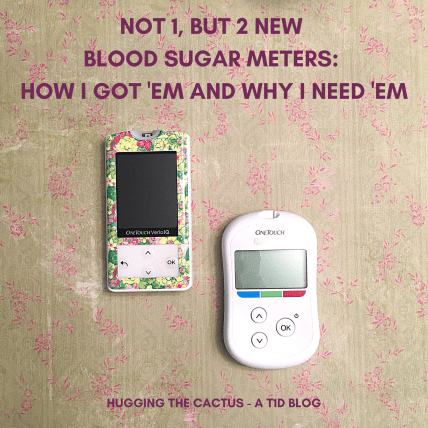
My old Verio IQ (left) with my new Verio Flex (right)

Instead, it was a generation after my Verio IQ – so it’s still a new one – though it’s decidedly less impressive, technology-wise, compared to its counterpart. It’s the OneTouch Verio Flex, and it’s very compact, but lacking a charging port (it runs on a battery) and the back-light that I loved so much about my Verio IQ.

Before I could fret too much about this minor disappointment – I can’t get too upset over a meter that I didn’t have to pay for – I noticed a letter on the counter addressed to me from my company.

I opened it up and was pleased to discover that my company is partnering with Livongo to offer a free blood glucose testing kit, free lancets/strips, and free coaching to all qualified associates with diabetes.

Talk about a sick benefit, right?!

I followed the instructions enclosed with the letter and within five minutes, my information was submitted to the Livongo website and my kit was on its way to me.

I’m totally pumped about this meter and this new program that my company set up. I’ve never heard of them doing anything like this before, and it will be a huge relief to know that I won’t have to worry about ordering blood sugar testing strips (or the associated cost) any time soon. But the meter itself sounds so dang cool, too – it has a full-color touchscreen! The meter actually knows when you’re running out of test strips and will remind you to reorder them!!! I’ve never heard of anything like that before, so I’m eagerly awaiting its arrival and can’t wait to check out all the features.

The one thing you might be wondering about these two new meters is…why the heck would I need them since I already have a Dexcom G6 that monitors my blood sugars 24/7???

There are two reasons: It never hurts to have back-ups and my Dexcom isn’t always accurate.

Let’s say that tomorrow, my Dexcom transmitter fails. Suddenly, I’d be without any blood sugar readings and I’d have to rely solely on my meters for blood sugar checks. That’s why it’s incredibly important to have functioning meters at all times, because you just never know when you may have no choice but to use them.

To compound that, my Dexcom doesn’t always work the way it should. Sometimes, I receive sensor errors and it doesn’t work properly for hours. Other times, I feel symptomatic of low or high blood sugars and my Dexcom doesn’t report them, so I resort to doing a finger stick check to verify the accuracy of my Dexcom’s readings.

It’s easy to understand, then, why I think it’s crucial to have at least one spare blood sugar meter. I may have come across these two new ones suddenly and fortuitously, but I welcome their addition to my diabetes toolkit and can’t wait to “test” ’em out (and of course, blog about ’em).


The Periodic Problem

I thought about how I was going to write this post many, many times. I so wanted to come up with a cute or clever euphemism for what I’m about to discuss, but really, that old “Ant Flo” cliche is all I could come up with, and that’s so overplayed.

If that didn’t give you a clue as to what this is all about, then look at the title again.

Still nothing?

Okay, this post is about my period.

Yep, the menstrual cycle, that time of the month, the curse…whatever name you want to call it, I’m talking about it today. And if you’re already cringing, chill. I promise there’s no need to, I’m not about to get graphic on you or anything.

Rather, I’m about to write about a reality that many women with diabetes face: The week leading up to a period, or the week that it starts, can be hell. And I’m not just referring to cramps or mood swings.

The Periodic Problem
This picture is actually a pretty accurate cartoon version of me…cacti plants, GameBoy, and pink included.

I’m talking about blood sugars, of course. I’ve thought about how my period and my diabetes interact more and more lately because of an “interesting” (that’s the nice way to put it) pattern that I’ve noticed each week leading up to my period for the last few months, and that’s how insulin essentially becomes as effective as water when I get it pumping through me: That is to say, my insulin intake has nearly doubled the week leading up to my period, and it’s something I never really noticed until recently.

I think I caught onto the trend in April. The week before my period started, I blamed my bad blood sugars and higher insulin intake on the fact that we were only a few weeks into quarantine, so it was natural that my body was having a tough time adjusting.

In May, I wondered whether I was dealing with faulty pods or bolusing incorrectly for my foods.

By the time June rolled around, though, I realized that there was something different at play here.

Last month, I dealt with the issue by raising my temp basal for most of the day – a 95% increase for 6-8 hours through the morning and afternoon – and giving myself 2-3 units more than I normally would at mealtimes. I still didn’t have great numbers, but they were better, and that was all that mattered to me.

But this month? I’m totally confused because this “periodic problem” did the opposite of what I expected it to do…the week before my period, it seemed like I need LESS insulin! It was simultaneously bemusing but exciting. I’ll never necessarily complain about having to take less insulin, or being able to eat an entire blueberry muffin without needing to bolus for it (yes, that really happened), but damn…some consistency here would be nice.

Who knows what my body will decide to do next month. At least I feel a little bit better knowing that there is some sort of pattern going on here that I need to pay attention to, so I’ll continue to monitor so I can try to anticipate what the week before my period will look like for my blood sugars.

Just one more reason why I kind of dread “that time of the month”, but also another justification to eat more chocolate in order to cope with it when it does come ’round.

A Nightmare-Induced High Blood Sugar?

I’d never tried competitive eating before, but there I was, tying a bib around my neck and preparing to eat as many pancakes as I could within a certain window of time.

Sounds like a T1D’s nightmare, right? Attempting to bolus for an unknown amount of high-carb food that will be consumed within a matter of minutes…

…well, that’s because it was this T1D’s nightmare!

Yes, I had an actual dream (but I’m calling it a nightmare because of what happened when I woke up) that I was in a pancake-eating competition. So bloody random, weird, and kind of funny. Unfortunately for me, I never found out how I fared in the competition, because just as it was about to begin I woke up to the sounds of my CGM (both my receiver and the app on my phone) buzz-buzz-buzzing.

Blearily, I rolled over in bed to silence both of them…but my eyes opened wide when I saw what was on the screen(s).

284 with an up arrow!

Look at the stars.
The more I think about it, the more it begins to make sense…nightmares COULD definitely cause high BGs. After all, just about anything else can make my BG go up or down!

Immediately, I grabbed my meter so I could confirm that I was, indeed, that high. One finger prick later, I discovered that yes, I WAS that high – just over 300, in fact.

I was absolutely bewildered. It made no sense that I was so high. I’d been 85 just before bed and had a small package of animal crackers (15 total grams of carbohydrates) to ensure stability throughout the night. That was hours before, at around 8 P.M., so they should’ve been through my system by the time I woke up to the high, at 2 A.M. Moreover, my high alarm on my CGM is set to 180, so I’d slept through numerous alarms. That was frustrating, but I’m relieved I did eventually wake up to correct the high…the alternative, staying in a deep sleep and waking up to a sky-high number to start my day, was definitely worse.

I was struggling to make sense of the high but I knew it was more important to treat it and stay awake until I knew I was coming back down. That way, I could rule out my pump as the problem. Sighing, I took my bolus, got up out of bed, grabbed a cold water bottle from the fridge, and trudged back up the stairs to prop myself up and watch some TV to make the next hour or so go by faster.

By 3:30 A.M., I’d watched three full episodes of Sex and the City (thank you, E! Network, for playing that show at such an odd hour) and my blood sugar had tumbled back down approximately 100 points. I felt like it was now safe for me to go back to sleep, so I drifted back off to dreamland…and continued having really weird freakin’ dreams for the rest of the night (one involving me auditioning to be the voice of Moana, the Disney princess, in the movie…I can’t even begin to fathom how or why I dreamt about that).

Days later, I still don’t know how the high happened. But I think I’m closer to a conclusion: It must’ve been all those damn pancakes that I ate in my dr- I mean, nightmare.

Conference Calls and Low BGs

Some things in this world simply belong together.

Peanut butter and jelly. Batman and Robin. Mickey and Minnie. Name an iconic pair, and…

…I can guarantee that it won’t be conference calls and low blood sugars.

Indeed, I can attest to how much the two DON’T belong together because I faced a rather annoying one the other day.

It happened during one of the many weekly meetings that I now attend virtually along with the rest of my department at work. Not only do I have to dial into these meetings, but there is a video component, as well. Fortunately for me, all that I’m doing is listening during these meetings instead of talking, so I can stay on mute for the duration of most of them, and occasionally make various facial expressions that show I’m listening.

So I was, indeed, on mute when the shrill BEEEEEEEEEEEEP BEEPBEEPBEEPBEEP of my CGM receiver started. And thank goodness I was, because that sound is enough to derail anyone’s line of thought.

But rather than address the low right away, I was a little stupid about it.

rld
I turned off my webcam for approximately 30 seconds just so I could capture how agonizing the wait for my blood sugar to come back up was.

I decided to wait as long as possible before I corrected it.

I know, I know – that’s a dangerous game to play. But hear me out! My meeting was running from 12:30 to 1:30. I planned on having lunch right after the meeting, and it was already 1 o’clock when my CGM started shrieking. I thought I could wait to treat it with my lunch food…but that’s not what ended up happening.

I started feeling low, low. Like, shaky, sweaty, unable to focus on anything that my group was discussing, and ravenously hungry.

So I did what any person with diabetes would do when their blood sugar is that low – the only thing to be done, of course, was to whip off my head phones, turn off my camera, sprint into the kitchen, wolf down a handful of raisins, and jump back onto the call.

Oh, and turn off the camera again for another 30 seconds or so (in the 15 minute window of time it took for my blood sugar to stabilize) to capture a picture of myself on the struggle bus that is the recovery process from a low.

The whole ordeal stood out to me because it’s very different from the last low that I remember experiencing during a work meeting. That one happened when we were all still in the office, and I had to get up and dismiss myself from the conference room so I could grab a package of fruit snacks from the office kitchen.

That one was much more disruptive, but I handled it much more promptly than this one.

This one wasn’t even noticed by a single person on the conference call (and if someone did see me pop off camera for a moment, I’m sure they just assumed I was having connectivity issues).

This one I didn’t react to immediately, and I ended up being punished for it because I missed out on some meeting information due to my inability to concentrate and the need to finally treat it.

This one and that one do have one thing in common, though: Low blood sugars absolutely do not complement meetings, conference calls, or any sort of work-related task, ever.

8 Things About Diabetes That Make Me Want to Rip My Hair Out

Life with diabetes can be the opposite of a cakewalk. In fact, it can be so frustrating at times that I seriously consider ripping my hair out due to sheer agitation.

When thinking about the things that drive me nuts about diabetes, I came up with a list of 8 occasions in which I come this CLOSE to losing my freakin’ marbles:

1. When low blood sugars refuse to come up…

2. …And when high blood sugars refuse to come back down.

I’m considering these first two as separate list items because the scariness of a lingering low and the frustrating nature of a stubborn high can be two very different types of “GAAAAAAAAHHHH!” But both can be especially suck-y when you feel and know that you’ve been doing everything right to treat them without experiencing the expected results.

3. Pod and CGM sensor failures.

Oooh, any sort of device failure can be so exasperating any time of day. But they’re worse when they happen at inconvenient times, such as in the middle of the night or during an important conference call. All diabetes technology should work flawlessly at all times, but that’s not always the reality that we live in.

4. Inaccurate results.

I can’t stand when my blood sugar meter or my CGM report false readings. Sometimes, I’ll check my blood sugar two times in a row just to see how close both readings are to one another, and it makes me want to throw my meter across the room when I see that they’re off by 20+ points. Once, I had a reading that was off by more than 50 points! That makes a major difference in how much insulin I give myself in that moment in time, so inaccurate results can really derail my blood sugars for hours after.

Need help_
I’m sure you can imagine how entertaining the search results were when I looked up images to go with this blog post.

5. Folds in the adhesive.

Whenever I apply a fresh sensor or a pod, I try to be super careful and make sure that the adhesive sticks smoothly…but despite my best efforts, that doesn’t always happen. Folds in the adhesive are far from the worst thing in the world, but they do make it more difficult for my devices to stick on for the full length of time that I need to wear them, and I usually end up having to add tape around them to reinforce the hold. More tape = more folds = more irritation!!!

6. Unexplained blood sugars.

Anyone with diabetes has been there, done that. You could follow the exact same routine from one day to the next, even eating the same foods at the same times, and get totally different blood sugar results. Or maybe you thought that you bolused perfectly for a meal, only to find out hours later that you’re much higher or lower than you anticipated. Whatever the reason behind them may be, unexplained blood sugars are just obnoxious.

7. Screeching alarms.

Speaking of things that are obnoxious, let’s talk about wailing OmniPod or Dexcom alarms for a hot second. There’s nothing like a resounding BEEEEEEEEEEEEEEEEEEEP to ruin your day!

8. The INSANE costs of our supplies.

Undoubtedly, the thing that most makes me want to rip my hair out when it comes to diabetes is the cost of supplies. I’ve blogged more and more recently about the criminal cost of insulin – since the 1990s, the cost of insulin has increased over 1,200% (!!!) – and I’ll continue to do so until EVERYONE with diabetes can afford this life-saving medication. We never asked for diabetes to happen to us. But it did. And the fact that many people with diabetes have to make sacrifices in order to, well, survive, is simply not okay, and the most infuriating thing about living with this chronic illness.

Bloody Dexcom Sensors: No Go or A-Okay?

This post was originally published on Hugging the Cactus on February 18, 2019. I’m re-posting it today with some updates because I recently noticed this post gets a LOT of clicks – this topic is one that many people are curious about it. Read on for my two cents on whether or not bleeders are readers, and note that I haven’t updated this because my experience with bleeders remains the same…

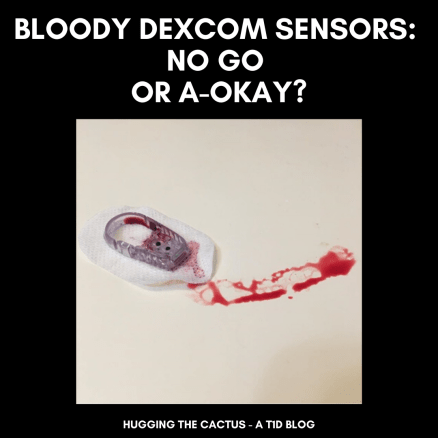
I placed the new Dexcom G6 sensor on my abdomen, hovering my index finger above the large orange insertion button. I pressed it, exhaling as I felt the minute needle pierce my skin’s surface. I looked down, and started to rub the adhesive in circles to make sure it was stuck, when I saw blood. Not just a drop, but a decent-sized pool forming beneath the sensor. Before long, just about the entire surface of the white adhesive was soaked in red.

Yeah, this was going to be a no-go.

It’s pretty rare for me to experience blood at the site of a Dexcom sensor. If I had to put a number on it, I would say less than 10% of my insertions draw blood. An even smaller amount – like, 2% – have caused me to bleed as much I did in the scenario described above. But I know I’m not alone in my bloody sensor experiences – it’s something that many other T1Ds who use a Dexcom have gone through.

There’s a bit of debate, though, that I’ve noticed in the past on Twitter threads and Instagram posts. What to do with a bleeder? Keep it and assume that it’ll read blood sugars normally? Or change it immediately and call Dexcom for a replacement?

Are bleeders readers? Or does it depend?

Bloody Dexcom Sensors_ No Go or A-Okay_
Do you think that bleeders are readers?

I’m going to go with…it depends.

Obviously, in that situation I described in the opening of this post, I decided that it wasn’t a good idea to keep the sensor on my body. There was too much blood and I didn’t trust that it would adhere well to my body. I didn’t know how long it would take for the blood to stop (only a few minutes, but still), and I couldn’t be sure that it wouldn’t mess up my readings. On top of that, I wasn’t trying to stain my clothing, if I could help it.

So in that circumstance, I did change my sensor right away, and was glad that the second try resulted in a much cleaner, blood-free insertion. I called Dexcom, explained what happened to the customer support representative, and got a replacement sensor mailed to me.

However, just about any other time I bleed upon a sensor insertion, it tends to be a minuscule amount of blood. I usually don’t even notice until it’s time to replace the sensor, and there’s a bit of dried blood left on the site. Other times, I’ll see small beads of blood forming underneath the spot where the transmitter snaps in. And there’s been a couple of occasions that I’ve bled a fair amount and been totally unaware of it until I caught my reflection in the mirror and noticed the blood staining the white adhesive. And in all of those cases, I’ve kept the sensor on for the full ten days, without noticing any discrepancies in my readings.

All that considered, in my inexpert opinion, I think that bleeders usually are readers and that they’re safe to continue wearing. Of course, there will be exceptions, like when there’s just too much blood to salvage the sensor. But every time I’ve kept using a bloody sensor, I’ve had the same amount of success with its functionality…so yes, I think that for me, bleeders are indeed readers.