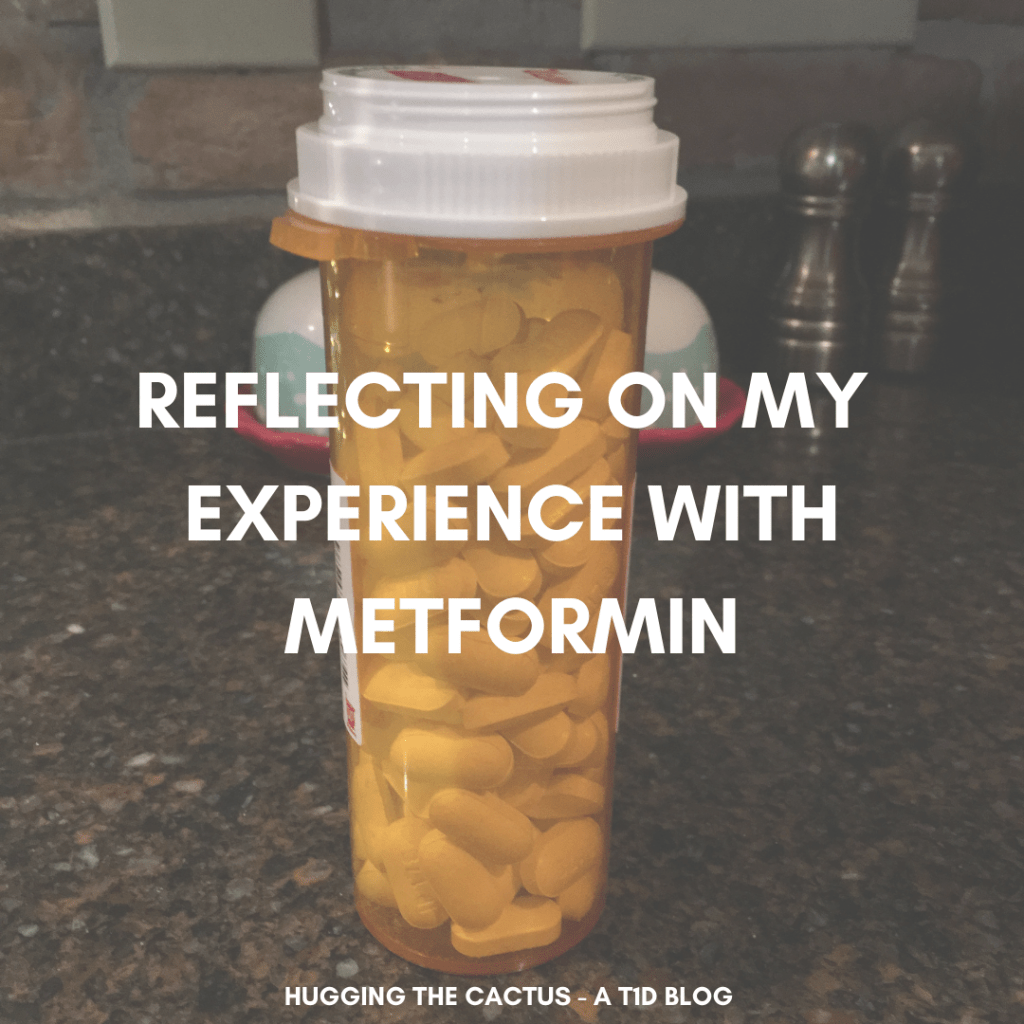
Reflecting on my Experience with Metformin

A couple of years ago, I wrote a blog post series about my experience with Metformin. As I was paging through my blog, looking for either an old post to republish or inspiration for a new post to write, I came across that series and got to thinking about how I felt on Metformin.

If you aren’t familiar with what Metformin is, it’s an oral medication that’s typically used to help stabilize blood sugar levels for people with type 2 diabetes. This is where you might be thinking…I (Molly) have type 1 diabetes, so why was I prescribed this medication?

Well, my endocrinologist at the time wanted me to try taking Metformin in tandem with doses of insulin in an attempt to reduce my overall insulin needs. She expressed concerns that my daily insulin intake was high (something I disagree with now, as I think about it a couple of years later), and that she had some general awareness of studies that indicated it might not be good for my future health if I continued using so much insulin each day. (Note: I don’t know what study or studies she was referring to, and this is where I should’ve done more research before just taking her word for it and going on the pill. This is an example of poor patient advocacy on my part.)
I did not enjoy my time on Metformin.

Even though I met her sentiments with skepticism, I trusted this endocrinologist, so I decided to give Metformin the old college try. And I hated it. Hated it! I tried taking it per my doctor’s instructions for two separate spans of time (each lasting a month or so) and made the decision to stop using it because I simply didn’t see that it was making any sort of difference. Actually, it was affecting something, just not my blood sugar levels or insulin intake – it was affecting my anxiety levels. I was afraid that Metformin, coupled with my insulin, would cause me to have low blood sugars all the time. While in reality, I didn’t experience many lows, I was still always paranoid about them and it was an unpleasant thing to have to deal with.

So now, about two years later as I think about these ineffective encounters with Metformin, I realize that I should have done a lot more before even considering taking it. I should’ve asked more questions. I should’ve done more research. I should’ve asked around the diabetes online community to see if anyone had advice for me. I should’ve pushed back more with my doctor to get to the bottom of the reason(s) why she wanted me to take Metformin. Going back to my point above…this was a big lesson in patient advocacy. It’s important to ask questions and gather all the facts, especially in situations like this where there was so much uncertainty, in order to receive the best care possible. And it’s important to remember that even the most trusted and well-liked doctors aren’t always right when it comes to the medical guidance they suggest or give. At the end of the day, I’ve got to keep in mind that nobody knows my body and brain better than I do, so it’s okay to challenge the authority of the experts (in a respectful, kind way of course).

5 Ways Hot Weather Affects Diabetes

This blog post was originally published on Hugging the Cactus on August 6, 2018. Call it an “oldie but goodie” because the ways in which hot weather can affect diabetes haven’t changed in the last few years and they won’t be changing any time soon…and with summer just around the corner, it’s good to remind ourselves of the extra precautions we might want to take in order to combat the heat. Read on for more on the ways summer weather can affect people with diabetes…

The summer heat seems to be here to stay in Massachusetts. We’ve experienced several weeks of soupy, high-heat weather that *almost* makes me long for cooler, autumnal days…but not quite, because that just means winter (and snow – blech) is right around the corner.

Truly, I do enjoy the summertime. To me, summer is about trips to the beach, ice cream consumption (and lots of it), barbecues with family and friends, long walks in the neighborhood, and endless outdoor adventures. Aside from all of those lovely things, summer also means that it’s time to be a little more diligent when it comes to my diabetes. That’s because hot weather can play some cruel tricks on a T1D’s body. What do I mean by that? Here’s five ways diabetes can be affected by hot weather.

Mr. Sun, Sun, Mr. Golden Sun, please shine down on me (and don’t make me go low or high…)
  1. Dehydration can lead to high blood sugar. Everyone knows that it’s important to stay hydrated when it’s hot out, but it might be less common knowledge that dehydration can directly affect blood sugar. There’s a scientific explanation for this: If not properly hydrated, the body sees an increase in blood glucose concentration because blood won’t flow as easily to the kidneys, making it difficult for the kidneys to get rid of excess glucose in urine. The best way to prevent this, naturally, is to drink plenty of water and monitor blood sugars.
  2. Sunburn can drive up blood sugars. I’m very familiar with how a sunburn can result in higher blood sugars; in fact, just last week I was dealing with a particularly gnarly sunburn on my thighs and belly that not only made my numbers higher, but also really hurt. My skin was literally damaged, so the stress from the injury lead to retaliation from my blood sugar. Luckily, it only lasted about 48 hours, but those couple of days were challenging as I dealt with sticky highs that were practically resistant to insulin. And for the record, I DID apply sunscreen – numerous times – when I was at the beach. Next time, I’ll seek shade under the umbrella.
  3. Sweat can make it difficult for devices to stick. I don’t know a single medical device that’s immune to prolonged exposure to moisture/water, but that doesn’t prevent me from spending as much time as I can outdoors/at the beach/by the pool in the summer. Thank goodness for Skin-Tac wipes and medical adhesive tapes that help preserve my precious pods and sensors!“
  4. Insulin can overheat. There’s a reason why insulin vials come packaged in cartons with directions that specify what temperature insulin should stay at in order for it to be safe to use. Insulin can spoil easily when it reaches a certain temperature, so it’s important to store it in a cool place when the weather’s warm. I alternate between a mini portable cooler (that can hold 3 vials of insulin) and a pouch from FRIO – both do an excellent job at keeping my insulin cool.
  5. Low blood sugars can occur more frequently. Summertime is prime time for outdoor activities that result in higher energy expenditure. So it’s no wonder that blood sugar tends to plummet in hot weather. Looking at it on the bright side, it’s an excuse to eat even more ice cream – but it also means that monitoring how I feel and checking blood sugars often is that much more important.

Regardless of the diabetes challenges it may cause, I love summer weather, and I know I’ll miss it the moment the first snowflake falls this year.

Dodging DKA: What Happened and What I Learned From It

In 23ish years of life with type 1 diabetes, I’ve never really experienced DKA…and I feel wildly fortunate to have avoided it.

But the other day, I came extremely close to it, and it’s something I won’t soon forget.

Here’s what happened: It was the wee hours of a Sunday morning. I woke up because I had to use the bathroom. My pod was on my thigh. I was due to change it that Sunday evening. I noticed that the pod’s adhesive folded up in the exact wrong way (it was crinkled up by the cannula), causing the cannula to bend and dislodge itself from my body…

…except I didn’t make that super-important observation until around 11 A.M., after several hours of tossing and turning in bed, unable to sleep because I was battling both a headache and stomachache.

What’s more is that around 10 A.M., I noticed that my CGM had been reporting a high blood sugar since about 5 A.M., and I simply hadn’t heard it alarming. When I saw that I was high, I took a bolus, but I didn’t bother checking on my pod because to my knowledge at that point, there was nothing wrong with it. Fast-forward to one hour later to when I did discover the dislodged cannula and I was feeling downright terrible: My stomachache turned into full-blown nausea, my head was pounding, my throat was drier than the Sahara, I couldn’t unfold myself out of the fetal position, AND I was feeling incredibly stupid for 1) missing my CGM’s blood sugar alerts and 2) not checking my pod to make sure it was secure to my body.

What bothered me more during this whole ordeal: my headache, my stomachache, or my anger at myself for letting this happen? (If you guessed the latter, then you’d be right.)

Fortunately, I did have a back-up pod and insulin with me, so I went about activating the new pod as quickly as possible. I felt a fleeting sense of relief when it was on me, but that relief turned into panic when I felt a swooping sensation in my stomach that indicated I was about to be sick. I ran to the bathroom and retched once, grateful that nothing actually came up, then sank down on the floor in shame, wondering how I could let myself get to this point of obvious borderline DKA.

The next few hours passed in a blur as I crumbled back into bed. I drank as much water as I could stomach, gave myself bolus after bolus, increased my basal rate, and tried to settle into a comfy position. I was extremely lucky that I wasn’t alone during this whole ordeal: My significant other was very concerned and doing everything he possibly could to help me. I was and am still so grateful for his care and attention. I didn’t admit it to him, but I was a little freaked out by the whole experience, but I took consolation over the fact that it didn’t come down to him having to bring me to the hospital.

By 4 o’clock that afternoon, my blood sugar was finally below 180 again and I was able to eat a little food, though I wasn’t overly hungry. I spent the remainder of the day beating myself up for letting this happen, but I guess that if I learned anything from it, it’s that I need to remember to 1) keep the volume turned up on my CGM so I can hear the alarms going off overnight, 2) check my pod immediately after hearing a high alarm so I can rule out any obvious pod issues, and 3) bring a syringe with me wherever I go so I can inject myself with insulin/get it in my system faster than a pod would be able to.

The experience also taught me a couple of other things…DKA is very real, very dangerous, and should be taken very seriously. The fact that I just barely dodged it is a jarring reminder that I should never underestimate it. On a much lighter note, though, I also proved to myself that I’m able to take control of a situation like that the moment I become aware of what’s going on. Thank goodness I was at least prepared enough that I had an extra pod and insulin on hand. I hope there isn’t a next time, but if there is, I know exactly what to do in order to take care of it as quickly as possible, thanks to this icky experience.

3 Things That Make Low Blood Sugars More Tolerable

This post was originally published here on Hugging the Cactus on August 21, 2019. I’m sharing it again today because it’s the perfect little companion to Monday’s more hateful post geared towards high blood sugars.

Okay, to be TOTALLY honest, low blood sugars aren’t – and won’t ever be – fun. Nine times out of ten, they can be inconvenient, upsetting, and even scary (depending on how low it is). But like most things associated with diabetes, I try to look at the bright side every now and then to remind myself that it could be worse. So even though I don’t welcome low blood sugars in just about any circumstance, I decided to look at them, and their less-than-pleasant side effects, from another perspective. Hence, this three-item list that explains what makes low blood sugars slightly more tolerable to me.

#1: The sweat. I detest sweating. I don’t care if sweat is the result of a good workout or a day spent at the beach – it’s gross either way. And it’s definitely not an attractive low blood sugar symptom. But…on the other side…I tend to sweat a LOT when my blood sugar is low and it makes me feel like I’ve just had an excellent workout without any effort or exertion on my part. So I guess it’s kinda like gleaning the health benefits that you’d get from sitting in a sauna for a bit? IDK…it’s a bit convoluted but just agree with me on this one.

#2: The excuses. I’ve made it a personal mission to try to avoid using my diabetes as a scapegoat. There are times, though, that it really does prevent me from doing something in a timely manner/when I’m asked. For example, if I’m experiencing a low blood sugar at work and a colleague comes by to talk to me and ask me for something, I do find it’s best to let them know that I can’t attend to it right away because of the blood sugar. Nine times out of ten, people understand, and they let me treat it accordingly. And it gives me time to just relax and deal with it, taking the stress away from a situation by simply being honest about it (so I guess it isn’t really an excuse, but sometimes I feel a little guilty about using a low as an out on something. Low guilt is real, people!).

#3: The cake. (Or really any food when you’re low. Because it all tastes delicious. But nothing is quite as satisfying as cake.) I think the inspiration for this blog post came when I was enjoying a big, fat slice of cake in order to bring my blood sugar back up. My goodness, some foods just taste beyond amazing when I’m using them to treat a low. The sweeter it is, the more satisfying it is to both my taste buds and blood sugar levels. And anyone who has experienced a low blood sugar before (people with and without diabetes) can attest to the fact that food is simply a million times better when it’s being consumed at a time that your body is URGENTLY telling you to feed it.

Alright…now that I’m looking back at these three things, I’m kind of laughing at myself. Because I can TRY to make low blood sugars a more positive thing, but let’s be real, they still kind of suck. But I guess there’s no harm in trying to be upbeat about them.

8 Things I Hate About High Blood Sugar

This was originally published here on Hugging the Cactus on April 5, 2019. I’m sharing it again today because this is an evergreen post, the kind that will always ring true for me. These are the things I simply cannot stand about high blood sugar…

High blood sugar, high bg, hypergycemia, sky high…whatever you want to call high blood sugar, it doesn’t change how I feel about it. I hate it. My loathing of high blood sugar is probably not unique among other T1Ds – I’m sure most would agree that it’s the worst – but on a recent and particularly bad day of high blood sugars, I started thinking about why I hate being high so much and it turned into this blog post…which turned into a very cathartic thing for me to write.What do you hate about high blood sugar?

What are the eight things that I hate about high blood sugar? Here they are…

#1: It makes me thirsty. This reference may be lost on some of my readers, but to those who get it, it’ll be wildly funny (or at least it will be in my mind): *Parched Spongebob Squarepants voice* “Waaaaaaaaater! I neeeeeeeeed it!” When my blood sugar is high, I basically turn into that shriveled-up version of Spongebob that appeared in the episode in which he visits Sandy the squirrel’s treedome for the first time. He doesn’t realize that, being a mammal, Sandy doesn’t depend on water like he does to be able to live/breathe. Hence, he struggles throughout the episode to stay hydrated. I bet that if he were dealing with a high blood sugar at the same time, his desperation for water would become much more dire…because let me tell you, I simply cannot drink enough of it when my blood sugar is above 200. This results in many trips to the bathroom, and as I’m sure you can imagine, it’s pretty annoying.

#2: It turns me into a major grump. Nothing kills a good mood quite as swiftly as high blood sugar…I don’t like admitting it, but I tend to snap at people when my blood sugar’s elevated. So really, it’s a lose-lose situation for everyone.

#3: It’s a weight on my shoulders. If my blood sugar is high, I can’t help but wonder what I did wrong to make it so. Did I miscalculate my carbs? Should I have given myself more insulin? Should I have timed my exercise better? Is my insulin pump work properly? The list of questions and possible answers are practically endless, and it weighs heavily on me when I’m dealing with an inexplicable high.

#4: It’s disruptive. When my blood sugar is high for a prolonged period of time, I can’t focus on anything else but that. I’ll do anything and everything I can to take my mind off it and just let my corrective insulin dose go to work, but I can’t help but worry. This can be especially disruptive when I’m trying to get work done at my desk job, or when I’m trying to enjoy a night out with friends. It can suck the joy out of any situation, and that can be incredibly disheartening.

#5: It doesn’t get along with exercise. High blood sugar is weird, because sometimes it cooperates with exercise, and other times it reacts very badly to it. I find that if I workout at 250 or below, my blood sugar responds wonderfully to the movement and it’ll drop my blood sugar down to a better level much faster than insulin. But if I dare to workout above 250, then things can go terribly wrong and my blood sugar will go up even more. I learned that lesson the hard way in college, when I went to a high-intensity spinning class…I was so nervous about going low in the middle of the class that I overcompensated with a pre-workout snack. So over the course of the class, my blood sugar shot up to 300 due to the strenuous exercise coupled with the extra carbs. Not fun.

#6: It makes my CGM wail. I appreciate the alarms on my CGM, but NOT when they go off over and over and OVER again. It feels like my CGM is judging me for being high and it couldn’t be more obnoxious…and I just want to throw my device across the room to get it to shut up.

#7: It prevents me from eating when I’m hungry. I don’t always want to eat when my blood sugar is high, but occasionally, high blood sugar coincides with mealtimes and I end up staring longingly at food while I wait for my blood sugar to stabilize at a better level. Depending on when the high happens and how badly I wanted to eat some food, I can get very hangry (angry AND hungry), which is never a good state of mind to be in.

#8: It’s stubborn. The worst part about high blood sugar is that sometimes, it feels like it takes FOREVER for it to come back down. During the waiting period, anxiety, irritation, and anger are all emotions that can manifest themselves within me. And it sucks. The mental games that high blood sugar can play with me are straight-up cruel, and since a high can be so damn stubbornly slow to respond to insulin, it makes it that much harder to handle…which is why, I can say with 100% certainty, that I hate high blood sugars with a bloody passion.

When Carbs Collide with a Bent Cannula, Chaos Ensues

Sushi. Wine. Not one, but two slices (I swear they were slivers, honest) of cake. A pod with a cannula that got bent out of shape accidentally due to clumsiness.

The above sounds like some sort of weird laundry list, but it’s really just all the factors that contributed to a night of high blood sugars and relative sleeplessness.

Let me explain what happened: The night started out fabulously! I got sushi for dinner from a local spot that I was trying for the first time. I was excited about it because sushi is a rare treat for me, and I figured the occasion warranted some wine – my first glass(es) that I’ve had in about 2 months (I gave it up for Lent).

Those two things right there are definitely a “dangerous” duo that can cause carbohydrate calculation errors or prolonged blood sugars, but I tucked that in the back of my mind because I wasn’t done with indulgences for the evening.

I want to say I regret nothing about this carb-o-licious evening, but…

That’s right, I kept up with the carb-loading by enjoying some cake (white chocolate blueberry cake that I made myself that is just as decadent as it sounds) soon after dinner was done. My problem is that I thought I’d curbed the impact of the carbs by setting a temporary basal increase and stacking a small amount of my insulin, but no such luck. I’d destroyed my second piece (it was just a tiny sliver, people) and noticed that I was creeping up. I took more insulin and soon forgot about my high blood sugar as I immersed myself in episode after episode of Impractical Jokers, which, side note: It’s a series I just discovered and it’s hilarious cringe comedy that is the perfect thing to watch after a long day.

A handful of episodes later, it was time for bed. Or so I thought…because soon after I was settled in bed, I twisted around in just the right – or in this case, wrong – manner that was rough enough to loosen my pod from its allegedly secure location on my back. The smell of insulin was pungent and indicated to me immediately that the pod would have to be ripped off completely and replaced. And the sooner, the better, because my blood sugar was getting closer and closer to 300…definitely not a level I want to see before I go to sleep.

By 12:30 A.M., the new pod was on my arm and a temp basal increase was running to combat my lingering high blood sugar. I also gave myself yet another bolus and crossed my fingers, hoping that the combination would be enough to bring my levels down overnight.

At around 2 A.M., my PDM started beeping to let me know that it’d been about 90 minutes since the new pod was activated, so in response I woke up to silence it and glance at my CGM. My blood sugar barely budged! Frustrated, I gave myself more insulin and fell back into a restless sleep.

Several hours later, my alarm was blaring, far sooner than I wanted it to. I hit the snooze button, also taking care to check out my CGM yet again before I made an attempt at 15 more minutes of sleep. And guess what – I was still high. Quite high. Not 300, but in the mid-200s.

It was official: My blood sugar was punishing me for my night of careless carb consumption and reckless pod-handling. I shouldn’t have been surprised by the resulting chaos, but at least I was able to restore peace again the next morning…eventually.

4 Tips on How to Handle T1D, Treats, and Temptation

If you regularly read this blog, then you know that I’m not a strict person with diabetes, in the sense that I don’t really restrict the foods that I include in my diet.

I’ve always been of the mindset that my diabetes can’t dictate what I choose to consume, though it might limit the actual quantity of a given food type that I eat.

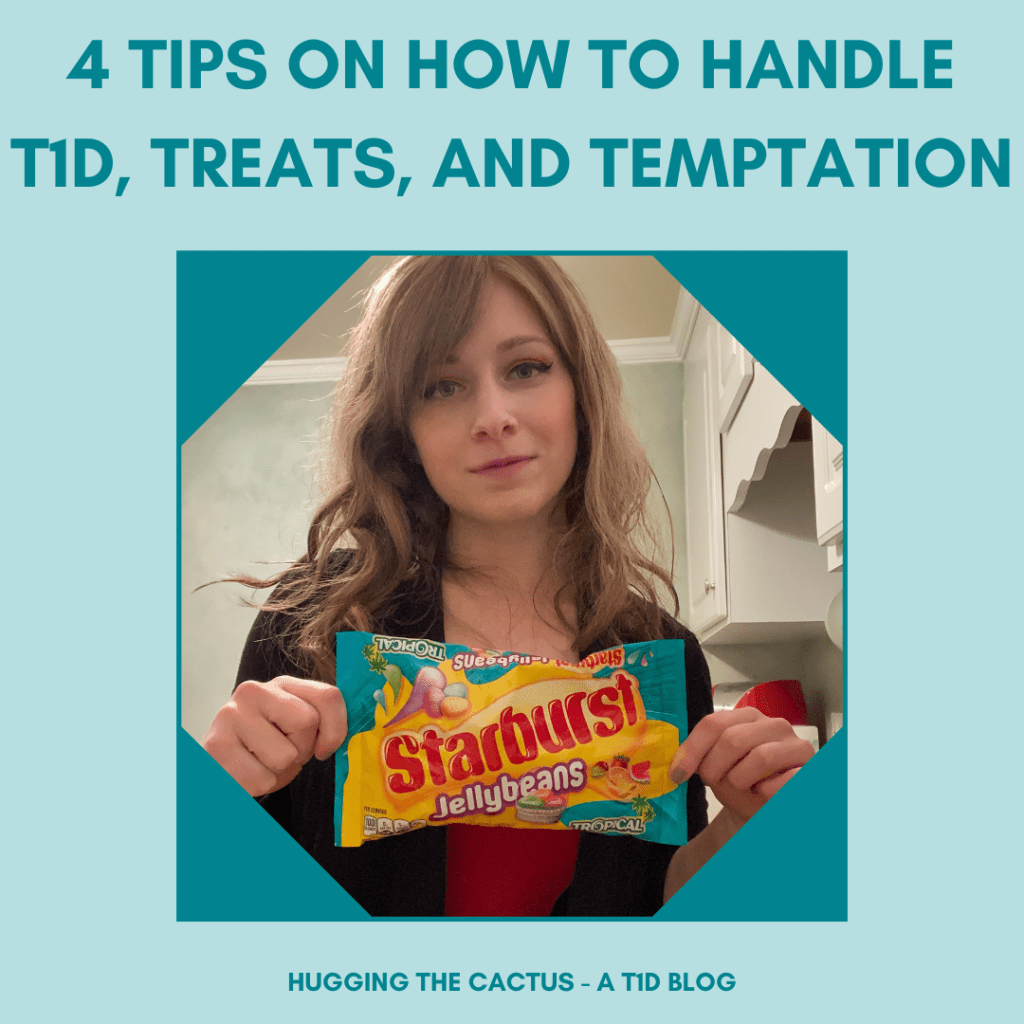
So while my fridge and freezer is almost always stocked with fresh and frozen fruits/veggies/proteins, my pantry often stores more shelf-stable (and usually less healthy) things like crackers, cookies, and even candy. In fact, a full week post-Easter, my cabinets contain 3 bags of jellybeans, a chocolate bunny, and several Reese’s eggs. And it’s very tempting to reach into the cupboards and help myself to as much sugary sweetness as I can stomach in one sitting – screw my diabetes/blood sugar, I’ve got delectable confections to consume!

I don’t even like jelly beans very much, but that doesn’t mean that I doubt my ability to crush this bag in one sitting…

But of course, I know that indulging my cravings will only wreak havoc on my blood sugar levels, so I’ve found a few ways to curb temptation but still keep tasty treats in my home. Here’s 4 things that have worked for me:

  1. Only eat these treats when my blood sugar is low. I call this “medically necessary” candy consumption, and let me tell you, it makes low blood sugars a whole lot more tolerable when they’re treated with something that’s more fun and yummier than chalky glucose tablets or juice boxes.
  2. Keep them out of sight. I do my best to shove bags of treats in the very back of my top cabinets. That way, if I’m tempted to dig into them, I remember that I won’t be able to reach them unless I get a chair and rummage through the contents of the top shelves…and usually, that’s enough to take away my desire to snack on something sugary. I’m not saying it always happens, but laziness will typically beat my sweet tooth.
  3. Pre-portion single servings of treats. I have a real problem with snacks that come in bottomless bags – it’s hard to know when to stop and my blood sugar always suffers the consequences. So I like to study the serving size on bags and use it as a guide to portion out single servings of treats. It’s much easier to bolus for whatever it may be (or treat a low blood sugar as described in tip #1) when I know the exact carbohydrate count; after all, a few handfuls of an unknown number of Skittles have far more carbs than a single serving of 15 Skittles.
  4. Be picky about the types of treats kept in the house. My kryptonite is most definitely Reese’s cups…I love the salty/sweet combination of peanut butter and chocolate almost as much as I love my dog. So I recognized that a bad habit was forming when I kept a little bowl out in my living room filled to the brim with mini cups. I was breaking every single one of the above rules with this practice! After I realized this, I put the bowl away and stopped buying Reese’s every time I went to the grocery store. I still have other things around the house that will satisfy my sweet tooth (before Easter, I bought a package of dark chocolate Oreos that I’ve easily kept around for the last 6 weeks because they don’t tempt me in the same way that Reese’s cups do), so I’m really not depriving myself at all.

Temptation can be tricky to navigate when you have T1Ds and love sugary treats as much as I do…but as long as you can come up with ways to cope with temptation like I did, then you don’t have to feel guilty for giving in to your cravings every now and then. I sure don’t!

The Forgotten Bolus

My friends and family have always complimented me for having a good memory.

What can I say? I have a knack for remembering names and faces. I’m slightly better than decent at keeping track of birthdays. And I’ve kept journals of some sort for most of my life, so I’m usually able to recall the date on which a certain event took place (or I can at least look it up fairly quickly).

But my memory can fail me sometimes, and it did just that the other day when I forgot to bolus for dinner.

I don’t think I’ve ever forgotten a mealtime bolus in more than 23 years of life with diabetes. I suppose there’s a first time for everything…

To give myself a little credit, I truly thought that I had bolused. I remembered picking up my PDM and entering my blood sugar and carbohydrate information, but I never actually hit the very important “enter” button that would start delivering my insulin.

Imagine my surprise, then, when I saw my blood sugar rapidly rising – I’m talking double “up” arrows here – approximately 20 minutes after I finished my dinner.

And at first, I decided to ignore it! I thought that my insulin just needed a little more time to kick in, so I waited. And waited. And waited. But when I saw that I was rising above 250 mg/dL, I figured I should increase my temp basal…perhaps my body just needed a bit more insulin than I anticipated.

That’s when I picked up my PDM and saw that I had zero units of insulin on board. Extreme confusion turned into extreme panic as I asked my mom if I could check her PDM – what if I had picked hers up instead when I bolused for dinner and mistakenly gave her the insulin that was intended for me?!

Thankfully, that wasn’t the case, and I slowly began to piece together that I simply forgot to hit the bolus delivery button.

Whoops.

Almost one full hour after finishing my meal, I was finally delivering my mealtime bolus and silently fuming over my high blood sugar that ended up lasting several hours. It was a completely avoidable situation that shouldn’t have happened, but at least one good thing came out of it: I don’t think I’ll be forgetting to bolus any time soon.

Ketones Strips: To Buy or Not To Buy?

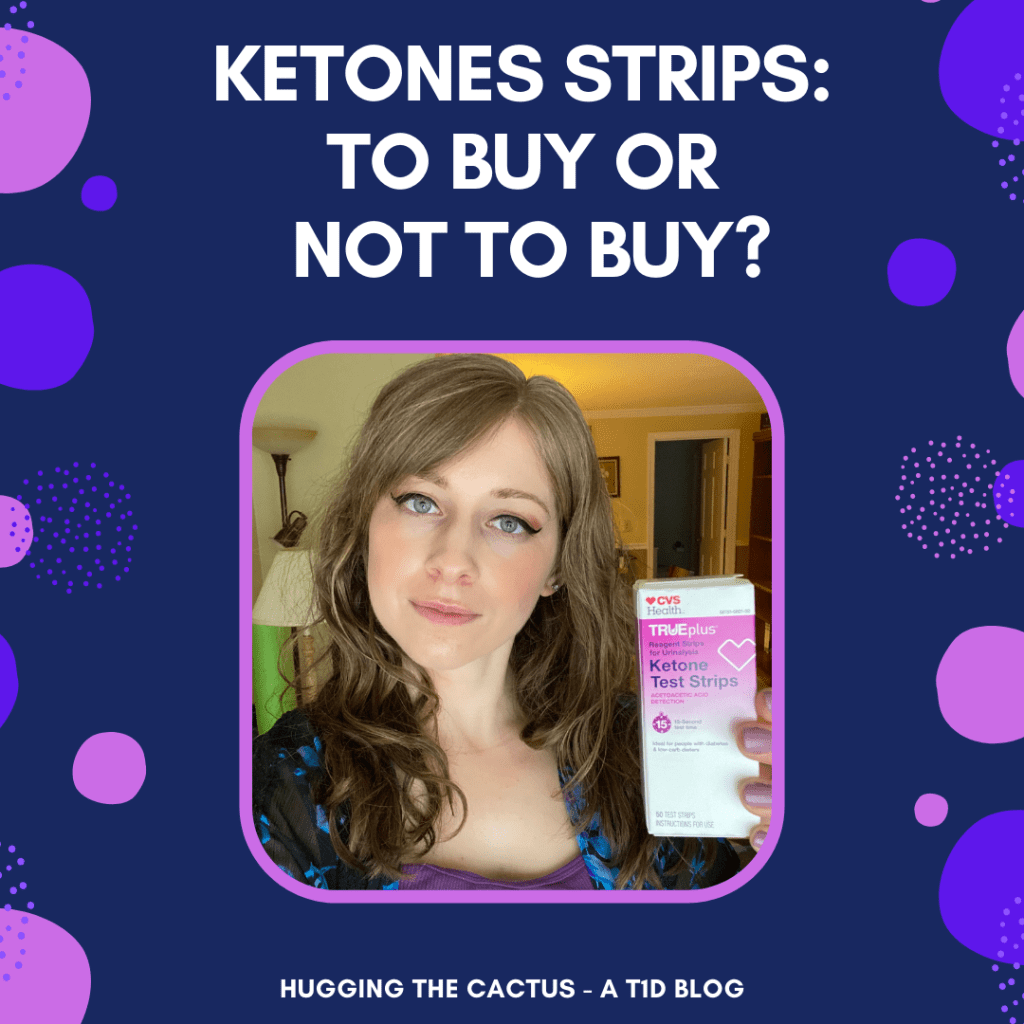
I popped into a CVS store on my way home from picking up groceries to pick up something very important…Starburst jellybeans, because naturally, I “needed” them.

When I was in the store, I wandered over to the diabetes aisle, curious to see if browsing the shelves would remind me of any supplies I should pick up.

My eyes fell on a box of ketones testing strips and I paused, pondering whether or not it was worth it to buy them.

Are ketones testing strips a must-have or no-need item for you?

I admit that I scarcely ever check my ketones when my blood sugar is above 250. I know that I should, but a combination of laziness, anxiety, and lack of unexpired strips usually stops me from checking. And when I do have strips on hand that aren’t expired, it seems that I’m only able to use a couple out of the 25+ strip bottle before the whole dang thing expires, which is frustrating. In fact, prior to this CVS trip, I had a vial of ketones strips sitting in my bathroom that expired more than 4 months ago. I hadn’t trashed them yet because I stubbornly hang onto things far longer than I should.

So I stood in that CVS aisle, my hand hovering out in front of me over that box containing the ketones strips. To buy or not to buy? Do I spend the money knowing that I’ll probably only use a few strips? Or do I save the approximately $12 and walk out the store knowing that I don’t have useable strips at home?

Ultimately, I bit the bullet and bought the strips. I know myself well enough to know that I’ll take comfort in knowing that they’re available to me if and when I decide to use them. Besides, $12 is a fairly small ask when it comes to monitoring something as important as this and granting myself peace of mind.

If only we could have a price like that for life-saving insulin…

How My T1D and I Handled My First COVID Vaccine

Imagine my surprise when I went to write about today’s new blog post on my Instagram account and swiftly realized…I didn’t have a new post! Life’s busy and as a result, I’ve fallen a bit behind my blogging schedule.

Luckily, I have the day off from work today, so I’m able to whip up a quick post on something that people might be wondering about: How did my diabetes and I fare after receiving dose 1 of 2 of a COVID vaccine?

I am officially halfway there on the vaccine front.

I’m going to rapid-fire this one and sum it all up with some bullet points:

  • I got the Moderna vaccine
  • I felt 0 pain when I was injected – in fact, I didn’t feel anything and was surprised when the nurse told me I was all set
  • I had to wait 15 minutes after the dose was administered to make sure I didn’t experience any type of reaction
  • I had no reaction whatsoever
  • About 18 hours after I got the vaccine, I noticed some slight pain around the site
  • I could not see any marks around the site – no redness, no apparent injection location
  • The pain was only noticeable when I was changing my clothes
  • My blood sugar within the first 24 hours was mostly fine (I wasn’t eating super healthy so any high blood sugars can be blamed on my poor diet)
  • My blood sugar was fine 48 hours later, leading me to believe that the vaccine had 0 impact on my blood sugar levels (I had somewhat anticipated elevated blood sugar levels because my mother, who also got the Moderna vaccine, said her levels were higher 2-3 days later post-vaccine)
  • I felt absolutely normal! I got the vaccine three full days ago as of this writing and I can’t say that I’ve noticed anything different

That was my experience; remember, all people with diabetes (and without diabetes) are different and may experience different things. If you have any questions after reading this post, I highly recommend reading this post from Beyond Type 1 that tells you what you want to know about the vaccines. And here’s my little disclaimer to talk to your doctor about any concerns you have.

I’m glad that I got my first vaccine and that it was a hassle- and pain-free experience. I’m looking forward to getting dose number 2 at the end of April and will be sure to recap what it’s like then. In the meantime, I’m happy to continue masking up and practicing social distancing – after all, we’re in this together, and just because I got one vaccine doesn’t mean that I can’t do my part to help protect others.