Would you believe me if I told you that last weekend, I ate mostly carbs for 36 hours straight and totally avoided high blood sugars the whole time?
I looooove carbs. Almost as much as Oprah Winfrey loves bread.
It sounds wild, but it’s the truth! I went on my annual weekend getaway with my college besties and it was the loveliest time filled with sunshine, conversation, and tons of delicious food. I can’t remember the last time I ate that much in such a short window of time, but it was all worth it, especially because my blood sugars didn’t pay the price for it for once.
Here’s the breakdown of what I ate:
Friday:
2 slices of Mediterranean-style pizza and 3 chicken tenders for dinner, the first official meal of the weekend trip
2 glasses of wine
Handfuls of crackers and cheese because who doesn’t love that with wine
Saturday
1 blueberry bagel accompanied by 1 fried egg for breakfast
Salad and heaping scoop of ice cream for lunch
Pita chips for a snack
Panko-crusted haddock with jasmine rice and veggies for dinner
2 cans of cider (and maybeeeee a glass or two of bubbly)
Sunday
1 everything bagel slathered in goat cheese plus 1 fried egg for breakfast
2 slices of leftover pizza for lunch, which is also when I arrived home from the trip
It definitely wasn’t my healthiest, most balanced weekend of eating, but I’m more than okay with that because it was about enjoying my time with my friends and indulging a little rather than stressing the whole time about bolusing and blood sugars. And you know what, I think that my laidback, let’s-just-savor-this approach is partially the reason why I had such stellar weekend blood sugar levels. That, coupled with extended boluses for most of my meals (you know that pizza and bagels contain alllll the slow-acting carbohydrates), really helped me achieve the relaxing weekend that I wanted.
Now if only I could get away with this on a regular basis – as I write this, my blood sugar is coasting from a peak of 248 back into the low 190s after I dared to consume a bagel at lunch in the middle of my busy workweek. But it’s all good, and maybe just evidence that I should try to remember to live in the moment on weekends of fun like this one and prevent diabetes/blood sugar from taking center stage. Perhaps that’s the key to more stable numbers.
If nothing else, this serves as a reminder to me that even with diabetes, I can still enjoy a sh*t ton of carbs every now and then.
You stir suddenly from a dreamless sleep, knowing that something must’ve disturbed your slumber but not quite sure what it may have been.
This blog post was inspired by a recent middle-of-the-night low that went…well, exactly as I wrote it here. I wrote in the second-person perspective so you might be able to imagine what it’s like, if it’s something you’ve never experienced before.
Reflexively, you reach over to where your phone is perched on your nightstand. You check your notifications and confirm what you’d been hoping wouldn’t be a problem tonight: Your blood sugar is low and you must do something to fix it.
You unroll a couple of Smarties from their package, almost surprised at how dexterously you do so. After all, it’s an odd skill to have honed over the course of your life to be really good at opening up packages of the food just moments after you were sleeping soundly, but you’re accustomed to it. You chew up the Smarties as quickly as you can, grimacing slightly as their sweet-sour taste mingles with traces of toothpaste from when you brushed your teeth before bed. You sink back against your pile of pillows, sighing, as you wait for your blood sugar to come back up.
You wait. You wait some more. You scroll mindlessly through various apps on your phone. You’re not feeling better. You wonder to yourself, how much more do I have to do to fix this? You wish you weren’t alone right now. Low blood sugars are scary to deal with on your own, especially when they sneak up like this in the middle of the night.
Your mind begins to spiral as those nasty “what ifs” enter your thoughts. What if you plummet further? What if you lose a lot of sleep over this one pesky low? What if you don’t recover from this low and…?
Just as you begin to think of the most unpleasant scenario, you realize that your shakiness has subsided. The sweat on your skin has dried and your vision seems to be less foggy – it’s hard to tell in the dark, but not wanting to turn on anymore lights, you settle back into bed more comfortably and close your eyes.
You hope you can go back to sleep quickly. You hope that you don’t have to wake up again for the rest of the night for any blood sugar-related issues. You hope that you aren’t exhausted because of this one tomorrow.
You hope that tomorrow night is different, but with diabetes, you never know.
I’ve posted this on Hugging the Cactus a couple of times now – once in 2018 and again last year. I’m sharing it a third time today because we are in the throes of summertime now that July has arrived, and I needed a little reminder as to why it’s important to take certain precautions when it’s hot outside to take the best possible care of myself and my diabetes…
The summer heat seems to be here to stay in Massachusetts. We’ve experienced several weeks of soupy, high-heat weather that *almost* makes me long for cooler, autumnal days…but not quite, because that just means winter (and snow – blech) is right around the corner.
Truly, I do enjoy the summertime. To me, summer is about trips to the beach, ice cream consumption (and lots of it), barbecues with family and friends, long walks in the neighborhood, and endless outdoor adventures. Aside from all of those lovely things, summer also means that it’s time to be a little more diligent when it comes to my diabetes. That’s because hot weather can play some cruel tricks on a T1D’s body. What do I mean by that? Here’s five ways diabetes can be affected by hot weather.
Another thing to know about hot weather and diabetes? It will most definitely trigger ice cream cravings. Bolus accordingly.
Dehydration can lead to high blood sugar. Everyone knows that it’s important to stay hydrated when it’s hot out, but it might be less common knowledge that dehydration can directly affect blood sugar. There’s a scientific explanation for this: If not properly hydrated, the body sees an increase in blood glucose concentration because blood won’t flow as easily to the kidneys, making it difficult for the kidneys to get rid of excess glucose in urine. The best way to prevent this, naturally, is to drink plenty of water and monitor blood sugars.
Sunburn can drive up blood sugars. I’m very familiar with how a sunburn can result in higher blood sugars; in fact, just last week I was dealing with a particularly gnarly sunburn on my thighs and belly that not only made my numbers higher, but also really hurt. My skin was literally damaged, so the stress from the injury lead to retaliation from my blood sugar. Luckily, it only lasted about 48 hours, but those couple of days were challenging as I dealt with sticky highs that were practically resistant to insulin. And for the record, I DID apply sunscreen – numerous times – when I was at the beach. Next time, I’ll seek shade under the umbrella.
Sweat can make it difficult for devices to stick. I don’t know a single medical device that’s immune to prolonged exposure to moisture/water, but that doesn’t prevent me from spending as much time as I can outdoors/at the beach/by the pool in the summer. Thank goodness for Skin-Tac wipes and medical adhesive tapes that help preserve my precious pods and sensors!“
Insulin can overheat. There’s a reason why insulin vials come packaged in cartons with directions that specify what temperature insulin should stay at in order for it to be safe to use. Insulin can spoil easily when it reaches a certain temperature, so it’s important to store it in a cool place when the weather’s warm. I alternate between a mini portable cooler (that can hold 3 vials of insulin) and a pouch from FRIO – both do an excellent job at keeping my insulin cool.
Low blood sugars can occur more frequently. Summertime is prime time for outdoor activities that result in higher energy expenditure. So it’s no wonder that blood sugar tends to plummet in hot weather. Looking at it on the bright side, it’s an excuse to eat even more ice cream – but it also means that monitoring how I feel and checking blood sugars often is that much more important.
Regardless of the diabetes challenges it may cause, I love summer weather, and I know I’ll miss it the moment the first snowflake falls this year.
today because it’s a great reminder that diabetes isn’t a static condition – what works for a person with diabetes one day might not work the same way the next. So when I decided to take a Dexcom break, it was a much-needed change in my diabetes care routine that worked wonders for my mental and physical health. I just might take another one after reading this post again…read on for the full story.
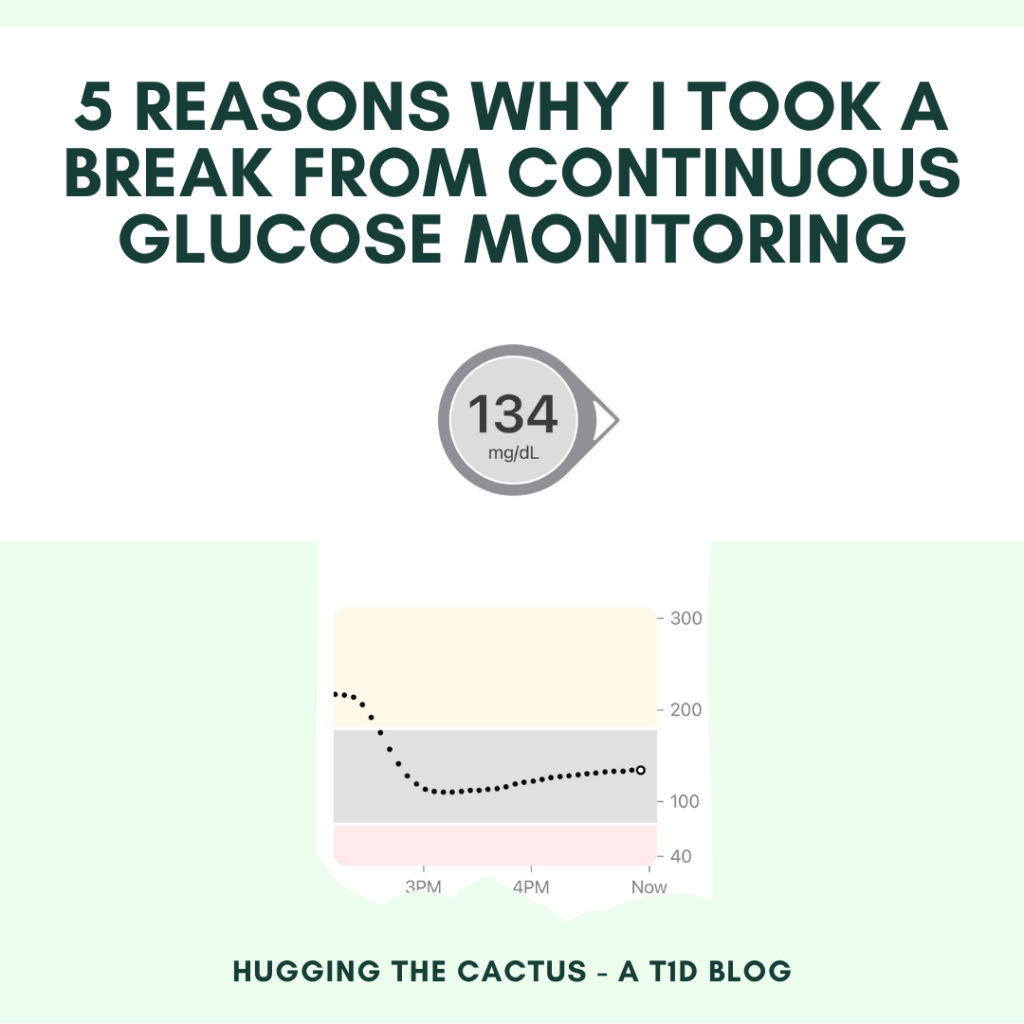
I’ve decided to take a break from continuous glucose monitoring. This means that for an undefined period of time – maybe 3-4 days, a week, or a few weeks – I’m not going to wear my Dexcom G6 CGM.
Initially, I wanted to give myself a break because I was just burnt out from wearing it all the time and feeling so dependent on it. But as I started thinking about more, I realized that there were some other really great reasons for me to take a break from my CGM:
1 – I wanted to wear one less device. It can be tough to wear two medical devices 24/7. Sometimes I get super self-conscious of them. Other times they just aren’t comfortable to wear, such as when I roll over one the wrong way when I’m sleeping at night. So it’s nice to feel a little more free with one less device stuck to my body at all times.
2 – I was sick of the constant data feed. All those alarms going off whenever I cross my high or low threshold are straight up annoying!!! I know I could just turn them off on my CGM receivers, but the point of them (for me) is to try to maintain as tight of a control on my numbers as possible. But now that I’m intentionally not wearing my CGM, I’m realizing how much I appreciate the reprieve from all that buzzing and beeping. There’s lots of reasons to take a break from continuous glucose monitoring, but sometimes one is enough.
Taking a break from my Dexcom was a much-needed change in my daily diabetes care routine.
3 – I have some new blood glucose meters to try. The only way that I can really put my new meters to the *test* (lol) is to use them – and goodness knows that I have very little desire to do manual finger stick checks when I’m wearing my CGM.
4 – I’d like to hold myself more accountable. I rely on my Dexcom heavily at all times. I look to it before I start exercising, before I eat something, before I do anything, really. I bolus using the data it provides and trust it implicitly. But I’ve recognized that by developing this habit, I’ve become lazy. I don’t measure out food as much because I figure that if I bolus too much or too little for it, I can just watch what my Dexcom tells me and treat from there. It’s kinda sloppy, in my humble opinion, so I’m trying to put more of the trust back in myself for my diabetes monitoring.
5 – I’m trying to reacquaint myself with my body’s cues. Before CGM technology, I was really good at recognizing high and low blood sugar symptoms…but then I started using a CGM and found myself reacting to highs and lows (e.g., treating them prematurely), even if I didn’t feel those high/low symptoms. So I want to retrain myself so I can make sure I never lose that ability, because I think it’s important to know exactly how my body alerts me to various blood sugars, rather than depending solely on a piece of technology to do it for me.
Pre-bolusing: It’s the term that describes taking insulin before eating food. The “before” part in the definition is key, because the amount of time that “before” is can and will vary among people with diabetes. It depends on a few factors, including the amount and type of insulin being used, the amount and type of food to be consumed, current blood sugar levels, and so forth.
It’s one of those things that’s tricky to nail the timing of, but boy, when it works it’s so worth it.
Pre-bolusing works well, but only when the timing of it is perfect.
I have two examples to complement that belief, one in which pre-bolusing almost lead to a disastrous outcome and the other in which everything turned out ideally. I’ll start with the more chaotic scenario first.
In this situation, my boyfriend and I spent the night in New Hampshire to attend a friends’ wedding and had a pretty late night, which meant we slept in a little later than we had intended the next day…actually, a lot later. We only had about 20 minutes to race around our room, pack up our belongings, and get ourselves looking presentable before we had to check out of the hotel. Luckily, our scrambling paid off and we made it out in time, but sleeping in cost us the opportunity to enjoy a complimentary hotel breakfast. We decided that it made sense to stop for brunch on our drive back home to Massachusetts, so we Googled a diner that was on our route home and stopped there for a meal.
When we got there, the restaurant was pretty crowded, but we were seated and able to place our brunch orders almost immediately – a good sign. I assumed this meant we wouldn’t have to wait more than 20 minutes or so (that feels like a restaurant standard) for our food to be ready, so I went ahead and pre-bolused my mealtime insulin. After all, I’d ordered a hearty omelet that would come with breakfast potatoes and toast, so I wanted to be proactive about avoiding high blood sugar and get my insulin in system sooner rather than later.
Unfortunately for me, our food ended up coming out later rather than sooner. In fact, we waited nearly 45 minutes for our dishes to finally come out. In that period of waiting, I was getting more and more anxious about my decision to pre-bolus with each minute that passed without food in front of me. By the 30-minute mark, I was close to full-on panic. Even though my Dexcom wasn’t indicating that my blood sugar was low (it held out steady the whole time), I was worried that the system delay in reporting my blood sugars would fail to catch a serious low in a timely manner. I told my boyfriend what was going on, and without hesitating he went to his car to grab some packs of honey that he’d stored in his glove compartment in case of emergency. We talked it over, and decided that it was probably best for me to consume at least one pack of honey because we couldn’t possibly know when our food was going to come out, and at this rate, we wanted to play it safe rather than be sorry. That didn’t exactly lessen the sorrow and stupidity that I felt for taking a pre-bolus (even though I couldn’t have possibly known that our food would be so delayed, I still felt badly about the whole thing), but it was what it was. And ultimately, I felt like I paid the price several hours later, when I was dealing with the very same high blood sugars that I’d hoped my pre-bolus would prevent. So much for making the pre-bolus grade that time…
But that doesn’t mean pre-bolusing always fails! This brings me to my other example. My mom and I had a nice lunch together last week. Before we left to go to the restaurant, I noticed my blood sugar was a little high. I decided to give myself a correction dose, plus one extra unit of insulin, because I knew we’d be eating foods that aren’t typical for me to consume at lunchtime that could result in highs later in the day. So again, I was aiming to be proactive and prevent prolonged high blood sugar.
And this time, the strategy worked great! At the restaurant, I stacked that pre-bolus with my actual meal bolus (not always a recommended tactic, but it was useful here) and rounded out my afternoon with a blood sugar in the 120s – a win in my book. Thanks to my pre-bolus, I didn’t experience any pesky blood sugar spikes and still landed in range, which in turn showcases the power of the pre-bolus perfectly.
So just like anything in life with diabetes, when pre-bolusing works, it’s wonderful…but it definitely requires a little finesse to learn exactly when/how/where to use it.
This blog post was originally published on Hugging the Cactus on June 27, 2018. I’m sharing it again today because it’s a blog post that has a surprising number of views – likely due to the fact that people have strong opinions (rightfully so) on glucose tablets and their various iterations! Read on for my thoughts on the best version of drugstore glucose supplements…
You may have heard of glucose tablets, but what about glucose gummies? Or liquid glucose, or glucose gel? Have you tried any of these forms of glucose?
The four forms of glucose (that I’ve tried).
I’ve used them all, and I’ve formed some pretty strong opinions about each of them. I thought it’d be fun to rank them in order of most appetizing to least appetizing, because while they can effectively and efficiently correct low blood sugar, they certainly aren’t created equally:
Best Tasting: Glucose Tablets. I can hardly believe that the most boring variety is the winner here, but it blows the competition out of the water for several reasons. For starters, glucose tablets come in an array of flavors. Orange, raspberry, fruit punch, grape, tropical, and sour apple are among the flavors I’ve tried over the years, and most of them are palatable. Plus, glucose tablets are most akin to actually candy: I’ve described them as giant Smarties to inquiring friends in the past. While actually Smarties are more fun to eat, glucose tablets are their closest counterpart in the diabetes world, making them a number-one choice in low blood sugar situations.
Runner-Up: Glucose Gummies. I’m awarding second place to glucose gummies, mainly because of their novelty. It’s not particularly a standout in other categories like taste and texture. The gummies only come in three flavors: grape, orange, and apple, leaving something to be desired in terms of variety. And all three of those flavors taste a little…off, like there’s a little too much artificial additives going on. Maybe this was done deliberately to distract from the texture of the gummies, which tends to be hard/stale in my experience. It’s nice that the gummies have a layer of sugar on them to convey the likeness of real gummies, but that stuck-to-your-teeth feeling makes it harder to appreciate the gummies for what they are.
Third Place: Glucose Gel. I’ve only ever found glucose gels in the fruit punch flavor at Walgreens – do they actually come in other flavors? Besides being one-note, the gel is a unique texture situation…not quite a liquid, not quite a solid. Gels aren’t a mainstay in my low blood sugar kit because I’m not fond of having to slurp them out of the pouch like a tube of Go-Gurt; in fact, I’d much rather have yogurt from a plastic tube than a gel because the yogurt is much tastier. The gel is just too artificial, with a medicinal aftertaste. And it doesn’t help that the consistency of it reminds me of hand sanitizer.
The Loser: Glucose Liquid. It’s surprising that the glucose liquid wound up in last place, because on the surface, it had a lot going for it. I liked that it came in a small bottle and it seemed like it would be super easy to consume. All I’d need to do is pop the cap off and swig it down. But MAN, the taste was HORRIBLE! I thought I’d like the mixed berry flavor, but it tasted so supremely saccharine and fake that I could scarcely force myself to swallow it. I know, I know, it’s liquid glucose, it’s supposed to be very sweet. But this stuff was just over the top. I definitely will not be buying glucose liquid again any time soon. I’ll stick with my tried-and-true tablets.
Do you agree with my rankings? Did I miss any form of glucose that can be bought in most drugstores, and you think I should give it a try? Let me know in the comments!
You’d think that 24 years of living with diabetes would turn anyone into a seasoned veteran of the condition, but even the most experienced people with diabetes slip up and make mistakes every now and then…
Case in point? Me, because I neglected to make sure I had a way of monitoring or checking my blood sugar when exercising…and then experiencing a scary low that I probably could have caught sooner, or maybe even avoided, if I hadn’t been so careless.
This all happened because I inserted a new Dexcom sensor just before taking off for my 3-hour self-defense class. I knew that the sensor’s warm-up period would end and that my continuous blood sugar readings would begin partway through class, so I felt fairly comfortable going without a blood sugar meter as a back-up. After all, my Dexcom sensors almost always start up without any issue, so I was trusting that this one would follow suit.
And that was my biggest mistake: trusting my technology.
Any time I make a rookie diabetes mistake, my palm goes straight to my face in embarassment.
When the warm-up period was complete and the class was taking a quick water break, I decided to check my Dex to see what my first blood sugar readings were. I was surprised (and instantly annoyed) to see that instead of a number, my Dexcom was displaying a request for a blood sugar calibration – just like the old G5s used to ask for upon insertion of a new sensor. I couldn’t understand why this happened, but I knew that pondering the matter wouldn’t make any difference…the only thing that would get my Dexcom running normally again was the finger stick checks, which wouldn’t be possible for me to do until I got home from the class because I was without my meter.
So I had no choice but to rely on nothing but my instincts and sensations in order to get a sense of where my blood sugar was headed for the remainder of the class.
And let me tell you, I can’t remember the last time I felt so vulnerable in terms of my diabetes. I was running on zero information, other than the fact that I typically can feel oncoming low blood sugars and that I tend to feel thirstier when my numbers are on the upswing. It was disconcerting – even more so when a little while later I started to feel shaky and dizzy, like I was starting to go low.
I knew I could either 1) treat what I thought was a low blood sugar and deal with the potential consequences (high blood sugar) when I got home, or 2) take a chance and ignore the low symptoms because I couldn’t confirm whether or not I was actually low. I hate to admit it, but I let a good 15-20 minutes pass before I decided it was better to correct what felt like a low rather than run the risk of passing out in front of the entire class. Turns out that I made the right call to treat my low: I felt much better after I ate some fruit snacks, and my blood sugar when I got home that evening was in the low 80s, indicating that I probably avoided a pretty nasty low in class.
While the whole incident could’ve been easily avoided, it did remind me that I ought to take some of the trust that I have in my technology and distribute it a little more evenly between it and my instincts. I proved to myself that in emergency situations, I don’t need a meter or a CGM to pick up on low blood sugars (though I obviously would prefer to have that equipment at my disposal at all times). Instead, I need to trust my instincts more and procrastinate less when it comes to taking an action – because if I had waited longer than those 15-20 minutes, the situation could’ve escalated and then I would’ve really been kicking myself for leaving my meter at home.
Rookie mistakes suck when they happen, but at least the silver lining is that there’s always a lesson to be learned (or reinforced) when they do.
Carbohydrates. Insulin intake. Exercise. These are things that most obviously impact blood sugar levels. But things like sleep, time of day, medication interactions, environmental changes, and yes, stress, might be more surprising factors that can wreak havoc on blood sugar in much stealthier ways.
Stress, in particular, is the one that’s been driving me (and my blood sugars) up the wall lately.
Truth be told, I’ve invited most of this stress into my life by committing to one (or seven) too many things this month. My calendar is positively overflowing with meeting invitations, hangouts, classes, and appointments, making the one or two evenings a week that I have to myself feel incredibly precious. Honestly, I kinda knew what I was doing when I flooded my schedule with so much because a significant part of me thrives under pressure and needs to stay busy. This is the same part of me that misses working full-time in an office because it broke up my otherwise fairly mundane routine; ergo, I felt justified in amping up my recent social activity.
Yet, there is another (smaller but still powerful) part of me that wishes I knew when to say “enough is enough”.
This image sums up the month of March perfectly for me: a bit of a time warp.
And now, that smaller part of me is standing with her hands on her hips, looking at the busy bee part of me defiantly, and saying “well, what did you expect?” in regards to the stressed-out feeling I haven’t been able to shake lately, as well as the high blood sugar levels that have been a direct result of that.
I’ve been doing everything I can to combat them – increasing my temp basal rate, lowering my carb intake, staying hydrated, getting daily exercise, and taking (nearly) double mealtime insulin doses at times. Some of these things have worked better than others, but as I sit here and write this post, I’m wondering if taking time to actively destress, in addition to prioritizing sleep, are the missing pieces in the puzzle.
Between jetting off from one thing to the next, I’ve barely had enough time to breathe, let alone practice self-care such as meditation or just…sitting on the couch and just being. And I’ve definitely not been getting as much sleep as I should. My teenage tendency to stay up late has collided with my adult habit of getting up early, which is an unpleasant combination.
So I’m thinking that the best way to evade stress, the sneaky blood sugar spiker, is to tackle it head on by addressing my lack of sleep and self-care. I know that my diabetes, and the rest of my body, will thank me once I take the chance to slow down.
I’m in an interesting phase of my life right now where I don’t like to say no to most things.
I think this has a lot to do with the fact that I’ve let fear and anxiety hold me back in many different areas. But if there’s anything I’ve learned as I’ve gotten older, it’s that life is too short to not jump at opportunities when they’re presented to me and to do my best to abandon my assumptions before deciding how I feel about something.
So when my boyfriend asked me if I wanted to go snowboarding with him last month, I enthusiastically said yes. I’ve never been a winter sports person, per se, but I’ve definitely spent too many weekends in the last couple of months cooped up indoors – so spending an afternoon outside at a nearby ski resort trying something completely new sounded like an awesome way to beat winter blues.
I should’ve expected it would also be a literal crash course in snowboarding with diabetes! Literal in more ways than one, because I fell…a LOT. Like, so many times that I lost count. But I was also learning how to navigate a brand-new physical activity with diabetes, which can be daunting. I handled it by preparing as best as I could, and practiced these tips and tricks that worked wonderfully for me when I hit the slopes:
#1: Set a temp basal. In the days leading up to snowboarding, I did a little research online to see what kind of tips other people with diabetes had to share about what to expect when snowboarding with diabetes. The most interesting piece of advice that I found and wound up taking was setting a temp basal with my pump. The physical activity of snowboarding, combined with the mountain’s higher altitude, meant that my insulin could be absorbed in my system at a more rapid pace. So I reduced the amount of basal insulin by about a third for a few hours, which worked out great because I didn’t have to worry about impending low blood sugars and could instead focus on trying to glide effortlessly across the snow like all the other skiers and snowboarders (I had little success in that, but that’s besides the point).
#2: Wear ALL the layers. The night before the snowboarding trip, I laid out all of the clothes that I would layer on the next day. I had thermal pants and a thermal undershirt that I wore for layer 1. I wore jeans and a sweatshirt for layer 2, followed by a fleece zip-up for layer 3. Before heading out onto the slopes, I put on my snow pants, winter jacket, waterproof gloves, snowboard boots, scarf, hat, helmet, and goggles…and yes, even though I resembled the Michelin man with all that clothing on, it was worth it because I didn’t feel the sting of the cold not even once. Plus, my diabetes devices, snacks, and other personal items were extra protected under all those layers, which gave me a sense of security throughout the day.
#3: Protect diabetes technology. This was my main concern for the day. I’ve heard horror stories about PDMs falling victim to particularly nasty skiing and snowboarding collisions. I refused to run the risk of smashing my screen by protecting it as best as I could. So I brought an extra sock with me that I used as a pouch for both my PDM and my cell phone. Once they were safely nestled in the sock, I placed it into a plastic baggie, which served as an extra layer of protection that was waterproof. I then put the plastic baggie into the pocket of the fleece I was wearing under my snow pants and zipped up the aforementioned pocket so there were zero chances of anything falling out of it. It was probably a little extreme in terms of protection, but my devices stayed completely dry and intact (despite the many, many falls I experienced over the course of the afternoon), and that was what mattered most to me!
If Shaun White (the pro snowboarder) is known as the Flying Tomato on the slopes, I want to be known as the Rainbow Wonder – I loved rocking my bright snowboarding accessories on the mountain!
#4: Be smart about packing snacks. I knew I would be limited in terms of what I could carry up and down the mountain – it’s not like I could safely snowboard with my purse or backpack strapped onto me (that would’ve added extra weight that would’ve made me even more wobbly on my board) – so my many pockets definitely came in handy and helped ensure that I had plenty of snacks stashed on me at all times. In addition, I chose to pack things like glucose tablets and granola bars because they were more likely to hold up in the cold weather/not freeze like a packet of honey or a juice box might.
#5: Stay hydrated. I think what surprised me more than anything else was how thirsty I felt after only about an hour of attempting to snowboard. In hindsight, though, it made sense – I was outside in the dry wintry air and trying to partake in fairly strenuous exercise, so of course I would be thirsty. Since I couldn’t carry around a water bottle with me, I made sure that any bathroom breaks that I took at the lodge also included trips to the water fountain – a strategy that kept me well hydrated out on the bunny slope.
#6: Monitor, monitor, monitor. I must’ve pulled out my phone to check my Dexcom graph a dozen different times over the course of the 4-5 hours we were snowboarding. That might sound like a bit much, but I had no idea what to expect in terms of the impact of snowboarding on my blood sugar. Watching my levels like a hawk helped me determine how much to eat at lunchtime, what kind of temp basal I should set, and how long I could stay committed to the activity before having to stop to treat a high or a low blood sugar. I felt extra grateful for my Dexcom on this day, because it would’ve been a pain and very inconvenient to check my blood sugar with a finger prick that many times.
Even though I wasn’t quite as badass as I wanted to be on the slopes (more like bruised-ass), I’m still really happy that I gave it a try and proved to myself that this is yet another thing that diabetes can’t stop me from enjoying. I look forward to my next attempt, which will hopefully include similar diabetes-related success as well as a lesson or two from an experienced instructor – because goodness knows I could benefit from that!
I read those six words, all strung together in a terse message from my doctor’s office.
Not exactly the response I was anticipating when I reached out to them to express concerns over a minor health issue I was experiencing…
Let me back up a bit. In early January, I decided to message one of my doctor’s to discuss said minor health issue. A week went by and I didn’t hear anything from them, so I sent them another message, reminding them gently that I was hoping for a reply sooner rather than later. Several more days pass by and I start to get annoyed, but I still keep everything in perspective: Maybe they’re understaffed at the moment. Perhaps a computer error prevented them from getting my messages. Or they might be just crazy busy with beginning-of-the-year appointments and responsibilities. Whatever the case may be, I decided to message one more time, drawing attention to the fact that my first message had been sent two weeks prior and that if I didn’t hear back by the end of the week, then I’d just call the office to hopefully connect with a nurse.
Luckily, it didn’t come down to that because within 48 hours of me sending that third message, I finally heard back from someone. And this someone said something that left me a bit gobsmacked:
“…with an A1c of 7 – you need to be better with your control.”
Life with diabetes often feels like this image – like you’re the only one in the control room of a command center that dictates whether or not you live. And yep, it’s exhausting.
I couldn’t believe what I’d just read, for multiple reasons. For starters, I’d mentioned in my first message that I *think* my A1c was right around 7, but I couldn’t be sure because it’s been a bit since I last had my A1c checked. So clearly, by reading the response from my doctor, nobody had gone in to check my records or look up my historical A1c – which may or may not have provided them with better context so they could answer my question better, but that’s besides the point. What had me most irate was the fact that I’ve been told – time and time again – that I’m doing a great job with an A1c around 7. I’ve had endos and nurse practitioners alike tell me that I don’t need to make any major changes and that I’m too hard on myself when I express a desire to get a lower A1c. So to have a completely different medical professional make a snap judgment right then and there that implies I do not have control over my A1c is obviously in direct conflict with what I’ve heard from others. How maddening is that?
Furthermore…I’m sorry, but A1c does not paint a complete picture of my “control”. I believe, along with many other people in the diabetes community (including medical professionals) that time in range is where it’s at. The amount of time I spend in range is leaps and bounds better than where I was in college – and honestly, so is my A1c.
This is why it’s incredibly frustrating to me that this person handled my health issue as though it was directly related to my diabetes and their perception of my lack of control. The three-sentence, curt reply to my initial message didn’t exactly help matters either, though I’m trying to not read too much into that…after all, you can’t gauge tone via written message.
I’ve decided the best way to handle this whole exchange is to bring my issue up again when I see this doctor later in the year. I’m not going to reply in the message thread, because I don’t see how that would cause any good, but I will bring this up when I go to see the nurse practitioner at my endocrinologist’s office at the end of this month. While she likely can’t fully help me address my health concern, she’s bound to provide me with some insight and some actual helpful advice that won’t involve her jumping to conclusions about my control. We’ll see how it goes.
For now, I will just have to try to keep my head held up high by taking control of the situation, if not my diabetes.





 Hugging the Cactus